 Embedded HandbookApps
143. Static and dynamic libraries: .a, .so, soname, rpath, LD_PRELOAD, dlopen
Section 74 covered the standard library — the one you are given. Here is how
to make your own: build code into a library, hand it to other programs and
update it without rebuilding them. In firmware a library is always static:
its code is pasted into the image. Linux has a second way — a dynamic
library, one file on disk for all programs at once — and around it
a whole household: soname, ldd, rpath, LD_PRELOAD, dlopen.
The library libgeom of four small functions (two public, one hidden
and one static) goes the whole way in _verify/sys143/
(stm-sys:1, gcc 12, glibc 2.36).
Terms used in the documentation
Term Meaning static library, archive ( .a)a static library, an archive of object files shared library, shared object ( .so)a dynamic (shared) library position-independent code (PIC) code that does not depend on the load address dynamic linker / loader ( ld.so)the program that loads libraries at startup soname the library name recorded in the program NEEDED,RUNPATHwhat the program needs and where to look for it symbol visibility whether a symbol is seen outside the library interposition replacing a symbol by a library loaded earlier dlopen,dlsymopen a library and find a name in it at run time plugin a library loaded by name ABI the binary interface: what you can change without breaking old programs
143.1 A library of four functions
static double square(double x) { return x * x; }                 /* static: не видна даже компоновщику */

double GEOM_HIDDEN geom_internal(double x) { return square(x) + 1; }   /* видна в .a, скрыта в .so */

GEOM_API double geom_dist(double x1, double y1, double x2, double y2)
{
    return sqrt(square(x2 - x1) + square(y2 - y1));
}
Three levels of visibility: static — the name does not leave the file; an ordinary
external one — visible to everyone who links against it; GEOM_HIDDEN — the
visibility("hidden") attribute: the name exists in the object file but is not exported from the dynamic
library. The program app.c calls geom_dist and
geom_version (the fourth function, it returns the version string) and does not know which library it will get.
143.2 Static: an archive of object files
gcc -O2 -c geom.c -o geom.o
ar rcs libgeom.a geom.o
gcc -O2 -o app_static app.c -L. -lgeom -lm
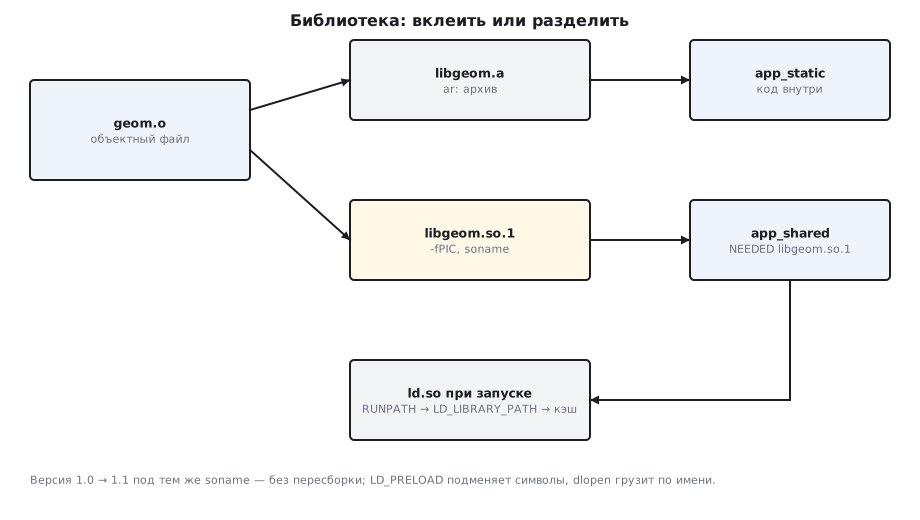
libgeom.a is just an archive: ar t lists geom.o. The linker
takes from the archive only the object files that contain the needed
symbols and pastes them into the program: app_static is 16152 bytes and does not
depend on libgeom.a after the build. nm shows what is in the archive:
T geom_dist
T geom_internal
T geom_version
U sqrt
T — defined in the code section, U — undefined, needed from outside (here
sqrt from libm). square is not in the list: at -O2 the compiler inlined
it into its callers; at -O0 it is there, marked t — local.
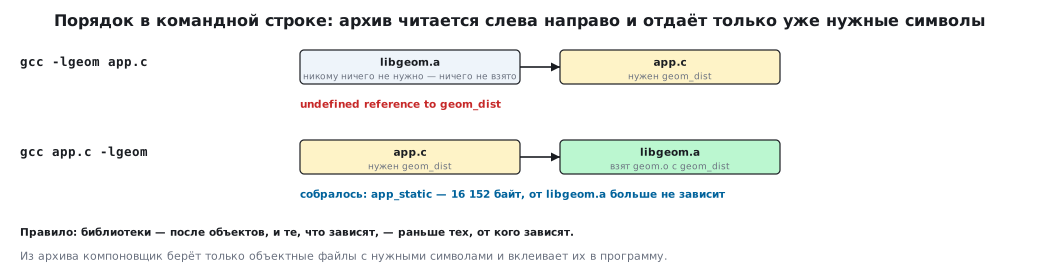
The order on the command line matters: the linker goes from left to right
and takes from an archive what has already been needed. gcc -lgeom app.c gives the error
undefined reference to geom_dist: at the moment libgeom.a is read, nobody needs the symbol
yet. gcc app.c -lgeom builds. Libraries go after
the objects, and the ones that depend on others come before the ones they depend on.
143.3 Dynamic: PIC, soname, three names
gcc -fPIC -fvisibility=hidden -c geom.c -o geom_pic.o
gcc -shared -Wl,-soname,libgeom.so.1 -o libgeom.so.1.0 geom_pic.o -lm
ln -s libgeom.so.1.0 libgeom.so.1
ln -s libgeom.so.1 libgeom.so
-fPIC — code without absolute addresses: the library is loaded into each
process at its own address. -fvisibility=hidden hides everything that is not
marked GEOM_API (visibility("default")): exactly two
functions are exported —
geom_dist
geom_version
and geom_internal does not exist from the outside. This is the library's ABI:
the less is exported, the fewer the obligations.
Three names of one file:
| Name | Who uses it |
|---|---|
libgeom.so.1.0 — the real file |
the package, installation |
libgeom.so.1 — the soname, a link |
the program at startup (NEEDED) |
libgeom.so — a link |
the linker at build time (-lgeom) |
-Wl,-soname records the name libgeom.so.1 in the library, and that is exactly what the
linker writes into the program:
(NEEDED) [libgeom.so.1]
(NEEDED) [libc.so.6]
The number in the soname is the ABI version: 1.0 → 1.1 are compatible, and the program
gets the new library without a rebuild; 1 → 2 are incompatible, and old
programs keep looking for libgeom.so.1. The experiment: build libgeom.so.1.1
with GEOM_VERSION "1.1", switch the libgeom.so.1 link — and the old
program prints:
geom 1.1: расстояние (0,0)-(3,4) = 5.0
The program with the dynamic library is 16048 bytes, almost the same as the
static one: the geom code is not in it, only the name and a table of the symbols it
needs.
143.4 Where to look: ld.so, LD_LIBRARY_PATH, rpath
Starting a program means starting /lib64/ld-linux-x86-64.so.2: it reads
NEEDED, finds the libraries, maps them and binds the symbols.
It searches in this order: RPATH in the program itself (the old entry; used
only if there is no RUNPATH), the LD_LIBRARY_PATH variable, RUNPATH
in the program, the cache /etc/ld.so.cache (built from the directories in /etc/ld.so.conf.d/),
then /lib and /usr/lib. A modern linker writes RUNPATH, so
LD_LIBRARY_PATH overrides it. The current directory is not in the list:
./app_shared: error while loading shared libraries: libgeom.so.1: cannot open shared object file: No such file or directory
LD_LIBRARY_PATH=. ./app_shared works, and ldd shows where
each library was taken from:
libgeom.so.1 ./libgeom.so.1
libc.so.6 /lib/x86_64-linux-gnu/libc.so.6
libm.so.6 /lib/x86_64-linux-gnu/libm.so.6
The environment variable is for development; for an installed program, either
put the library in a system directory and run ldconfig, or record the path in
the program: -Wl,-rpath,'$ORIGIN' writes RUNPATH [$ORIGIN] —
"next to the executable", and the program can be moved as a whole
directory.
143.5 LD_PRELOAD: replacing a function without a rebuild
A library from LD_PRELOAD is loaded before all others, and its symbols
override the same-named ones in libc. This is how you count malloc calls in any
program:
void *malloc(size_t n)
{
    if (!real_malloc) real_malloc = dlsym(RTLD_NEXT, "malloc");   /* RTLD_NEXT: настоящий malloc из libc */
    calls++;
    return real_malloc(n);
}
[preload] malloc вызван 994 раз      ← python3 -c pass
[preload] malloc вызван 1 раз        ← app_rpath: буфер printf
[preload] malloc вызван 0 раз        ← /bin/true
Inside the replacement you must not call printf — it calls malloc itself, and
you get recursion; the report is written with snprintf into a static buffer and
write. The same way people replace malloc entirely (jemalloc, section 135), catch
memory errors (libasan), and fake time and the network in tests. For
setuid programs LD_PRELOAD has no effect: the kernel marks such a launch
as secure, and the dynamic loader ignores the variable (except for
libraries from system directories).
143.6 dlopen: a library by name at run time
A plugin is a library whose name is known only at startup:
    void *h = dlopen(path, RTLD_NOW);                          /* RTLD_NOW: все символы сразу, ошибка — здесь */
    if (!h) { printf("dlopen: %s\n", dlerror()); return 1; }
    double (*dist)(double, double, double, double) = dlsym(h, "geom_dist");
плагин ./libgeom.so.1.1: версия 1.1, dist = 10.0, geom_internal скрыт
плагин ./libgeom.so.1.0: версия 1.0, dist = 10.0, geom_internal скрыт
dlopen: ./nope.so: cannot open shared object file: No such file or directory
One program opened both versions in turn, and dlsym did not find
geom_internal — hidden visibility applies here too. RTLD_NOW
binds everything when the library is opened, RTLD_LAZY on the first call;
dlerror gives the text of the last error. This is how editors,
servers and format handlers load plugins; a library meant for dlopen usually
exports one "entry" function that returns a table of
pointers to the rest.
143.7 Windows: DLL
In Windows a dynamic library is a .dll, and next to it the linker
creates an import library .lib (.dll.a with MinGW): the program
is built against it, and at startup it looks for the .dll in its own directory, then
along PATH. Exporting is done with __declspec(dllexport) on a function or with a .def file;
by default nothing is exported, as with -fvisibility=hidden.
The counterpart of dlopen/dlsym is LoadLibrary/GetProcAddress. The file format is
PE instead of ELF, and there is no soname: versions are handled by the file name and
by a directory next to the program.
143.8 Pitfalls
| Symptom | Cause |
|---|---|
undefined reference at link time, although the library is given |
-l comes before the object that uses it |
cannot open shared object file at startup |
not in RUNPATH, LD_LIBRARY_PATH or the cache; the current directory is not searched |
| works for me, fails for a colleague | LD_LIBRARY_PATH set in your shell — record an rpath or install into the system |
relocation R_X86_64_32 … recompile with -fPIC |
the object was built without -fPIC — it is unfit for a .so |
dlsym returned NULL |
the symbol is hidden (visibility), the C++ name is mangled, or there is no extern "C" |
| the program crashes after a library update | the ABI broke under the same soname: a structure size or the field order changed |
LD_PRELOAD has no effect |
the program is setuid, or static |
recursion and a crash in a malloc replacement |
printf/malloc called inside the replacement |
| two instances of one variable | the library was loaded twice under different paths |
ldd shows not found for one of the dependencies |
the library has its own NEEDED — it is searched for the same way |
143.9 Summary
.ais an archive: the code is pasted in,-lgoes after the objects..so:-fPIC,-shared,-Wl,-soname; three names; onlyGEOM_APIis exported with-fvisibility=hidden.- Version 1.0 → 1.1 under the same soname — no rebuild of the program.
- Search:
LD_LIBRARY_PATH→RUNPATH($ORIGIN) → cache →/lib,/usr/lib; the oldRPATHcomes before the variable. LD_PRELOADreplaces symbols (994malloccalls forpython3 -c pass); noprintfinside.dlopen/dlsym— plugins;hiddenhides symbols from them too.
Full sources
geom.c — the "geometry" library: two public functions and one hidden one.
/* Раздел 143: библиотека «геометрия» — две открытые функции и одна скрытая. */
#include <math.h>
#include "geom.h"

static double square(double x) { return x * x; }                 /* static: не видна даже компоновщику */

double GEOM_HIDDEN geom_internal(double x) { return square(x) + 1; }   /* видна в .a, скрыта в .so */

GEOM_API double geom_dist(double x1, double y1, double x2, double y2)
{
    return sqrt(square(x2 - x1) + square(y2 - y1));
}

GEOM_API const char *geom_version(void) { return GEOM_VERSION; }
preload_malloc.c — replacing malloc through LD_PRELOAD.
/* Раздел 143: подмена malloc через LD_PRELOAD — считаем вызовы в любой программе без пересборки.
   Внутри — только write и dlsym, без printf: printf сам зовёт malloc. */
#define _GNU_SOURCE
#include <stdio.h>
#include <stdlib.h>
#include <unistd.h>
#include <dlfcn.h>

static void *(*real_malloc)(size_t);
static long calls;
static char buf[64];

void *malloc(size_t n)
{
    if (!real_malloc) real_malloc = dlsym(RTLD_NEXT, "malloc");   /* RTLD_NEXT: настоящий malloc из libc */
    calls++;
    return real_malloc(n);
}

__attribute__((destructor)) static void report(void)
{
    int len = snprintf(buf, sizeof buf, "[preload] malloc вызван %ld раз\n", calls);
    write(2, buf, len);
}
plugin_host.c — loading a library at run time through dlopen and dlsym.
/* Раздел 143: загрузка библиотеки во время работы — dlopen/dlsym; так устроены плагины. */
#include <stdio.h>
#include <dlfcn.h>

int main(int argc, char **argv)
{
    const char *path = argc > 1 ? argv[1] : "./libgeom.so";
    void *h = dlopen(path, RTLD_NOW);                          /* RTLD_NOW: все символы сразу, ошибка — здесь */
    if (!h) { printf("dlopen: %s\n", dlerror()); return 1; }
    double (*dist)(double, double, double, double) = dlsym(h, "geom_dist");
    const char *(*ver)(void) = dlsym(h, "geom_version");
    void *hidden = dlsym(h, "geom_internal");
    printf("плагин %s: версия %s, dist = %.1f, geom_internal %s\n", path, ver(), dist(0, 0, 6, 8),
           hidden ? "найден" : "скрыт");
    dlclose(h);
    return 0;
}
Next: section 144 — x86-64 assembly through the eyes of C.