 Embedded HandbookApps
144. x86-64 assembly through the eyes of C: registers, calling convention, gcc -S, inline asm, nasm
Cortex-M assembly is covered in section 7б: on a microcontroller you
look at it every time you debug. The processor in a computer is different: x86-64,
with sixteen registers and CISC instructions that are turned
into micro-operations inside. You do not need to write programs in it; you need
to read what the compiler produced — to understand why code is slow,
what happened at the crash site and where the loop went after -O2. All
listings are the output of gcc -S -masm=intel and objdump from stm-sys:1 on
funcs.c, and the program without libc and the nasm function were built and run
(_verify/sys144/).
What it is called in the documentation
Term Meaning general-purpose register a register for any data and addresses flags register ( RFLAGS)the condition flags: ZF, CF, SF, OF calling convention (System V ABI) the rules for passing arguments and results caller-saved, callee-saved registers saved by the calling / the called function prologue, epilogue the entry and exit code of a function red zone 128 bytes below rspthat a leaf function uses withoutsub rspjump table, lookup table a table of addresses to jump to, a table of values inline assembly assembly embedded in C code constraint ( "r","=a","memory")an operand restriction in inline assembly system call a request to the kernel AT&T vs Intel syntax two ways of writing instructions
144.1 Registers
There are sixteen 64-bit general-purpose registers: rax, rbx, rcx,
rdx, rsi, rdi, rbp, rsp and r8–r15. Each has lower
halves: eax is 32 bits, ax is 16, al is 8; a write to eax clears the
upper half of rax, and that is why listings contain many mov edi, edi —
this clears the upper 32 bits. A write to ax or al leaves the upper bits
as they were, so a byte is loaded into a register with movzx eax, byte ptr …:
it zero-extends to 32 bits, and therefore to 64 as well. Separate from these are the instruction pointer rip, the flags
RFLAGS and the registers xmm0–xmm15 for floating-point numbers and vectors.
Almost every arithmetic instruction sets the flags: ZF — the result is zero,
CF — a carry out of the top bit (unsigned overflow), SF —
the sign, OF — signed overflow. Conditional jumps read the flags:
je (ZF), ja (unsigned greater: CF = 0 and ZF = 0), jg (signed
greater). This is how an if in C becomes a "cmp + jcc" pair.
Register frequency in the funcs.c listing at -O2: rdi 14 times, rdx 8,
eax 8, rax 7, rsp 5 — arguments and the result, everything else less often.
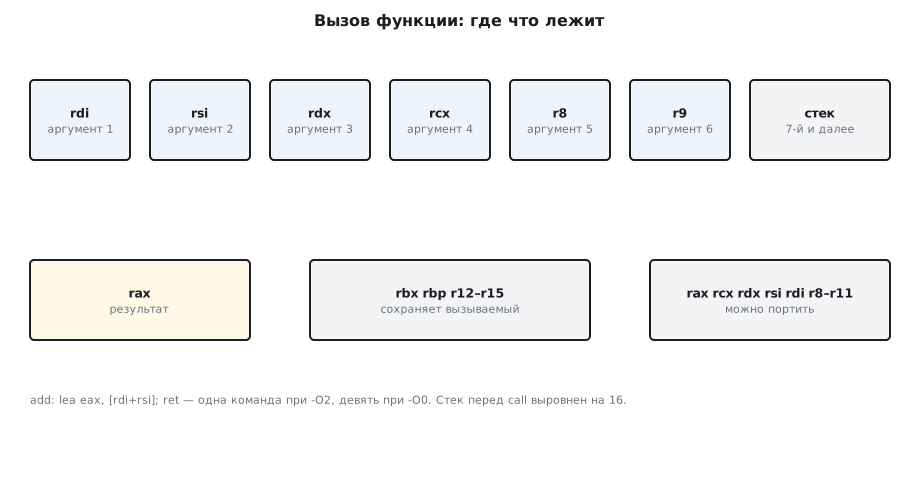
144.2 The System V calling convention
On Linux x86-64 one convention applies to all C code:
| What | Where |
|---|---|
| integer arguments 1–6 | rdi, rsi, rdx, rcx, r8, r9 |
| seventh and beyond | on the stack, the first of them at [rsp + 8] after call |
| floating-point arguments | xmm0–xmm7 |
| result | rax (and rdx for 128 bits), floating-point in xmm0 |
| may be clobbered | rax, rcx, rdx, rsi, rdi, r8–r11, all xmm |
| must be saved by the callee | rbx, rbp, r12–r15 |
stack before call |
aligned to 16 bytes |
A function with two arguments at -O2:
int add(int a, int b) { return a + b; } /* аргументы в edi, esi; результат в eax */
add:
    lea eax, [rdi+rsi]
    ret
One instruction: lea computes the address rdi + rsi, but puts it into eax as
a number — an addition without flags. With seven arguments the sixth is still in r9,
and the seventh comes from the stack:
sum7:
    add rdi, rsi
    add rdi, rdx
    add rdi, rcx
    add rdi, r8
    lea rax, [rdi+r9]
    add rax, QWORD PTR 8[rsp]
    ret
A nasm function must follow the same convention — and then C calls it like one of its own:
asm_add3:
        mov     rax, rdi            ; a
        add     rax, rsi            ; + b
        add     rax, rdx            ; + c
        ret
nasm: asm_add3(1, 2, 3) = 6
Windows has a different convention (rcx, rdx, r8, r9 and 32 bytes
of "shadow space" on the stack) — so an assembly function written for Linux will not work
under Windows without rewriting.
144.3 Prologue, epilogue and what -O2 does
The same add at -O0:
add:
    push    rbp
    mov rbp, rsp
    mov DWORD PTR -4[rbp], edi
    mov DWORD PTR -8[rbp], esi
    mov edx, DWORD PTR -4[rbp]
    mov eax, DWORD PTR -8[rbp]
    add eax, edx
    pop rbp
    ret
The prologue push rbp; mov rbp, rsp builds a frame, and the arguments are stored on the stack
and read back — this way the debugger sees every variable. At -O2
there is no frame and no variables in memory; nine instructions became two. The
loop_sum loop is 22 lines at -O0 versus 11 at -O2.
Calling another function: space for the array buf[4] is taken by subtracting from
rsp, the address is passed in rdi, the size in esi, then call, then release:
calls_other:
    movd    xmm1, edi
    sub rsp, 24
    mov esi, 4
    pshufd  xmm0, xmm1, 0
    paddd   xmm0, XMMWORD PTR .LC0[rip]
    mov rdi, rsp
    movaps  XMMWORD PTR [rsp], xmm0
    call    loop_sum
    add rsp, 24
    ret
The compiler filled the four elements {x, x+1, x+2, x+3} with a single
vector instruction paddd — 16 bytes at a time. sub rsp, 24, not 16:
after call the stack also holds the return address, and 24 + 8 = 32 keeps
the 16-byte alignment.
144.4 Arithmetic, switch and tables
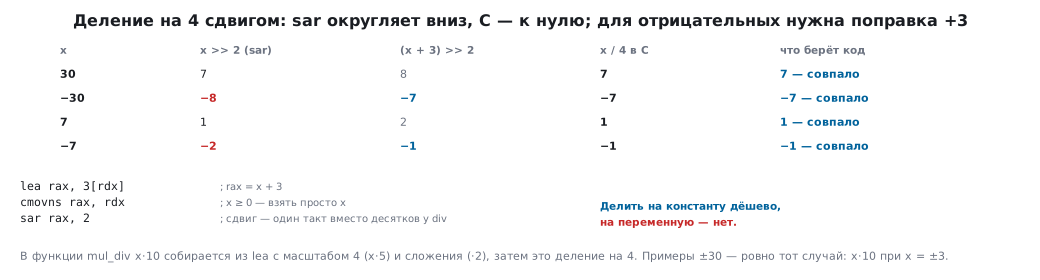
Multiplying by 10 and dividing by 4 without mul and div:
mul_div:
    lea rdx, [rdi+rdi*4]
    add rdx, rdx
    lea rax, 3[rdx]
    cmovns  rax, rdx
    sar rax, 2
    ret
x·5 via lea with a scale of 4, ·2 via an addition, division by 4 is
an arithmetic right shift, and lea rax, 3[rdx] with cmovns is a correction
for negative numbers: the shift rounds toward minus infinity, while C requires rounding toward
zero. div costs tens of cycles, a shift costs one; so dividing by a
constant is cheap, and dividing by a variable is not.
The switch over six values became not a chain of comparisons but a lookup table
in .rodata:
by_switch:
    mov eax, -1
    cmp edi, 5
    ja  .L10
    mov edi, edi
    lea rax, CSWTCH.5[rip]
    mov eax, DWORD PTR [rax+rdi*4]
.L10:
    ret
One ja comparison and a read from an array. ja compares the 32-bit edi
as an unsigned number: for it −1 is 0xFFFFFFFF, so the "greater than 5" condition
cuts off negative values too. The following mov edi, edi clears the upper
half of rdi — the index in the address [rax+rdi*4] must be 64-bit.
When the branches do not reduce to a value, the compiler builds a jump
table — an array of addresses and jmp [rax + rdi*8]. This way a switch over dozens of
densely packed case labels costs one comparison and one read. For
sparse values the compiler builds a comparison tree: log₂N checks
instead of N.
144.5 Reading machine code: objdump
gcc -S shows the assembly before linking; objdump -d disassembles
a finished object file or program together with the instruction bytes:
0000000000000000 <add>:
   0:   8d 04 37                lea    eax,[rdi+rsi*1]
   3:   c3                      ret
lea is three bytes, ret is one; x86 instructions have variable length, from 1 to
15 bytes. The -M intel option gives Intel syntax ("destination, source");
without it you get AT&T with % before register names and the reverse operand order. objdump -d -S
(for objdump the -S option means "with source", not what it means for gcc), on a build
with -g, interleaves machine code with C lines. The code of the six functions in funcs.o
takes 395 bytes (size, the text column).
144.6 Inline assembly
Sometimes you need an instruction that C does not have: a time counter, processor identification, the carry flag, a system call without libc.
static inline uint64_t rdtsc(void)
{
    uint32_t lo, hi;
    __asm__ volatile ("rdtsc" : "=a"(lo), "=d"(hi));           /* выходы: eax → lo, edx → hi */
    return ((uint64_t)hi << 32) | lo;
}
The form is: asm(text : outputs : inputs : clobbers). "=a"(lo) is an output in
eax, "=d" in edx, "r" is any register, "m" is memory,
"+r" is input and output at once. The list after the third colon tells
the compiler what the instruction changes: "cc" — the flags, "memory" — memory
(a barrier against reordering), register names — specific registers.
volatile forbids dropping the instruction as "useless".
    __asm__ ("add %[b], %[a]\n\t"
             "setc %[c]"                                        /* флаг переноса → байт */
             : [a] "+r"(a), [c] "=r"(carry)
             : [b] "r"(b)
             : "cc");                                           /* меняем флаги */
A system call made directly: the number in rax, the arguments in rdi, rsi,
rdx, the syscall instruction, the result in rax; the kernel clobbers rcx and r11:
    __asm__ volatile ("syscall"                                 /* номер 1 = write; аргументы rdi, rsi, rdx */
                      : "=a"(ret)
                      : "a"(1), "D"(fd), "S"(buf), "d"(n)
                      : "rcx", "r11", "memory");                /* syscall портит rcx и r11 */
cpuid: GenuineIntel, старший лист 28
rdtsc: 1000 итераций — 4528 тиков TSC
add 0xFFFF…FFFF + 2 = 1, перенос 1
syscall write без libc
syscall вернул 26
add gave 1 with a carry — an unsigned overflow that C makes
invisible and the CF flag reveals. On a terminal the lines appear in program
order: printf flushes the buffer at every newline. But if the
output goes to a pipe (./inline_asm | cat), the line "syscall write without
libc" comes out first, before cpuid: in that case printf accumulates everything in the buffer until
exit, while write goes to the kernel immediately.
rdtsc returns not core cycles but ticks of the TSC counter. On modern x86
it runs at a constant, nominal processor frequency and ignores both
turbo mode and reduced frequency — there ticks and cycles diverge. Besides,
the instruction is not ordered: the processor may execute it before or after
its neighbours, so a short measurement is wrapped in lfence, or rdtscp is used,
which waits for the preceding instructions. Only a
performance counter counts core cycles honestly: perf stat -e cycles.
144.7 A program without libc
_start:
        mov     rax, 1              ; write
        mov     rdi, 1              ; stdout
        mov     rsi, msg
        mov     rdx, len
        syscall
        mov     rax, 60             ; exit
        mov     rdi, 7              ; код возврата 7
        syscall
nasm -f elf64 hello.asm && ld -o hello hello.o — 8896 bytes, and ldd says
"not a dynamic executable": neither libc nor the dynamic linker.
The entry point is _start, not main: main is called by the libc startup code,
which is not here. The program prints a line and exits with code 7 —
exit is also a system call, number 60. This is exactly what
Reset_Handler does in firmware before main (section 11), only on a different
processor.
144.8 Pitfalls
| Symptom | Cause |
|---|---|
| the debugger says "variable optimized out" | -O2 keeps it in a register; look at -O0 or -Og |
| an assembly function corrupts C data | rbx/rbp/r12–r15 touched without saving |
a crash inside call from assembly |
the stack is not aligned to 16 before call |
| an assembly function works on Linux and crashes on Windows | a different convention: rcx, rdx, r8, r9 |
asm "disappears" at -O2 |
no volatile and no outputs that are used |
the asm result is wrong at -O2 |
"memory" or "cc" not given, the compiler reordered |
syscall returned garbage in other registers |
rcx, r11 not in the clobber list |
| nasm assembly does not build with gcc | Intel syntax versus AT&T; -masm=intel is only for reading |
ld: warning: missing .note.GNU-stack |
add a .note.GNU-stack section to the nasm file |
| division is slow | div by a variable costs tens of cycles; by a constant the compiler replaces it with a shift |
rdtsc does not match cycles |
the TSC runs at a constant frequency, the instruction is not ordered: lfence, rdtscp; cycles — perf stat -e cycles |
144.9 Summary
- Arguments:
rdi,rsi,rdx,rcx,r8,r9, then the stack; result inrax; saverbx,rbp,r12–r15; stack aligned to 16. -O0: a frame and variables on the stack (9 instructions);-O2:lea+ret.- Multiplication and division by a constant —
leaand shifts;switch— a table. gcc -S -masm=intel,objdump -d -M intel.- Inline assembly: outputs, inputs, clobbers;
volatile,"memory","cc". - Without libc:
_start,syscall1 and 60, 8896 bytes.
Full sources
inline_asm.c — GCC inline assembly: rdtsc, cpuid, carry, write without libc.
/* Раздел 144: встроенный ассемблер GCC — счётчик тактов rdtsc, cpuid, add с флагом переноса,
   системный вызов write без libc, функция из файла на nasm. */
#include <stdio.h>
#include <stdint.h>
#include <string.h>

long asm_add3(long a, long b, long c);                          /* написана на nasm (add3.asm) */

static inline uint64_t rdtsc(void)
{
    uint32_t lo, hi;
    __asm__ volatile ("rdtsc" : "=a"(lo), "=d"(hi));           /* выходы: eax → lo, edx → hi */
    return ((uint64_t)hi << 32) | lo;
}

static int add_carry(uint64_t a, uint64_t b, uint64_t *sum)
{
    uint8_t carry;
    __asm__ ("add %[b], %[a]\n\t"
             "setc %[c]"                                        /* флаг переноса → байт */
             : [a] "+r"(a), [c] "=r"(carry)
             : [b] "r"(b)
             : "cc");                                           /* меняем флаги */
    *sum = a;
    return carry;
}

static long raw_write(int fd, const void *buf, size_t n)
{
    long ret;
    __asm__ volatile ("syscall"                                 /* номер 1 = write; аргументы rdi, rsi, rdx */
                      : "=a"(ret)
                      : "a"(1), "D"(fd), "S"(buf), "d"(n)
                      : "rcx", "r11", "memory");                /* syscall портит rcx и r11 */
    return ret;
}

int main(void)
{
    char vendor[13] = {0};
    uint32_t eax = 0, ebx, ecx, edx;
    __asm__ ("cpuid" : "+a"(eax), "=b"(ebx), "=c"(ecx), "=d"(edx));
    memcpy(vendor, &ebx, 4); memcpy(vendor + 4, &edx, 4); memcpy(vendor + 8, &ecx, 4);
    printf("cpuid: %s, старший лист %u\n", vendor, eax);
    uint64_t t0 = rdtsc(); volatile int x = 0; for (int i = 0; i < 1000; i++) x += i; uint64_t t1 = rdtsc();
    printf("rdtsc: 1000 итераций — %llu тиков TSC\n", (unsigned long long)(t1 - t0));
    uint64_t s; int c = add_carry(UINT64_MAX, 2, &s);
    printf("add 0xFFFF…FFFF + 2 = %llu, перенос %d\n", (unsigned long long)s, c);
    const char msg[] = "syscall write без libc\n";
    long n = raw_write(1, msg, sizeof msg - 1);
    printf("syscall вернул %ld\n", n);
    printf("nasm: asm_add3(1, 2, 3) = %ld\n", asm_add3(1, 2, 3));
    return 0;
}
Next: section 145 — UNIX as a development environment.