 Embedded HandbookApps
11а. MPU: protecting memory from your own mistakes
A microcontroller has no "operating system" to stop a program that writes to the wrong place. A write through a null pointer, a stack overflow into neighbouring variables, a jump into data — and the program keeps running with corrupted memory until something strange happens far away. The MPU (Memory Protection Unit) in Cortex-M3/M4/M7 cores lets you turn such errors into an immediate stop right on the guilty instruction — together with the address that was accessed.
The MPU is not only in M3/M4/M7. On Cortex-M0+ (G0, C0, L0 from L05x) it
is built the same way — RBAR, RASR, eight regions — but without the TEX field,
and the smallest region is 256 bytes: a 32-byte guard is not possible there.
On Cortex-M33 (L5, U5, H5) the MPU is different, ARMv8-M: a region is given by a base
and a limit (RBAR and RLAR) in steps of 32 bytes, with no power of two
and no subregions, attributes are an index into the MAIR registers, and overlapping
regions do not mean the higher number wins but a fault. The rasr() function of this
section does not apply there. The M33 catches stack overflow even without the MPU —
with the limit registers MSPLIM and PSPLIM (a UsageFault, flag STKOF).
The section is an experiment in QEMU (netduinoplus2, Cortex-M4): five MPU regions and
four traps. The rules follow the Cortex-M4 core manual from the pack.
Program _verify/mpu11a/mpu11a.c, check _verify/mpu11a_check.py.
Terms used in the documentation
Term Meaning Memory Protection Unit (MPU) the memory protection block region, background region a region and the background region MPU_RBAR, MPU_RASR region base address register and region attribute and size register access permission (AP) access rights execute never (XN) execution forbidden subregion disable (SRD) switching off subregions MemManage fault, MMFSR, MMFAR memory protection fault, its flags and its address PRIVDEFENA default memory map enabled for privileged code
11а.1 How the MPU works
- Eight regions (0…7) — MPU_TYPE read as 0x00000800 in the experiment: the region count field = 8.
- A region has a base, a size and permissions. The size is a power of two from 32 bytes to 4 GB, the base is aligned to the size: a 1 KB region starts at an address that is a multiple of 1 KB.
- Regions may overlap — the region with the higher number wins.
- A violation is a MemManage fault on that very instruction.
- The background region (PRIVDEFENA): where there are no regions, privileged code sees the normal memory map. Convenient — no need to describe the peripherals.
The size is encoded in the SIZE field: size = 2^(SIZE+1). In one place the manual gives the minimum as SIZE = 3, while the table next to it gives 4 (32 bytes) as the "minimum permitted"; go by the table: the smallest region is 32 bytes.
Permissions (AP):
| AP | Privileged code | Unprivileged |
|---|---|---|
| 000 | no access | no access |
| 001 | read and write | no access |
| 010 | read and write | read only |
| 011 | read and write | read and write |
| 101 | read only | no access |
| 110 | read only | read only |
The XN bit forbids executing instructions from the region.
11а.2 Experiment: five regions
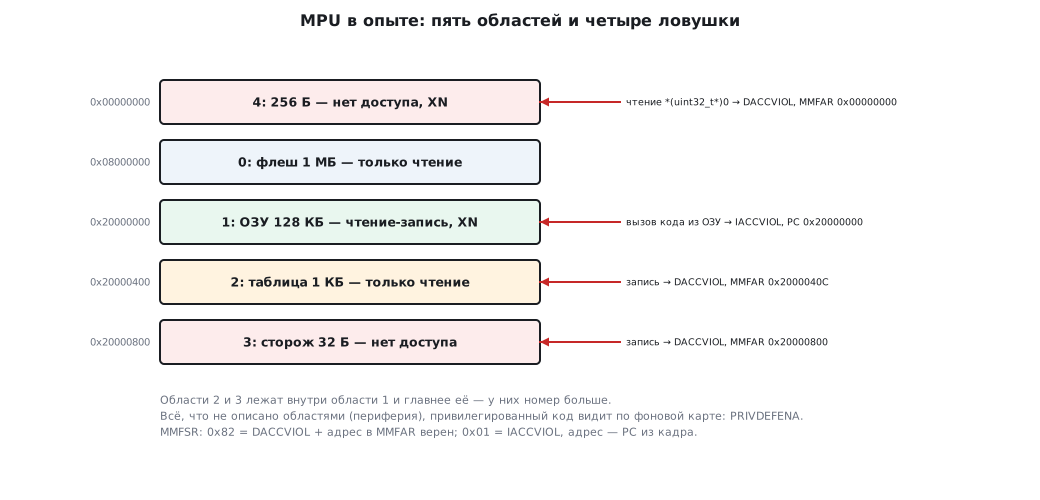
| No. | Where | Size | Permissions | XN | RASR |
|---|---|---|---|---|---|
| 0 | Flash memory, 0x08000000 | 1 MB | read only | no | 0x06020027 |
| 1 | RAM, 0x20000000 | 128 KB | read-write | yes | 0x13080021 |
| 2 | table, 0x20000400 | 1 KB | read only | yes | 0x16080013 |
| 3 | "guard", 0x20000800 | 32 bytes | no access | yes | 0x10080009 |
| 4 | addresses from zero | 256 bytes | no access | yes | 0x1000000F |
Regions 2 and 3 lie inside region 1 and override it — their numbers are higher.
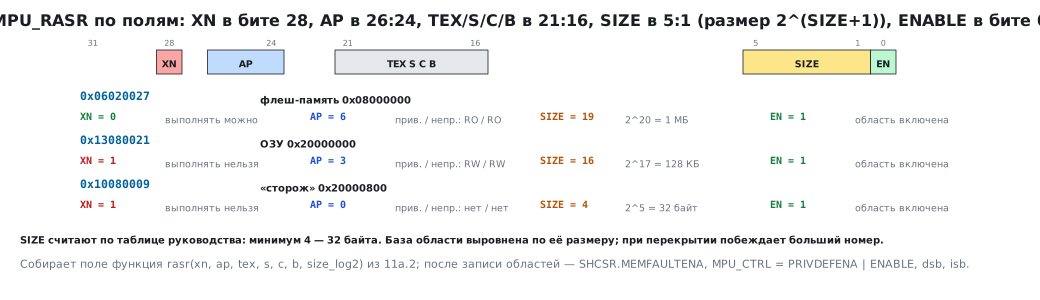
The RASR value is assembled from the fields:
static uint32_t rasr(int xn, int ap, int tex, int s, int c, int b, int size_log2)
{
    return (uint32_t)xn << 28 | (uint32_t)ap << 24 | (uint32_t)tex << 19 | (uint32_t)s << 18 | (uint32_t)c << 17 |
           (uint32_t)b << 16 | (uint32_t)(size_log2 - 1) << 1 | 1u;
}
Enabling: region by region through MPU_RNR, MPU_RBAR, MPU_RASR; then
enable the MemManage fault (SHCSR.MEMFAULTENA, bit 16) and the MPU itself with the background
map: MPU_CTRL = PRIVDEFENA | ENABLE; and the dsb, isb barriers.
11а.3 Four traps
The MemManage handler records the flags (MMFSR), the address (MMFAR) and the instruction address from the stack frame (section 7а) — and returns control to the caller so that the next trap can be checked:
| What we did | MMFSR | What it means | MMFAR |
|---|---|---|---|
read *(uint32_t *)0 |
0x82 | DACCVIOL + address valid | 0x00000000 |
| wrote to the read-only table | 0x82 | DACCVIOL + address valid | 0x2000040C — ro_table[3] |
| called code in RAM | 0x01 | IACCVIOL: instruction fetch | not written (PC in frame = 0x20000000) |
| wrote to the "guard" below the stack | 0x82 | DACCVIOL + address valid | 0x20000800 |
- On a data violation MMFAR holds the exact address, and the PC in the frame points to
the faulting instruction. Then
addr2lineon the PC — and the line is found. - On an instruction fetch violation MMFAR has no address (bit MMARVALID = 0 — the old value 0x2000040C stayed there), but the PC in the frame is the forbidden address itself.
- The write to the table did not happen: after the trap
ro_table[3]= 0.
11а.4 Three uses the MPU is switched on for
Null pointer. On STM32 address 0 is not empty: the boot memory is mapped there, and a read through a null pointer silently returns something (for example, the initial stack value). A "no access" region over the first 256 bytes turns such an error into a fault on the spot.
Stack overflow. The stack grows downwards and, when it overflows, corrupts .bss
below it — the error shows up anywhere. A 32-byte "no access" "guard"
below the stack catches the overflow on the very first write past the boundary. RTOSes with MPU
support reprogram the regions on every task switch — this protects
the stack of each task as well.
The guard has two weaknesses, and both are visible in the experiment _verify/fixw2a3/guard11a.
The first is a large frame. A function with a 4 KB array (as in section 11.4)
moves SP down by 4 KB at once, past the 32 bytes of the guard, and its write lands below
it: no fault, the memory below the guard is corrupted. So the guard is made
no smaller than the largest stack frame — GCC prints frame sizes with the
-fstack-usage option. The second is the handler's own stack. When the task stack
(PSP) overflows, the MemManage handler runs on MSP and calmly reports
the address; in the experiment MMFSR = 0x92 — MSTKERR joined DACCVIOL, a failure to write
the frame on exception entry. But when MSP overflows, the handler
gets the same corrupted stack: its first stack write escalated the fault
to HardFault (HFSR = 0x40000000, FORCED). Such a case is dealt with
in HardFault, and its handler first of all puts MSP on an intact area.
Code in data. XN on RAM forbids executing what came in from outside as data — the first defence against code injection through a buffer overflow.
11а.5 Pitfalls
The compiler threw away the read of address zero. In the experiment, without the
-fno-delete-null-pointer-checks option GCC removed the function reading *(uint32_t *)0
entirely: for it, dereferencing zero is undefined behaviour, so it "never
happens". On a microcontroller, where there is memory at zero, this option is needed.
The region "does not work". The base is not aligned to the size: a 1 KB region at address 0x20000100 is impossible — the low bits of the base are ignored.
Peripherals stopped responding after the MPU was enabled. No background map: without PRIVDEFENA everything not described by regions is forbidden — including USART.
HardFault instead of MemManage. The fault itself is not enabled (MEMFAULTENA),
and it escalates to HardFault.
A "foreign" address in MMFAR. An instruction fetch violation does not write an address — check MMARVALID; the address is the PC from the frame.
MPU settings did not take effect immediately. dsb and isb were missing after the write.
A region smaller than 32 bytes. Does not exist: the smallest size is 32 bytes (SIZE = 4).
11а.6 Summary
- Cortex-M4 MPU: 8 regions, size 2^(SIZE+1) from 32 bytes, base aligned to the size, the higher number wins.
- AP permissions and XN execute-never; the background map is PRIVDEFENA.
- Experiment: reading zero and writing to the protected table and the "guard" give DACCVIOL (MMFSR 0x82) with the exact address in MMFAR; calling code in RAM gives IACCVIOL (0x01) with the address in the frame PC.
- Main uses: null pointer trap, stack guard, execute-never for data.
- GCC without
-fno-delete-null-pointer-checksthrows away the read at zero.
Full sources
mpu11a.c — experiment firmware in QEMU: five MPU regions and MemManage traps.
/* Раздел 11а: MPU — защита памяти. Прогон в QEMU netduinoplus2 (STM32F405, Cortex-M4).
 * Области: 0 — флеш-память только для чтения; 1 — ОЗУ без исполнения; 2 — таблица только для чтения;
 * 3 — «сторож» под стеком; 4 — первые 256 байт адресов (ловушка нулевого указателя).
 * Обработчик MemManage запоминает MMFSR, MMFAR и адрес команды и возвращает управление вызывающему
 * (PC в кадре := LR в кадре), чтобы проверить следующую ловушку. */
#include <stdint.h>

#define RCC_APB2ENR  (*(volatile uint32_t *)0x40023844)
#define USART1_SR    (*(volatile uint32_t *)0x40011000)
#define USART1_DR    (*(volatile uint32_t *)0x40011004)
#define USART1_BRR   (*(volatile uint32_t *)0x40011008)
#define USART1_CR1   (*(volatile uint32_t *)0x4001100C)
#define SCB_SHCSR    (*(volatile uint32_t *)0xE000ED24)
#define SCB_MMFSR    (*(volatile uint8_t  *)0xE000ED28)
#define SCB_MMFAR    (*(volatile uint32_t *)0xE000ED34)
#define MPU_TYPE     (*(volatile uint32_t *)0xE000ED90)
#define MPU_CTRL     (*(volatile uint32_t *)0xE000ED94)
#define MPU_RNR      (*(volatile uint32_t *)0xE000ED98)
#define MPU_RBAR     (*(volatile uint32_t *)0xE000ED9C)
#define MPU_RASR     (*(volatile uint32_t *)0xE000EDA0)

static void putc1(char c)
{
    while (!(USART1_SR & (1u << 7))) {
    }
    USART1_DR = (uint32_t)c;
}

static void puts1(const char *s)
{
    while (*s)
        putc1(*s++);
}

static void puthex(uint32_t v)
{
    static const char hex[] = "0123456789abcdef";
    puts1("0x");
    for (int i = 28; i >= 0; i -= 4)
        putc1(hex[(v >> i) & 0xF]);
}

/* ── обработчик MemManage ── */
volatile uint32_t f_mmfsr, f_mmfar, f_pc, f_count;

void MemManage_C(uint32_t *frame)
{
    f_mmfsr = SCB_MMFSR;
    f_mmfar = SCB_MMFAR;
    f_pc = frame[6];
    f_count++;
    SCB_MMFSR = 0xFF;              /* флаги сбрасываются записью единиц */
    frame[6] = frame[5] & ~1u;     /* вернуться туда, откуда вызвали сбойную функцию */
}

__attribute__((naked)) void MemManage_Handler(void)
{
    __asm volatile("tst lr, #4 \n ite eq \n mrseq r0, msp \n mrsne r0, psp \n b MemManage_C");
}

/* ── области ── */
/* RASR: XN[28] AP[26:24] TEX[21:19] S[18] C[17] B[16] SRD[15:8] SIZE[5:1] ENABLE[0]; размер = 2^(SIZE+1) */
static uint32_t rasr(int xn, int ap, int tex, int s, int c, int b, int size_log2)
{
    return (uint32_t)xn << 28 | (uint32_t)ap << 24 | (uint32_t)tex << 19 | (uint32_t)s << 18 | (uint32_t)c << 17 |
           (uint32_t)b << 16 | (uint32_t)(size_log2 - 1) << 1 | 1u;
}

static void region(int n, uint32_t base, uint32_t attr)
{
    MPU_RNR = (uint32_t)n;
    MPU_RBAR = base;
    MPU_RASR = attr;
    puts1("region ");
    putc1((char)('0' + n));
    puts1(" base=");
    puthex(base);
    puts1(" rasr=");
    puthex(attr);
    puts1("\r\n");
}

__attribute__((aligned(1024), section(".bss"))) static volatile uint32_t ro_table[256];
__attribute__((aligned(32))) static volatile uint32_t guard[8];      /* «сторож»: сюда стек упрётся первым */
__attribute__((aligned(4))) static uint16_t ram_code[2] = {0x4770, 0x4770};   /* bx lr */

/* сбойные действия — отдельные функции без собственного стека: в кадре LR = адрес возврата */
__attribute__((noinline)) uint32_t t_read_null(void) { return *(volatile uint32_t *)0; }
__attribute__((noinline)) void t_write_ro(void) { ro_table[3] = 0x12345678u; }
__attribute__((noinline)) void t_write_guard(void) { guard[0] = 0xDEADu; }

static void report(const char *name)
{
    puts1(name);
    puts1(" faults=");
    puthex(f_count);
    puts1(" mmfsr=");
    puthex(f_mmfsr);
    puts1(" mmfar=");
    puthex(f_mmfar);
    puts1(" pc=");
    puthex(f_pc);
    puts1("\r\n");
    f_mmfsr = f_mmfar = f_pc = 0;
}

int main(void)
{
    RCC_APB2ENR |= 1u << 4;
    USART1_BRR = 0x008B;
    USART1_CR1 = (1u << 13) | (1u << 3);

    puts1("mpu_type=");
    puthex(MPU_TYPE);
    puts1("\r\n");

    region(0, 0x08000000u, rasr(0, 6, 0, 0, 1, 0, 20));                        /* флеш 1 МБ: только чтение */
    region(1, 0x20000000u, rasr(1, 3, 1, 0, 0, 0, 17));                        /* ОЗУ 128 КБ: чтение-запись, без исполнения */
    region(2, (uint32_t)ro_table, rasr(1, 6, 1, 0, 0, 0, 10));                  /* таблица 1 КБ: только чтение */
    region(3, (uint32_t)guard, rasr(1, 0, 1, 0, 0, 0, 5));                      /* сторож 32 байта: нет доступа */
    region(4, 0x00000000u, rasr(1, 0, 0, 0, 0, 0, 8));                          /* 256 байт с нуля: нет доступа */
    SCB_SHCSR |= 1u << 16;                                                      /* MEMFAULTENA */
    MPU_CTRL = (1u << 2) | 1u;                                                  /* PRIVDEFENA + ENABLE */
    __asm volatile("dsb \n isb");

    (void)t_read_null();
    report("read_null");
    t_write_ro();
    report("write_ro");
    ((void (*)(void))((uint32_t)ram_code | 1u))();
    report("exec_ram");
    t_write_guard();
    report("write_guard");
    puts1("ro_table[3]=");
    puthex(ro_table[3]);                         /* читать таблицу можно: запись не прошла */
    puts1("\r\nro_table=");
    puthex((uint32_t)ro_table);
    puts1(" guard=");
    puthex((uint32_t)guard);
    puts1(" ram_code=");
    puthex((uint32_t)ram_code);
    puts1("\r\ndone\r\n");
    for (;;) {
    }
}
Next: section 11б "Cache, TCM and memory domains on F7 and H7" — what changes in memory and in working with DMA when the core gets caches.