 Embedded HandbookApps
141. Non-blocking I/O: select, poll, epoll, event descriptors
The server from section 78 served one connection at a time: read waits
for data, and while one client is silent, all the others are stuck. A thread per connection
(section 139) solves this for up to a few hundred clients, and beyond that it runs
into the memory for stacks and into context switches. The third way is one thread and a kernel
that tells you which descriptors are ready: non-blocking sockets and
multiplexing. nginx, Redis and Node.js are built on it.
Here one echo server is written three times — on select, poll and epoll —
and run under a load of 500 and 2000 connections (_verify/sys141/,
stm-sys:1); after that come a timer, an event and a signal as descriptors, and
what lies behind the words "reactor", io_uring and "coroutines".
Terms used in the documentation
Term Meaning blocking, non-blocking I/O a call that waits, a call that returns at once EAGAIN/EWOULDBLOCK"nothing right now" — try again later I/O multiplexing waiting on many descriptors at once readiness notification a notice that a descriptor is ready level-triggered, edge-triggered reported while the state holds, reported once on a change FD_SETSIZEthe selectlimit — 1024 descriptorsinterest list, ready list the watched list and the ready list ( epoll)timerfd, eventfd, signalfd a timer, an event, a signal as a descriptor C10K problem the problem of ten thousand connections reactor pattern an event loop with handlers completion-based I/O I/O reported on completion ( io_uring, IOCP)coroutine a function that can suspend and resume
141.1 Non-blocking mode
By default read, write, accept and connect wait. The
O_NONBLOCK flag changes the contract: if there is nothing to do, the call returns −1
with errno == EAGAIN immediately. The exception is connect: it returns EINPROGRESS,
and you learn the result of the connection when the socket becomes ready for writing, via
getsockopt(fd, SOL_SOCKET, SO_ERROR, …):
static int set_nonblocking(int fd)
{
    int fl = fcntl(fd, F_GETFL, 0);
    return fcntl(fd, F_SETFL, fl | O_NONBLOCK);
}
неблокирующий read без данных: -1, errno Resource temporarily unavailable
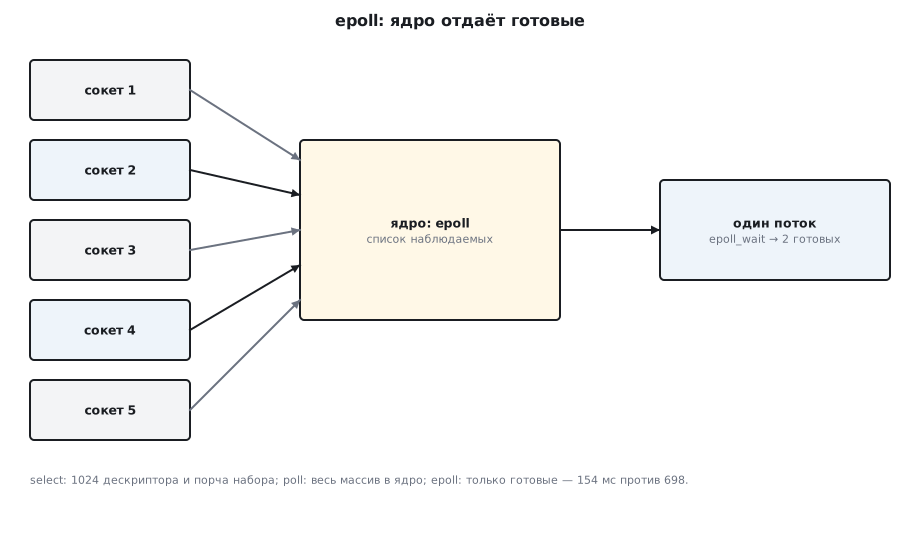
Non-blocking mode on its own is useless — spinning in a loop polling sockets means burning the CPU. You need a call that sleeps and wakes up when at least one descriptor becomes ready.
141.2 Three calls, one server
The server does the same thing whatever the way of waiting: the listening
socket is in the set; when it is ready, accept everyone you can and add them to the set;
when a connection is ready, read everything up to EAGAIN and send it back:
static int serve(int fd)
{
    char buf[4096];
    for (;;) {
        ssize_t n = read(fd, buf, sizeof buf);
        if (n < 0) return errno == EAGAIN ? 1 : 0;      /* EAGAIN: данных больше нет — не ошибка */
        if (n == 0) return 0;
        if (write(fd, buf, n) < 0) return 0;
    }
}
This is a simplification: on a non-blocking socket write may write only part of the data
or return EAGAIN when the send buffer is full. A real server keeps
the unsent tail in the connection's buffer, subscribes to EPOLLOUT
and finishes writing when the socket is ready for writing again.
select is the oldest. The descriptor set is an fd_set bit mask
of 1024 bits (128 bytes), and that is the limit: a descriptor numbered 1024 or above
does not fit into it. The call overwrites the set, so you copy it before every
call, and afterwards you go through all numbers up to maxfd:
        fd_set rd = all;                                 /* select портит набор — копия на каждый вызов */
        select(maxfd + 1, &rd, NULL, NULL, NULL);
        for (int fd = 0; fd <= maxfd; fd++) {            /* перебор всех номеров до maxfd */
poll takes an array of struct pollfd of any length, with no 1024 limit, but
every call passes the whole array into the kernel and gets the whole
array back with revents flags; the work grows with the number of connections, not with
the number of ready ones.
epoll — the kernel keeps the watched list itself; epoll_ctl
adds and removes one at a time, and epoll_wait returns only the ready ones:
int n = epoll_wait(ep, evs, 64, -1); /* ядро отдаёт только готовые дескрипторы */
The load: a client opens connections and sends messages back and forth over each one:
| Server | 500 connections × 20 messages | 2000 connections × 2 |
|---|---|---|
select |
10000 of 10000, 469 ms | 2040 of 4000 — connections numbered ≥ 1024 rejected |
poll |
10000 of 10000, 436 ms | 4000 of 4000, 698 ms |
epoll |
10000 of 10000, 328 ms | 4000 of 4000, 154 ms |
At 500 connections all three cope; the difference in speed comes from
scanning: select and poll walk the whole set for every message.
At 2000 connections select breaks — the server has to close everything that did not
fit into fd_set, and the client gets an echo on only half of them. poll
copes, but four times slower than epoll: 2000 structures into the kernel and
back for each of the 4000 exchanges.
141.3 epoll: level-triggered and edge-triggered
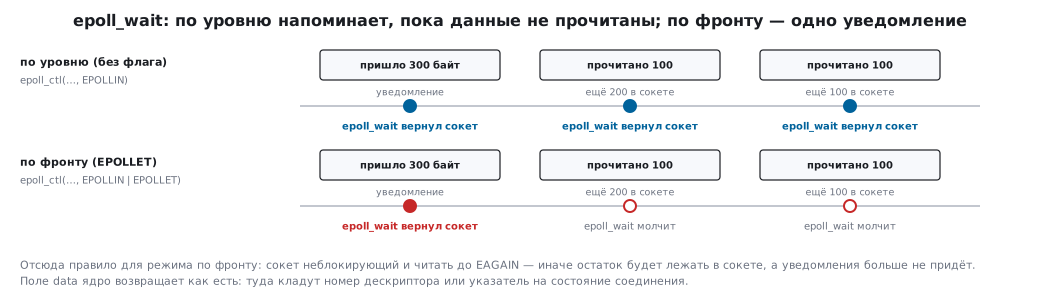
By default epoll_wait is level-triggered: while the socket has
unread data, it returns this descriptor again and again.
The EPOLLET flag makes it edge-triggered: one notification when data arrives, and
if you do not read all of it, the next one comes only with new data. A client
that waits for a reply and stays silent will not send any — the tail stays in the socket for good. Hence the rule for
edge-triggered mode: the socket is non-blocking, and you read up to EAGAIN — as in serve above.
The server in the experiment accepts connections with accept4(…, SOCK_NONBLOCK) and sets
EPOLLIN | EPOLLET:
                    struct epoll_event ce = { .events = EPOLLIN | EPOLLET, .data.fd = c };   /* по фронту */
                    epoll_ctl(ep, EPOLL_CTL_ADD, c, &ce);
The data field can be anything: the descriptor number or a pointer to a connection
structure with buffers and state; the kernel returns it as is. EPOLLRDHUP
reports that the client has closed its side; EPOLLONESHOT gives one
trigger, after which the descriptor must be re-armed (for a thread pool).
epoll exists only in Linux; in BSD and macOS its role is played by kqueue, in
Windows by completion ports (IOCP). The libraries libevent, libuv (the core of
Node.js) and libev hide this difference behind one event loop and add
timers, DNS and HTTP.
141.4 Everything is a descriptor
In one poll, next to the sockets, it is convenient to wait for other things too, if they are also
descriptors. Linux provides three of them:
timerfd— a timer:readreturns the number of periods that have elapsed;eventfd— a counter for signalling between threads or processes:writeadds to it,readtakes the value and resets it to zero;signalfd— signals arrive assignalfd_siginforecords rather than in a handler; the signal itself is blocked with the mask, otherwise it goes the old way.
struct pollfd p[3] = { { tfd, POLLIN, 0 }, { efd, POLLIN, 0 }, { sfd, POLLIN, 0 } };
таймер: тик 1
eventfd: 1 от другого потока
таймер: тик 2
signalfd: сигнал 10
таймер: тик 3
This way the server's main loop receives timers, SIGTERM signals and
messages from worker threads by the same path as data from sockets — with no
races between the signal handler and the loop (section 136).
141.5 Reactor, C10K and io_uring
The loop "wait for readiness → call the handler" is called a reactor; this is
how nginx (one reactor process per core), Redis
(one thread) and Node.js are built. Ten thousand simultaneous connections is the problem
on which servers with a thread or process per client broke down in the late nineties;
epoll and kqueue appeared as the answer to it. Today the same
scheme holds a million connections: the only cost is memory for buffers.
epoll reports readiness, and the program must read and write
itself. io_uring changes the model: the program puts requests (read
so many bytes into this buffer) into a ring in memory shared with the kernel, the kernel
executes them and puts the results into another ring — with no system call
per operation. This is completion-based I/O, like IOCP in Windows,
and it also covers files, for which epoll is useless (a regular file
is always "ready"). The old POSIX AIO in glibc is threads with pread inside,
and it gives no gain.
141.6 Coroutines: sequential code on an event loop
Reactor handlers tear the logic of a connection into pieces between events.
A coroutine hides this: a function "waits for data" and suspends,
and the event loop resumes it when the data has arrived; the code reads as
sequential. C has no coroutines in the language; they are provided by libraries:
context switching via makecontext/swapcontext (libtask) or
a short piece of assembly (libco), macros on a switch by line
number (Duff's device trick — with no stack of its own), or ready-made libmill/libdill
in the Go style. Each coroutine has its own stack on the heap (usually 8–64 KB) instead
of megabytes for a thread. A switch in assembly does without the kernel — a few
nanoseconds; swapcontext from glibc also saves the signal mask
with a system call on every switch and comes out many times slower — in the experiment,
more than a hundred nanoseconds. The downside: one coroutine that goes
off into a long computation stops all of them.
141.7 Pitfalls
| Symptom | Cause |
|---|---|
read returned −1 on a non-blocking socket |
EAGAIN is not an error but "nothing yet" |
a select server loses clients after ~1000 |
FD_SETSIZE is 1024; move to poll/epoll |
select "stopped seeing" descriptors |
the call overwrites the set — copy it before each call |
epoll with EPOLLET misses data |
you did not read up to EAGAIN — there will be no second notification |
level-triggered epoll spins doing nothing |
a socket is always ready for writing — set EPOLLOUT only when there is something to write |
poll slows down on thousands of connections |
the whole array goes into the kernel on every call — use epoll |
signalfd does not receive the signal |
the signal is not blocked by the mask — it went to the handler |
| one handler "hung" — everything stopped | the reactor is single-threaded: move long work to a thread pool |
epoll on a regular file is "always ready" |
files do not support readiness — use io_uring or threads |
141.8 Summary
O_NONBLOCK: instead of waiting —EAGAIN; read up to it.select— 1024 descriptors and an overwritten set;poll— no limit, but the whole array goes into the kernel;epoll— only the ready ones: 154 ms versus 698 forpollat 2000 connections.EPOLLETrequires reading up toEAGAIN;dataholds your own pointer.timerfd,eventfd,signalfd— a timer, an event and a signal in onepoll.- A reactor is one thread per core;
io_uringis completion-based; coroutines are sequential code on top of an event loop.
Full sources
echo_epoll.c — an echo server on epoll, select or poll.
/* Раздел 141: эхо-сервер на epoll — один поток обслуживает любое число соединений.
   Ключ -s — select, -p — poll, по умолчанию epoll. Порт — первый аргумент. */
#define _GNU_SOURCE
#include <stdio.h>
#include <stdlib.h>
#include <string.h>
#include <errno.h>
#include <fcntl.h>
#include <signal.h>
#include <unistd.h>
#include <poll.h>
#include <sys/select.h>
#include <sys/epoll.h>
#include <sys/socket.h>
#include <netinet/in.h>

static int set_nonblocking(int fd)
{
    int fl = fcntl(fd, F_GETFL, 0);
    return fcntl(fd, F_SETFL, fl | O_NONBLOCK);
}

static int listen_on(int port)
{
    int fd = socket(AF_INET, SOCK_STREAM, 0);
    int one = 1; setsockopt(fd, SOL_SOCKET, SO_REUSEADDR, &one, sizeof one);
    struct sockaddr_in a = { .sin_family = AF_INET, .sin_port = htons(port), .sin_addr.s_addr = htonl(INADDR_ANY) };
    if (bind(fd, (struct sockaddr *)&a, sizeof a) < 0 || listen(fd, 128) < 0) { perror("bind/listen"); exit(1); }
    set_nonblocking(fd);
    return fd;
}

/* обслужить готовый дескриптор: читать всё, что есть, и вернуть; 0 — соединение закрыто */
static int serve(int fd)
{
    char buf[4096];
    for (;;) {
        ssize_t n = read(fd, buf, sizeof buf);
        if (n < 0) return errno == EAGAIN ? 1 : 0;      /* EAGAIN: данных больше нет — не ошибка */
        if (n == 0) return 0;
        if (write(fd, buf, n) < 0) return 0;
    }
}

static void run_epoll(int lfd)
{
    int ep = epoll_create1(0);
    struct epoll_event ev = { .events = EPOLLIN, .data.fd = lfd }, evs[64];
    epoll_ctl(ep, EPOLL_CTL_ADD, lfd, &ev);
    for (;;) {
        int n = epoll_wait(ep, evs, 64, -1);             /* ядро отдаёт только готовые дескрипторы */
        for (int i = 0; i < n; i++) {
            int fd = evs[i].data.fd;
            if (fd == lfd) {
                int c;
                while ((c = accept4(lfd, NULL, NULL, SOCK_NONBLOCK)) >= 0) {
                    struct epoll_event ce = { .events = EPOLLIN | EPOLLET, .data.fd = c };   /* по фронту */
                    epoll_ctl(ep, EPOLL_CTL_ADD, c, &ce);
                }
            } else if (!serve(fd)) {
                epoll_ctl(ep, EPOLL_CTL_DEL, fd, NULL); close(fd);
            }
        }
    }
}

static void run_poll(int lfd)
{
    static struct pollfd fds[8192]; int n = 1;      /* poll: массив любого размера, но весь идёт в ядро */
    fds[0] = (struct pollfd){ lfd, POLLIN, 0 };
    for (;;) {
        poll(fds, n, -1);                                /* каждый вызов — весь массив в ядро и обратно */
        for (int i = 0; i < n; i++) {
            if (!(fds[i].revents & (POLLIN | POLLHUP))) continue;
            if (fds[i].fd == lfd) {
                int c;
                while ((c = accept4(lfd, NULL, NULL, SOCK_NONBLOCK)) >= 0 && n < 8192)
                    fds[n++] = (struct pollfd){ c, POLLIN, 0 };
            } else if (!serve(fds[i].fd)) {
                close(fds[i].fd); fds[i] = fds[--n]; i--;
            }
        }
    }
}

static void run_select(int lfd)
{
    fd_set all; FD_ZERO(&all); FD_SET(lfd, &all); int maxfd = lfd;
    for (;;) {
        fd_set rd = all;                                 /* select портит набор — копия на каждый вызов */
        select(maxfd + 1, &rd, NULL, NULL, NULL);
        for (int fd = 0; fd <= maxfd; fd++) {            /* перебор всех номеров до maxfd */
            if (!FD_ISSET(fd, &rd)) continue;
            if (fd == lfd) {
                int c;
                while ((c = accept4(lfd, NULL, NULL, SOCK_NONBLOCK)) >= 0) {
                    if (c >= FD_SETSIZE) { close(c); continue; }     /* select не умеет больше 1024 */
                    FD_SET(c, &all); if (c > maxfd) maxfd = c;
                }
            } else if (!serve(fd)) { close(fd); FD_CLR(fd, &all); }
        }
    }
}

int main(int argc, char **argv)
{
    signal(SIGPIPE, SIG_IGN);
    int lfd = listen_on(argc > 1 ? atoi(argv[1]) : 7000);
    const char *mode = argc > 2 ? argv[2] : "-e";
    if (!strcmp(mode, "-s")) run_select(lfd);
    else if (!strcmp(mode, "-p")) run_poll(lfd);
    else run_epoll(lfd);
    return 0;
}
Next: section 142 — web services in C: HTTP, CGI, FastCGI, sendfile.