 Embedded HandbookApps
140. C11 threads, atomic operations and OpenMP
POSIX threads are a standard of the operating system, not of the language. C11 added
three things to the language itself: threads in <threads.h>, atomic types in <stdatomic.h>
and the _Thread_local storage class. The first is a thin wrapper over pthread,
the second is what every lock is built on, the third gives a thread its own data
without any functions. Plus OpenMP: a way to parallelize a loop with one
line, without writing a single create or join. Everything is in the experiments in
_verify/sys140/, stm-sys:1, gcc 12.
Atomic operations are the same topic as in section 124 on interrupts in a microcontroller; here they are examined from another side: how a lock is built on them and what memory order means with several cores.
Terms used in the documentation
Term Meaning thrd_t,mtx_t,cnd_tC11 thread, mutex, condition variable atomic operation an operation other threads cannot see half-done lock-free works without a lock compare-and-swap (CAS), compare-exchange compare a value and swap it in one step memory order the order in which other threads see memory accesses relaxed, acquire, release, seq_cst no ordering, acquire, release, a single total order memory fence an ordering barrier without a variable thread-local a separate copy in each thread reentrant can be called again before the previous call has finished thread-safe can be called from several threads at once reduction combining the threads' partial results
140.1 C11 threads
The same concepts as in pthread, with other names and error codes
thrd_success/thrd_error instead of errno:
| POSIX | C11 |
|---|---|
pthread_create(&t, NULL, f, arg) |
thrd_create(&t, f, arg) — f returns int |
pthread_join(t, &p) |
thrd_join(t, &res) |
pthread_detach, pthread_exit, pthread_self |
thrd_detach, thrd_exit, thrd_current |
sched_yield, nanosleep |
thrd_yield, thrd_sleep |
pthread_mutex_t, _lock, _unlock, _trylock, _timedlock |
mtx_t, mtx_lock, mtx_unlock, mtx_trylock, mtx_timedlock |
pthread_cond_t, _wait, _signal, _broadcast |
cnd_t, cnd_wait, cnd_signal, cnd_broadcast |
pthread_once |
call_once |
pthread_key_* |
tss_create, tss_get, tss_set |
    for (long k = 0; k < 4; k++)
        if (thrd_create(&th[k], worker, (void *)k) != thrd_success) { puts("thrd_create"); return 1; }
    for (int k = 0; k < 4; k++) { thrd_join(th[k], &res); printf("thrd_join поток %d вернул %d\n", k, res); }
A mutex is created with mtx_init(&mx, mtx_plain); mtx_timed allows
mtx_timedlock, mtx_recursive allows nested locking. In glibc it is the same
40 bytes as pthread_mutex_t. In the container the threads.h header is present
(glibc since 2.28) and builds with -std=c11 -lpthread. C11 has no thread attributes
(stack, priority), no cancellation, no barriers and no rwlock — when
you need them, use pthread.
140.2 Atomic types
_Atomic int or atomic_int is a variable on which every operation
is indivisible: ++, +=, assignment and reading — and two threads will not
lose an increment. How this is done depends on the processor. On x86-64
++ is a single instruction with the lock prefix (lock addl), and a read is a plain
mov. On Cortex-M3 and M4 it is an LDREX/STREX loop (section 124.5). The
Cortex-M0 has no such instructions, and ++ becomes a library call: with GCC,
__atomic_fetch_add_4, with armclang, __sync_fetch_and_add_4. The libraries do not provide
ready-made atomicity for a bare chip: GCC and armclang's microlib
do not have this function at all, and armclang's standard library asks
for __user_cmpxchg_4 instead. The firmware writes the missing part itself, by disabling
interrupts. The explicit functions are atomic_load, atomic_store,
atomic_fetch_add, atomic_fetch_or, atomic_exchange,
atomic_compare_exchange_*. Four threads, 200 000 times each:
        atomic_fetch_add_explicit(&acnt, 1, memory_order_relaxed);   /* атомарно */
        plain++;                                                       /* гонка */
        mtx_lock(&mx); guarded++; mtx_unlock(&mx);                     /* мьютекс C11 */
        while (atomic_flag_test_and_set_explicit(&spin, memory_order_acquire)) ;   /* спин */
        spin_guarded++;
        atomic_flag_clear_explicit(&spin, memory_order_release);
atomic 800000, мьютекс 800000, спин 800000, без защиты 789678 (потеряно 10322), mine в main 0
atomic_int lock-free: 1; sizeof mtx_t 40
atomic_is_lock_free tells whether a type is implemented with a processor instruction
(1) or with a hidden lock (0): atomic_int on x86-64 is lock-free,
a 32-byte structure is not. atomic_flag is the only
type that must be lock-free everywhere; the four-line
spin lock above is written on it.
_Thread_local is the same as __thread in section 139: each
thread has its own copy of mine, and in main it stayed zero.
140.3 Compare-and-swap: how a lock works
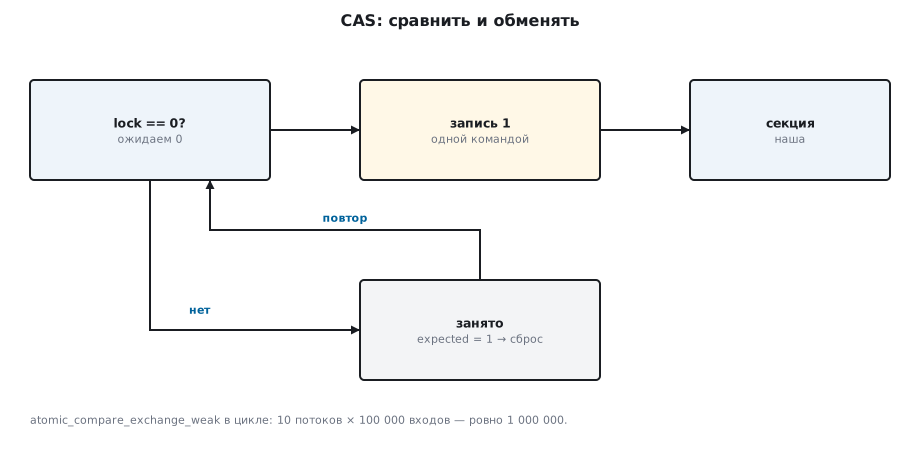
All mutexes, semaphores and lock-free queues rest on one
instruction: compare and swap. atomic_compare_exchange_weak(&v,
&expected, desired) atomically checks whether v equals
expected; if it does, it writes desired and returns true; if
not, it puts the value it found into expected and returns false. The lock:
        int expected = 0;
        while (!atomic_compare_exchange_weak(&lock, &expected, 1))   /* если lock == 0 — ставим 1 */
            expected = 0;                                            /* иначе expected стал 1 — сбросить и повторить */
        lock_count++;                                                /* критическая секция */
        atomic_store(&lock, 0);
CAS-замок: 10 потоков × 100000 = 1000000
Ten threads, a million entries into the critical section, not a single
one lost. weak may return false spuriously (on some
architectures), so it sits in a loop; strong has no spurious failures
but costs more. Reference counters, the lock-free stack and
futex in glibc are built the same way: the fast path is a CAS in user mode, and the kernel is entered
only when the lock is taken.
140.4 Memory order
A single core always shows a program its own accesses in order. But the compiler reorders ordinary memory accesses even on a single-core microcontroller, and other bus masters — DMA and peripherals — may see the writes in a different order: on a Cortex-M7 because of the write buffer and the cache (section 124.6). On a multicore machine the processor itself reorders too: a write made earlier in the code may become visible to another core later. Hence the second parameter of the atomic functions — the memory order:
| Order | What it guarantees |
|---|---|
memory_order_relaxed |
atomicity only; no ordering at all relative to other accesses |
memory_order_release (write) |
everything written before it is visible to a thread that reads it with acquire |
memory_order_acquire (read) |
everything read after it sees the writes made before the paired release |
memory_order_acq_rel |
both (for read-modify-write) |
memory_order_seq_cst |
one total order for all threads; the default |
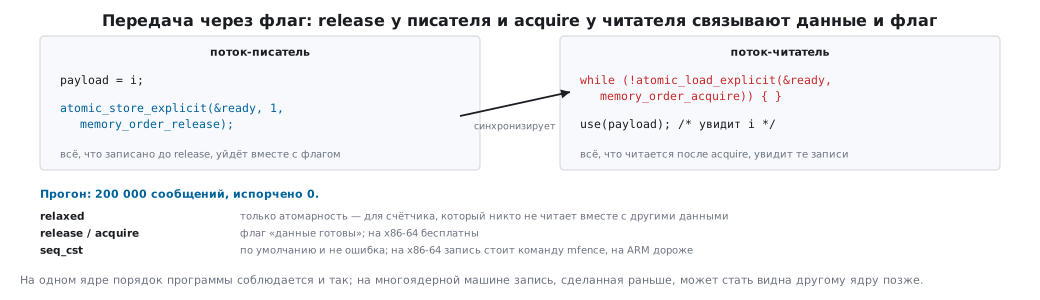
Passing a message through a flag: the writer stores the data, then raises the
flag with release; the reader waits for the flag with acquire and only then reads the
data:
        payload = i;
        atomic_store_explicit(&ready, 1, memory_order_release);                 /* всё до этого видно после acquire */
release/acquire: 200000 сообщений, испорчено 0
A counter that nobody reads together with other data is relaxed:
the cheapest, and sufficient (as in the first experiment). A "data ready" flag is a
release/acquire pair. Everything else is seq_cst: it is the default and
it is not a mistake, only more expensive on ARM and on weak memory models; on x86-64
acquire/release are free, while seq_cst costs an mfence instruction on a
write. A barrier without a variable is atomic_thread_fence(order). In section
124 the same barriers stood before starting DMA: __DMB is
atomic_thread_fence in Cortex-M terms.
140.5 Reentrancy and thread safety
A function is reentrant if it can be called again while the
previous call has not finished — from a signal handler or an
interrupt. A function is thread-safe if several
threads can call it at the same time. These are different properties: malloc is thread-safe
(it has a mutex inside) but not reentrant — a call from a signal handler
in the middle of malloc runs into a locked mutex. Static buffers make functions
non-reentrant: strtok, localtime, getenv in their old form;
their _r variants (strtok_r, localtime_r) get the buffer from the
caller. POSIX lists the functions that may be
unsafe for threads; everything else in the standard library
must be safe.
140.6 OpenMP: a parallel loop with one directive
OpenMP is a set of #pragma omp directives plus a library; the compiler itself
creates the threads and splits the loop between them. The switch is -fopenmp; the version in
the container is _OPENMP 201511 (OpenMP 4.5):
    #pragma omp parallel for reduction(+:r)          /* у каждого потока своя копия r, в конце сложение */
    for (long i = 0; i < TOTAL; i++) r += sqrt((double)i);
последовательно: 46 мс
parallel for reduction: 10 мс, потоков 24, ускорение 4.5, сумма та же: да
без reduction: cnt = 666665 из 4000000
с omp atomic: cnt = 4000000
reduction(+:r) is the key word: without it r is shared, and the threads
create the same race as everywhere else: a counter without reduction, in the worst
of 20 runs, reached 666 665 out of 4 000 000. The race does not show up
every time: if the threads happened to finish their chunks one after another, nothing
is lost — that is why the experiment is repeated. #pragma omp atomic before cnt++ fixes
this at the cost of speed; #pragma omp critical is a section under a mutex.
The number of threads is set by the OMP_NUM_THREADS variable or num_threads(3) in the
directive; omp_get_thread_num and omp_get_num_threads tell who I am and
how many of us there are. With four threads the speedup is 3.9 — as with the hand-made threads
in section 139; with 24 threads on the same task it is only 4.5, even though the experiment's
machine has 24 cores and no hyperthreading. A 46 ms task is small: for 24 threads that means
chunks of 2 ms, and starting the threads, waiting for the slowest one and neighbouring
processes eat a noticeable share. Repeated runs show this: 8 threads
give a speedup of 6.5–7, 24 give 6.4–7.3, while 12 and 16 jump around from 4 to 12 times.
Speedup is measured on a longer task, taking the best of several runs.
OpenMP fits computational loops over arrays — signal processing, matrices, images; a server with connections needs ordinary threads or event descriptors (section 141).
140.7 Pitfalls
| Symptom | Cause |
|---|---|
threads.h not found |
an old glibc (before 2.28) or Windows without C11 threads |
mtx_timedlock returns thrd_error |
the mutex was created with mtx_plain; mtx_timed is needed |
atomic_is_lock_free = 0 on a structure |
the type is larger than a processor word — a hidden lock inside |
| a CAS loop "spins forever" | expected is not reset after a failure |
| the data behind the flag is sometimes stale | relaxed on the flag; a release/acquire pair is needed |
| a function crashes when called from a signal handler | it is thread-safe but not reentrant (malloc, printf) |
| an OpenMP loop computes the wrong result | a shared variable without reduction, private or atomic |
| 24 threads give no more speedup than 8 | the task is small: chunks of 2 ms, the time varies from run to run — measure on a longer task |
140.8 Summary
- C11:
thrd_*,mtx_*,cnd_*,call_once,tss_*— a wrapper overpthread, without attributes, cancellation or rwlock. _Atomic: 800 000 out of 800 000 versus losses without protection;atomic_flagis always lock-free;atomic_is_lock_freechecks a type.- CAS lock: 10 × 100 000 = 1 000 000;
weakgoes in a loop. - Memory order:
relaxedfor counters,release/acquirefor a flag,seq_cstby default. - Reentrancy ≠ thread safety:
mallochas the second, not the first. - OpenMP:
parallel for reduction,atomic,critical; withoutreductionthere is a race.
Full sources
c11_threads.c — C11 threads, mutexes and atomic operations, _Thread_local, a spin lock.
/* Раздел 140: потоки и мьютексы C11 (<threads.h>), атомарные операции (<stdatomic.h>),
   _Thread_local, спин-блокировка на compare-and-exchange, thrd_sleep. */
#include <stdio.h>
#include <stdlib.h>
#include <threads.h>
#include <stdatomic.h>
#include <time.h>

#define N 200000
static atomic_int acnt;
static int plain;
static mtx_t mx;
static int guarded;
static _Thread_local int mine;                       /* своя копия у каждого потока */
static atomic_flag spin = ATOMIC_FLAG_INIT;
static int spin_guarded;

static int worker(void *arg)
{
    for (int i = 0; i < N; i++) {
        atomic_fetch_add_explicit(&acnt, 1, memory_order_relaxed);   /* атомарно */
        plain++;                                                       /* гонка */
        mtx_lock(&mx); guarded++; mtx_unlock(&mx);                     /* мьютекс C11 */
        while (atomic_flag_test_and_set_explicit(&spin, memory_order_acquire)) ;   /* спин */
        spin_guarded++;
        atomic_flag_clear_explicit(&spin, memory_order_release);
        mine++;
    }
    printf("поток %d: _Thread_local mine = %d\n", (int)(long)arg, mine);
    return (int)(long)arg * 10;
}

int main(void)
{
    thrd_t th[4]; int res;
    mtx_init(&mx, mtx_plain);
    for (long k = 0; k < 4; k++)
        if (thrd_create(&th[k], worker, (void *)k) != thrd_success) { puts("thrd_create"); return 1; }
    for (int k = 0; k < 4; k++) { thrd_join(th[k], &res); printf("thrd_join поток %d вернул %d\n", k, res); }
    printf("atomic %d, мьютекс %d, спин %d, без защиты %d (потеряно %d), mine в main %d\n",
           atomic_load(&acnt), guarded, spin_guarded, plain, 4 * N - plain, mine);
    printf("atomic_int lock-free: %d; sizeof mtx_t %zu\n", atomic_is_lock_free(&acnt), sizeof(mtx_t));
    struct timespec t0, t1;
    timespec_get(&t0, TIME_UTC);
    thrd_sleep(&(struct timespec){ .tv_nsec = 200000000 }, NULL);
    timespec_get(&t1, TIME_UTC);
    printf("thrd_sleep 200 мс: прошло %ld мс\n", (t1.tv_sec - t0.tv_sec) * 1000 + (t1.tv_nsec - t0.tv_nsec) / 1000000);
    mtx_destroy(&mx);
    return 0;
}
cas_order.c — a lock on compare-and-exchange and the release/acquire memory order versus relaxed.
/* Раздел 140: compare-and-exchange (CAS) как основа блокировок без ядра, и порядок памяти:
   передача данных через флаг с release/acquire против relaxed. */
#include <stdio.h>
#include <stdatomic.h>
#include <threads.h>

static atomic_int lock;
static int lock_count;

static int locker(void *a)
{
    (void)a;
    for (int i = 0; i < 100000; i++) {
        int expected = 0;
        while (!atomic_compare_exchange_weak(&lock, &expected, 1))   /* если lock == 0 — ставим 1 */
            expected = 0;                                            /* иначе expected стал 1 — сбросить и повторить */
        lock_count++;                                                /* критическая секция */
        atomic_store(&lock, 0);
    }
    return 0;
}

/* Передача сообщения через флаг: писатель кладёт данные, потом поднимает флаг;
   читатель ждёт флага и читает данные. С relaxed порядок не гарантирован. */
static int payload;
static atomic_int ready;
static long bad;

static int writer(void *a) { (void)a; for (int i = 1; i <= 200000; i++) {
        while (atomic_load_explicit(&ready, memory_order_acquire)) ;            /* ждём, пока читатель заберёт */
        payload = i;
        atomic_store_explicit(&ready, 1, memory_order_release);                 /* всё до этого видно после acquire */
    } return 0; }
static int reader(void *a) { (void)a; for (int i = 1; i <= 200000; i++) {
        while (!atomic_load_explicit(&ready, memory_order_acquire)) ;
        if (payload != i) bad++;
        atomic_store_explicit(&ready, 0, memory_order_release);
    } return 0; }

int main(void)
{
    thrd_t t[10];
    for (int k = 0; k < 10; k++) thrd_create(&t[k], locker, NULL);
    for (int k = 0; k < 10; k++) thrd_join(t[k], NULL);
    printf("CAS-замок: 10 потоков × 100000 = %d\n", lock_count);
    thrd_t w, r;
    thrd_create(&w, writer, NULL); thrd_create(&r, reader, NULL);
    thrd_join(w, NULL); thrd_join(r, NULL);
    printf("release/acquire: 200000 сообщений, испорчено %ld\n", bad);
    printf("порядки: relaxed %d, acquire %d, release %d, acq_rel %d, seq_cst %d\n",
           memory_order_relaxed, memory_order_acquire, memory_order_release, memory_order_acq_rel, memory_order_seq_cst);
    return 0;
}
Next: section 141 — non-blocking I/O and epoll.