 Embedded HandbookApps
121а. OpenMV: a machine-vision camera on STM32H7 — DCMI, MicroPython and object search
Sections 116–121 worked with numbers from sensors: vibration, current, voltage. A camera gives a different volume: one 320×240 colour frame is 153600 bytes, more than the entire on-chip SRAM of many STM32 parts. Section 22б showed how DCMI and DMA put a frame into memory. Here is a ready-made open system that goes further: it receives the frame, searches it for colour blobs, AprilTag markers and QR codes, and runs a neural network, all controlled by a MicroPython script. This is the OpenMV project.
This section takes apart its sources: which boards and chips, how the frame travels
from the sensor to the buffer, how many frames fit in memory, how colour
is converted to LAB and how find_blobs finds blobs. The blob search function
was built on a PC from the project sources and run on a synthetic frame
with known answers.
References: the OpenMV sources (github.com/openmv/openmv,
commit 62369938a94b). License: MIT — the line
SPDX-License-Identifier: MIT in the imlib headers (blob.c,
framebuffer.c; the lab_tab.c table is generated by the MIT script
tools/gen_rgb2lab.py), stm_dma.c and py_image.c. But not everywhere. The camera layer (common/omv_csi.c,
ports/stm32/omv_csi.c, modules/py_csi_ng.c), the neural network module
modules/py_ml.c and the boot/ bootloader are under a different license: you may copy
them, but "solely for personal benefit and not for any commercial purpose";
commercial use needs a separate agreement with OpenMV. The barcode decoder
lib/imlib/zbar.c is LGPL 2.1, the ST library in cubeai/AI is under the ST license
SLA0044. The DCMI registers and splitting the frame into
parts for DMA are in section 22б, the H7 cache and memory domains in section 11б,
quantization and TensorFlow Lite Micro in section 119.
What it is called in the documentation
Original Meaning machine vision a program finding objects in a frame frame buffer memory holding one frame line buffer buffer for one or two lines of the frame MDMA (master DMA) the H7 D1-domain DMA: copies blocks between memories UMA pool the OpenMV memory pool that frames and models are taken from blob a connected area of pixels that passed the threshold threshold six bounds on L, A, B CIELAB (L*a*b*) colour space: lightness L and two colour axes A and B flood fill walking a connected area roundness, elongation how round or stretched a blob is AprilTag a square coded marker for finding the camera pose
121а.1 Boards and chips
Each board in OpenMV is a directory boards/<name> with two files:
board_config.mk (chip, clock, which modules to build) and
board_config.h (pins, memory, sensors). From them:
| Directory | Chip | Clock | UMA pool | Where the pool is |
|---|---|---|---|---|
| OPENMV2 | STM32F427 | 192 MHz | 160 KB | SRAM |
| OPENMV3 | STM32F765 | 216 MHz | 383 KB | SRAM |
| OPENMV4 (H7) | STM32H743 | 480 MHz | 480 KB | SRAM at 0x2400 0000 |
| OPENMV4P (H7 Plus) | STM32H743 | 480 MHz | 27 MB | 32 MB SDRAM at 0xC000 0000 |
| ARDUINO_NICLA_VISION | STM32H747 | 400 MHz | 476 KB | SRAM |
| ARDUINO_PORTENTA_H7 | STM32H747 | 400 MHz | 4 MB | SDRAM |
| OPENMV_RT1060 | MIMXRT1062 | 600 MHz | 23 MB | SDRAM |
| OPENMV_N6 | STM32N657 | 800 MHz | 31 MB | external memory |
From here on we talk about OPENMV4 — the STM32H743. Its Flash is 2 MB: 128 KB is taken by the bootloader, 128 KB by the file system, 1664 KB is left for the firmware, and the last 128 KB hold the ROMFS image. The stack is 64 KB in ITCM. Frames, neural network models and temporary arrays live in the UMA pool: 480 KB of the 512 KB of SRAM at 0x2400 0000.
There are 20 driver files in drivers/sensors; OPENMV4 includes
ten: OV2640, OV5640, OV7725, MT9V0xx, OV9650, MT9M114, the Lepton thermal
camera, PAG7920, PAJ6100 and FrogEye2020. The XCLK clock for the sensor comes from
timer TIM1 on pin PA8: 12 MHz on H7, 6 MHz on OPENMV2, 9 MHz on OPENMV3
(OMV_CSI_CLK_FREQUENCY).
The hardware JPEG codec is present in the H7 and N6 builds
(OMV_JPEG_CODEC_ENABLE (1)), F4 and F7 do not have it.
The user program is a MicroPython script. A frame is one line,
blob search is one more (example from
scripts/examples/02-Image-Processing/02-Color-Tracking/single_color_rgb565_blob_tracking.py,
MIT):
thresholds = [
    (30, 100, 15, 127, 15, 127),  # generic_red_thresholds
    (30, 100, -64, -8, -32, 32),  # generic_green_thresholds
    (0, 30, 0, 64, -128, 0),  # generic_blue_thresholds
]
A threshold is six numbers: the bounds of L, A and B. Under Python runs the imlib
library in C: the script calls img.find_blobs(...), and the work is done by the function
imlib_find_blobs from lib/imlib/blob.c.
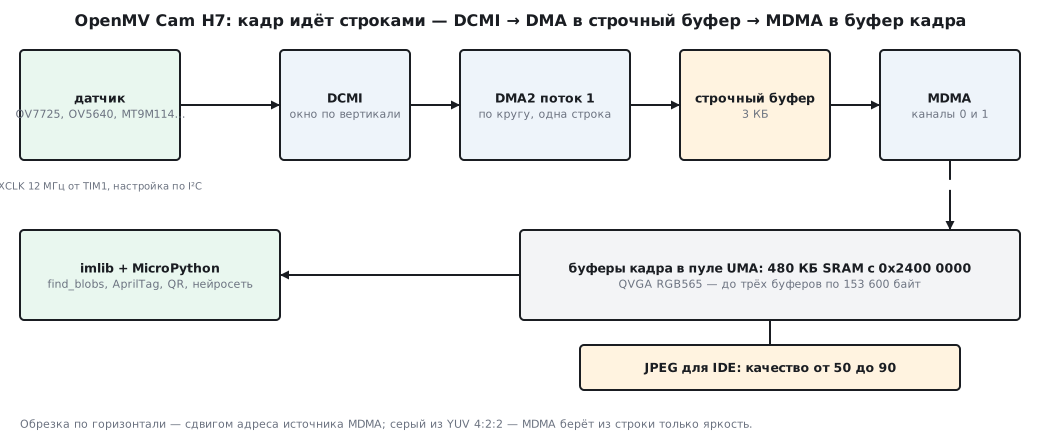
121а.2 The frame path: DCMI, a line and MDMA
Section 22б drove DMA over the whole frame, in parts of up to 65535 words. OpenMV on H7
does it differently: DMA receives one line in circular mode, and a second controller —
MDMA — lays the lines out into the frame. The camera driver for STM32
(ports/stm32/omv_csi.c) enables circular mode on the DMA stream, starts
DCMI in continuous capture and gives DMA a length of exactly one line, in
words, with the address of the line buffer. DMA writes the line, reaches the end of the
buffer and starts again from the beginning — in that time MDMA must take the finished
line.
The DMA stream is DMA2_Stream1, the DCMI request. The line buffer is defined in
boards/OPENMV4/board_config.h:
#define OMV_LINE_BUF_SIZE (3 * 1024) // Image line buffer round(640 * 2BPP * 2 buffers).
A check before starting requires the line to be no longer than half the
buffer: 1536 bytes, that is 768 RGB565 pixels. A VGA line is 1280 bytes,
it fits. On the transfer-complete interrupt the handler starts MDMA: channels 0 and 1
are reserved for MDMA (OMV_MDMA_CHANNEL_DCMI_0, _1), and on AXI
MDMA has the highest priority, 15, for reads and writes.
What this gives:
- Horizontal cropping without DCMI. The vertical window is set by DCMI
(
HAL_DCMI_ConfigCrop, section 22б), and the horizontal one by the MDMA source address: the copy starts from the needed pixel of the line. DCMI only cuts lines, the extra pixels on the left and right are dropped by the copy. - Grayscale from a colour sensor. Many sensors output grayscale as YUV 4:2:2 — two bytes per pixel. On H7, MDMA takes only the luma bytes from the line; 2 bytes still travel over the DCMI bus. On N6 DCMI itself does the same by byte decimation (the BSM field, section 22б).
- Frame rotation. In transpose mode a line goes into the frame as a column — by copying with a stride.
The data rate on the DCMI bus is computed as in section 22б: 8 bits per PIXCLK cycle, 2 bytes per pixel. The PIXCLK frequency is set by the sensor configuration; for the board only XCLK of 12 MHz is known; here is what an example at 24 and 48 MHz gives:
| PIXCLK | QVGA RGB565, frame data | VGA RGB565, frame data |
|---|---|---|
| 24 MHz | 6.4 ms — at most 156 frames/s | 25.6 ms — at most 39 frames/s |
| 48 MHz | 3.2 ms — at most 312 frames/s | 12.8 ms — at most 78 frames/s |
This is the upper bound without line and frame blanking and without processing: the real frame rate is lower.
121а.3 Frame buffers and JPEG for the IDE
Frame size:
| Frame | RGB565 | Grayscale | Buffer in the pool |
|---|---|---|---|
| QQVGA 160×120 | 38400 bytes | 19200 bytes | 38432 bytes |
| QVGA 320×240 | 153600 bytes | 76800 bytes | 153632 bytes |
| VGA 640×480 | 614400 bytes | 307200 bytes | 614432 bytes |
A buffer in the pool is larger than the frame by the vbuffer_t header — offset and flags,
with the data starting on a cache line boundary: 32 bytes, and the alignment is also 32
(lib/imlib/framebuffer.h). Buffers move between two queues: free and
filled. The number of buffers is chosen by the function omv_csi_set_framebuffers
in common/omv_csi.c: if the script has not set the number, it asks
framebuffer_resize for three buffers, on failure for two, then one; if
even one does not work — an error.
It computes the frame size as window width × height × 2 — two bytes per
pixel for any format. framebuffer_resize adds two queues
of 28 bytes for three buffers (24 for two, 20 for one). How many buffers
fit in the pool if it is empty:
| Board | Pool | QVGA buffers | VGA buffers |
|---|---|---|---|
| OPENMV2 | 163840 bytes | 1 | 0 |
| OPENMV3 | 392192 bytes | 2 | 0 |
| OPENMV4 (H7) | 491520 bytes | 3 | 0 |
| ARDUINO_NICLA_VISION | 487424 bytes | 3 | 0 |
| OPENMV4P (H7 Plus) | 28311552 bytes | 3 | 3 |
Three QVGA buffers are 460952 bytes out of 491520 on H7. VGA at 16 bits needs 614472 bytes for one buffer — impossible on H7; on H7 Plus three fit in SDRAM (section 41б).
Three buffers mean triple buffering: DMA writes into one, the program reads
another, the third holds the last finished frame. When only one free buffer
is left, framebuffer_release with three buffers swaps the old
finished frame for the new one, and with two it does not hand out the new frame: the next one is written into the same buffer.
Preview in the IDE. The frame goes to OpenMV IDE over USB compressed as JPEG
(lib/imlib/framebuffer.c). The quality adapts: the initial value is
the middle between 50 and 90, that is 70. If the compressed frame did not fit into the transmit
buffer, the quality is halved, the frame is skipped, and for the next 60
frames the quality does not grow: 70 → 35 → 17 → 8 → 4 on overflows in a row.
Without overflows it grows by 1 per frame up to a ceiling: 90 for frames up to
153600 bytes inclusive (QVGA RGB565 is exactly that much) and 50 for
larger ones. The ceiling only stops the growth: for VGA RGB565 the quality will not rise
above 50, but it does not lower the starting 70 by itself — only
an overflow does.
121а.4 Colour: RGB565 to LAB by a table
A colour threshold in RGB copes badly with lighting: a shadow changes all three channels. In LAB the lightness is a separate axis L (0…100), and the colour is on the axes A (green — red) and B (blue — yellow). That is why OpenMV thresholds are in LAB.
Computing LAB for every pixel is expensive: a power of 2.4 and a cube root. imlib
takes ready values from the lab_table table in lib/imlib/lab_tab.c, three
bytes L, A, B per entry. There are not 65536 entries but 32768 — the index is pixel >> 1,
the lowest bit of blue is dropped:
#define COLOR_RGB565_TO_L(pixel) lab_table[((pixel >> 1) * 3) + 0]
The table takes 98304 bytes instead of 196608. The generator is in the project —
tools/gen_rgb2lab.py: it converts each of the 65536 pixels with the
sRGB and CIELAB formulas (D65 white point), rounds and averages neighbouring pairs.
Running the generator on a PC:
- the table matched
lab_tab.cin all 98304 bytes, the linearization tablexyz_tablein all 256 numbers; - the difference between the table and the exact formula for an individual pixel is up to 1 in L, up to 3 in A and in B; 1761 pixels out of 65536 match exactly;
- values in the table: L from 0 to 100, A from −86 to 97, B from −106 to 94.
The colours of the test frame from this table:
| Colour, RGB | L | A | B |
|---|---|---|---|
| red 200, 30, 30 | 44 | 65 | 51 |
| green 30, 170, 40 | 61 | −60 | 54 |
| blue 20, 40, 170 | 25 | 42 | −69 |
| gray 128, 128, 128 | 55 | 2 | −3 |
The red passes the example's "generic red" threshold (L 30…100, A and B from 15), the blue passes "generic blue" (L up to 30, A 0…64, B up to 0). But the green does not: its B = 54, and the "generic green" threshold limits B to 32. This green with a yellow tint will not be found in the run below.
121а.5 find_blobs: flood fill by lines
imlib_find_blobs walks the frame line by line with a step of x_stride in X (by
default 2) and y_stride in Y (1). A pixel that passed the threshold and is not yet
taken becomes the start of a blob, and the blob is filled line by line: the
segment is extended left and right while the pixels pass the threshold, they are marked in a
frame-sized bitmap, and a continuation is searched for in the line above and below. Instead of
recursion — a LIFO stack of xylr_t records (six 16-bit numbers, 12
bytes); for the stack lifo_alloc_all takes everything that is free in the UMA pool.
During the fill each segment adds its pixel count and the sums of
X, Y, X², X·Y and Y² to the blob — from these moments come the centre,
the rotation angle and the roundness without a second pass. Then blobs with fewer than
pixels_threshold pixels or less than area_threshold bounding-box area are dropped
(by default both are 10), and with merge=True overlapping boxes
are merged; margin expands the box before the check.
The run. The files blob.c, collections.c, fmath.c, lab_tab.c,
sincos_tab.c and three functions from imlib.c were built with gcc on a PC with stubs for
MicroPython and the UMA pool. A QVGA RGB565 frame: a gray background with ±12 noise in each
channel, rectangles 60×40 (red), 50×80 (green), 70×30 (blue),
a red 60×10 strip 4 lines below the red rectangle, a red
circle of radius 20 with 1257 pixels and 40 single red pixels.
| Run | Blobs | What was found |
|---|---|---|
| red, default | 3 | rectangle 2400 pixels, centre 49.50; 49.50; strip 600, centre 49.50; 78.50; circle 1257, centre 250.00; 180.00 |
red, merge=True, margin=4 |
3 | the same: the 4-line gap is not closed |
red, merge=True, margin=5 |
2 | rectangle and strip merged: box 60×54, 3000 pixels, centre Y 55.30 |
| red, step 2, threshold 1 pixel | 22 | three blobs and 19 single pixels out of 40 |
| red, step 1, threshold 1 pixel | 43 | three blobs and all 40 single pixels |
| green, example threshold | 0 | — |
| green, B up to 64 | 1 | 4000 pixels, centre 164.50; 139.50, angle 90.0° |
| blue, example threshold | 1 | 2100 pixels, centre 264.50; 34.50 |
Areas and centres matched the constructed ones exactly: 60 × 40 = 2400, 70 × 30 = 2100, the centre of the 60×40 rectangle with its corner at 20, 30 is 49.5; 49.5. The merged blob has a weighted centre: (2400 · 49.5 + 600 · 78.5) / 3000 = 55.3. The roundness of the circle is 1.000, of the 60×40 rectangle 0.445, of the 60×10 strip 0.028. No memory leaks: all pool blocks are freed.
With the default threshold (10 pixels) all single pixels are dropped — this is how noise is filtered. With step 2 the function does not see 21 pixels out of 40 at all: the start of a blob is searched for only at every second pixel of a line.
Other searches in imlib. find_apriltags is a wrapper around the
AprilTag 3.4.5 library (the lib/apriltag submodule); on H7 the
TAG36H11 family is enabled. find_qrcodes is the quirc decoder (MIT), embedded in
lib/imlib/qrcode.c. Haar cascades (lib/imlib/haar.c, face and
eye cascades in lib/haar) compute the integral image not over the whole frame
but in a sliding window of lines (imlib_integral_mw_*) — the memory needed is for
the window, not for the frame.
121а.6 Neural networks: TensorFlow Lite Micro and ST Edge AI
The ml module (modules/py_ml.c) loads a .tflite model into the UMA pool —
into fast memory and for good, until the model is unloaded — and runs it through the
build's engine: on OPENMV4, OPENMV4P, Nicla Vision and Portenta it is TensorFlow
Lite Micro (MICROPY_PY_ML_TFLM = 1), on N6 it is ST Edge AI for the
neural accelerator (MICROPY_PY_ML_STAI = 1). The input scale and zero point
are taken from the model itself, and the input is quantized by the formula of section 119:
the value is divided by the scale (in the code it is multiplied by the precomputed
reciprocal), the zero point is added, and the result
is written as int8. The output is converted back: (q − zero_point) · scale.
Ready models in lib/models and their sizes:
| Model | Bytes | What it does |
|---|---|---|
fomo_face_detection.tflite |
57040 | faces: labels background, face |
person_detect.tflite |
300568 | is there a person or not: no_person, person |
yolov8n_192.tflite |
3228400 | YOLOv8n, label person |
person_detect is 300568 bytes; together with three QVGA buffers (460952)
this is more than the H7 pool of 491520 bytes, so the model and the frames have to
share memory: fewer buffers, a smaller frame. YOLOv8n at 3.2 MB does not fit
into the H7 pool at all — that is a job for H7 Plus with SDRAM or N6.
The cubeai/ directory is a build variant with STM32Cube.AI models for H7 and
H7 Plus: the wrappers nn_st.c, py_st_nn.c are under MIT, and the library in
cubeai/AI is under the ST license SLA0044.
Building the firmware. For this section the submodules were not fetched:
lib/micropython, lib/tflm/libtflm, lib/apriltag, lib/tinyusb,
modules/ulab are empty (git submodule status shows them with "−"). Without
MicroPython the firmware does not build — so the firmware
size is not given here. Only a test file of the frame buffer
structures was built for ARM: sizeof(vbuffer_t) = 32 and the queue sizes
28/24/20 bytes are confirmed by _Static_assert in arm-none-eabi-gcc for
Cortex-M7.
121а.7 Pitfalls
- The threshold drifts with auto gain. Auto gain and auto white
balance shift L, A and B from frame to frame. The OpenMV example turns both off
before a colour search:
auto_gain(False)andauto_whitebal(False)with the note "must be turned off for color tracking". - A "generic" threshold does not catch your colour. Green 30, 170, 40 has B = 54, the example threshold is B up to 32: zero blobs. Tune the threshold for your object and lighting — the IDE has a threshold editor.
- Merging does not work when the gap equals the margin. The boxes are compared
strictly: with a 4-line gap
margin=4leaves two blobs, you need 5. - Step 2 loses small things. With
x_stride=2, 19 of 40 single pixels were found. For thin lines and small objects usex_stride=1. - Thresholds near the table's limits. The LAB table is off for individual pixels by up to 3 units in A and B: if the threshold bound is closer than 3 units to the object's colour, the blob will "flicker".
- A grayscale frame takes as much space as a colour one.
omv_csi_set_framebuffersreserves 2 bytes per pixel for any format: a grayscale VGA frame on H7 does not fit in the pool, just like a colour one. - The model and the frames share one pool.
person_detectat 300568 bytes and three QVGA buffers do not fit together in the 480 KB of H7. - The picture in the IDE is worse than the frame. The preview is JPEG; after overflows the quality drops to single digits; processing works on the uncompressed frame. Do not judge a threshold by the IDE picture under heavy compression.
- The H7 cache. Frame buffers are in cacheable SRAM;
framebuffer_acquirewith theFB_FLAG_INVALIDATEflag invalidates the cache lines withSCB_InvalidateDCache_by_Addr— without it the CPU reads a stale frame (section 11б). - The licenses differ. imlib is MIT, but the camera driver (
omv_csi.c) and themlmodule are for non-commercial use only,zbar.c(barcodes) is LGPL 2.1, the Cube.AI library is SLA0044. For a device for sale you can freely take imlib from OpenMV, and write the frame capture yourself (section 22б) or make an agreement with OpenMV.
121а.8 Summary
- OpenMV is an open machine vision system: OPENMV4 on the STM32H743
at 480 MHz, H7 Plus with 32 MB SDRAM, Arduino boards on H747, N6 on the STM32N657;
imlib is MIT, the camera driver and the
mlmodule are under a non-commercial license, zbar is LGPL, Cube.AI is SLA0044. - The frame goes by lines: DMA2 stream 1 in circular mode into a 3 KB line buffer, MDMA on channels 0 and 1 into the frame buffer; a line is no longer than 1536 bytes.
- QVGA RGB565 is 153600 bytes; the H7 with a 480 KB pool holds three buffers (460952 bytes), VGA RGB565 not a single one, H7 Plus three.
- JPEG for the IDE: quality 70 at the start, growth up to 90 for frames up to 153600 bytes and up to 50 for larger ones, on overflow — halved and 60 frames without growth.
- LAB by a table of 98304 bytes for 32768 entries; the project's generator reproduces it byte for byte, the error against the exact formula is up to 3 units.
find_blobson a synthetic frame: areas 2400, 1257, 2100 and centres matched exactly;margin=5merges blobs across a 4-line gap;x_stride=2finds 19 single pixels out of 40.- int8 models:
person_detect300568 bytes through TensorFlow Lite Micro; the firmware cannot be built without the submodules — its size is not given.
Next: section 121б "Audio on a microcontroller: from a PDM microphone to MFCC and command recognition" — the path from a PDM bit to a command: CIC and FIR, MFCC in integers, an int8 network and a decision on the stream.