 Embedded HandbookApps
206а. EAEU certification step by step: regulations, declaration or certificate, scheme, EAC
Section 206 deliberately did without regulation numbers: it is about what is tested in electronics and why a ready-made radio module pays off. Here is the same path for one market, the Eurasian Economic Union (EAEU: Russia, Belarus, Kazakhstan, Armenia, Kyrgyzstan), based on the texts of the regulations themselves: which regulation applies to a microcontroller device, when a declaration is enough, which scheme to choose, how long the document lives and when the EAC mark may be put on the enclosure.
All quotations are from the official texts of TR CU 004/2011 and TR CU 020/2011 (technical regulations of the Customs Union) on the website of the Eurasian Economic Commission (EEC; 2011 edition) and EEC Council Decision No. 44 on standard schemes. Since 11 December 2022 both regulations have been amended: used products and products covered by other regulations have been excluded from their scope (EEC news of 9 December 2022). Before submitting documents, check the current edition and the lists of standards on the EEC website — and with the certification body: it will confirm both the regulations and the scheme for your product.
Terms used in the documentation
Term Meaning technical regulation of the Customs Union (TR CU) mandatory requirements for products in the EAEU conformity assessment permission to sell: a declaration or a certificate declaration of conformity the manufacturer states conformity itself; the declaration is registered certification conformity is confirmed by a certification body scheme (1д, 3д, 1с…) a set of steps: who tests, what is monitored; labels are Cyrillic, д= declaration,с= certificationaccredited testing laboratory a laboratory from the Unified Register whose test reports are accepted single mark of circulation (EAC) the mark on a product: it complies with all regulations that apply to it production control the manufacturer makes sure the series matches the tested sample
206а.1 Which regulations apply to a microcontroller device
For electronics, three regulations come up most often:
| Regulation | What it covers | When it applies to an MCU device |
|---|---|---|
| TR CU 020/2011 "Electromagnetic compatibility of technical equipment" | the interference the device emits and its immunity to that of others | almost always, if the device is sold for stand-alone use |
| TR CU 004/2011 "On the safety of low-voltage equipment" | electrical safety | only at a rated voltage from 50 to 1000 V AC or from 75 to 1500 V DC |
| TR EAEU 037/2016 "On the restriction of the use of hazardous substances…" | lead, mercury, cadmium and some other substances in the product | electrical and radio-electronic products from its list |
Hence three typical cases:
| Device | TR CU 004 | TR CU 020 |
|---|---|---|
| sensor on a 3 V battery | no: below 50 V AC and 75 V DC | yes |
| 12 V device with an external power supply | no — for the device itself; the 230 V power supply — yes, it has its own documents | yes |
| device with a 230 V mains supply inside (section 208) | yes | yes |
A ready-made power supply with its documents is the shortest path: the device stays low-voltage, and mains electrical safety has been confirmed by the power supply manufacturer.
206а.2 What the regulation does not cover
TR CU 020/2011, Article 1, does not apply to technical equipment that is:
- used by manufacturers of other technical equipment as components and not intended for stand-alone use;
- passive with respect to electromagnetic compatibility;
- not included in the Unified List of products for which mandatory requirements are established.
The first item matters to a developer. A board or a module sold to other manufacturers for integration is a component: the documents are prepared by whoever releases the finished product. The same module in a box with a power supply for the end buyer is already a stand-alone product.
206а.3 Declaration or certificate
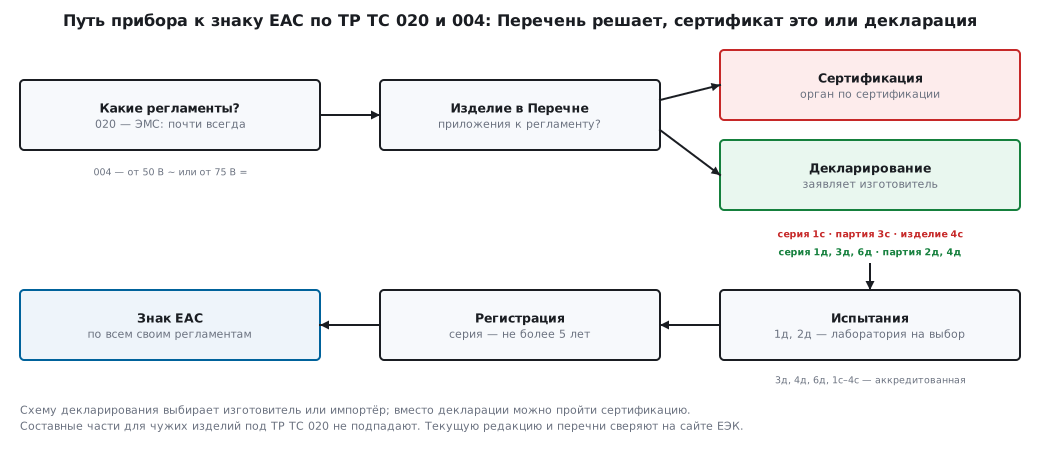
Both regulations are built the same way (TR CU 004, Article 7, clause 2; TR CU 020, Article 7, clause 2):
- the product is in the List in the annex to the regulation (for TR CU 020, Annex 3) — certification, schemes 1с, 3с, 4с;
- the product is not in the List — declaration, schemes 1д, 2д, 3д, 4д, 6д; the scheme is chosen by the manufacturer or the importer;
- at the manufacturer's choice, certification may be done instead of a declaration.
206а.4 Schemes: who does the testing
According to TR CU 020/2011, Article 7, clause 6, and EEC Council Decision No. 44:
| Scheme | For what | Testing | What else |
|---|---|---|---|
| 1д | serial products | a laboratory chosen by the manufacturer | production control |
| 2д | a batch or a single item | a laboratory chosen by the manufacturer or importer | — |
| 3д | serial products | an accredited laboratory | production control |
| 4д | a batch or a single item | an accredited laboratory | — |
| 6д | serial products | an accredited laboratory | a certified quality management system |
| 1с | serial products | an accredited laboratory, the decision by a certification body | production assessment, surveillance |
| 3с / 4с | a batch / a single item | an accredited laboratory | — |
For a small series of microcontroller devices the usual choice is 1д or 3д. The difference is the laboratory: under 1д the test report may come from any testing laboratory chosen by the manufacturer, under 3д only from an accredited one from the Unified Register. Which scheme your buyer or the marketplace selling the device will accept should be clarified before testing: redoing the test report costs more than asking.
206а.5 What to collect: the set of documents
TR CU 020/2011, Article 7, clause 7.1.1: for a declaration under schemes 1д and 2д the manufacturer prepares a set that includes:
- technical specifications (if any);
- user documentation;
- a list of standards from the List to the regulation whose requirements the product meets;
- test reports from a testing laboratory chosen by the manufacturer;
- a certificate of conformity and the manufacturer's declaration (if any);
- for a batch — the supply contract or shipping documents.
The user documentation and technical specifications are what is described in section 205: the operating manual, the passport, designations, revisions. Under scheme 1д the manufacturer also runs production control: the series must match the tested sample (206.6 — which changes require repeat testing).
206а.6 Validity, registration, the EAC mark
Validity. A certificate or declaration for serial products is valid for no more than 5 years; for a batch or a single item no validity period is set (TR CU 004 and TR CU 020, Article 7). A declaration is valid from the day it is registered.
The mark. The single mark of circulation EAC is applied before the product is placed on the market (TR CU 020, Article 8). It is applied to every product so that the mark stays legible for the whole service life; if it cannot be applied to the product, it goes on the packaging and in the user documentation (TR CU 004, Article 8). And the main condition: the mark is applied when the product meets the requirements of all the regulations that apply to it. An EMC declaration for a 230 V device whose electrical safety has not been confirmed does not give the right to the EAC mark.
206а.7 Pitfalls
- Taking regulation numbers from old memory. Since 11 December 2022 the scope of both regulations has changed; the lists of standards are updated. Check the current edition on the EEC website.
- Treating a module for integration as a stand-alone product — or the other way round. A component for other manufacturers' products does not fall under TR CU 020; the same module in a box for a buyer does.
- Forgetting the power supply. A 12 V device is low-voltage, but a power supply from 230 V is not; it must have its own documents.
- Applying EAC under one regulation out of two. The mark is allowed only when the product complies with all regulations that apply to it.
- Changing the device design after testing. Production control under schemes 1д and 3д is an obligation to keep the series the way the tested sample was.
- Confusing the validity for a series and for a batch. A series — up to 5 years, then the document is issued again; a batch — no time limit, but only for that batch.
206а.8 Summary
- An MCU device almost always needs TR CU 020/2011 (EMC); TR CU 004/2011 — only from 50 V AC or 75 V DC, that is, for a device powered from the mains.
- Components for other manufacturers' products do not fall under TR CU 020.
- A product from the List in the annex — certification (1с, 3с, 4с), anything else — a declaration (1д, 2д, 3д, 4д, 6д) chosen by the manufacturer.
- For a small series — 1д or 3д; under 3д an accredited laboratory does the testing.
- The set: technical specifications, user documentation, the list of standards, test reports.
- A series — no more than 5 years, a batch — no time limit; EAC only when the product complies with all regulations that apply to it.
Next: section 207 "The assembly workbench: static, SMD soldering, cleaning".