 Embedded HandbookApps
76м. Union-find: connectivity of network nodes and labelling regions in a binary image
Sometimes what is needed from a graph is not a path, as in 76л, but a single answer: are two nodes connected at all. Has any route at all reached node 8 from node 0? How many separate blobs are there in a frame from an image sensor? For this there is the "union-find" structure: it keeps a partition of nodes into groups, merges two groups in a few steps and answers whether two nodes are in the same group. The whole thing is one byte array, and with path compression its operations hardly depend on the number of nodes.
Basis: alg.c with union-find and two-pass region labelling
built with gcc 12.2.0 on the computer (stm-sys:1) — a network of 16 nodes with
links appearing one by one, a worst-case chain of 200 nodes with search with
and without compression, labelling of a 32 × 24 frame. The number and areas of the regions
are recomputed in Python by breadth-first search. The same file built with
arm-none-eabi-gcc 12.2.1 (stm-arm:1) at -O2 for Cortex-M4F and Cortex-M0 —
sizes and frames. Work is expressed as the number of steps along links, not cycles.
Terms used in the documentation
Original Meaning union-find, disjoint-set forest union-find, a forest of disjoint sets find, union find the representative of a group; merge two groups path compression, path halving path compression; halving the path on every search union by size union by size: the smaller tree goes under the larger connected components connected components: groups of nodes linked with each other connected-component labelling labelling the connected regions of an image 4-connectivity, 8-connectivity neighbours by sides; by sides and corners provisional label, equivalence a provisional label; equivalence of labels of one region In plain words. Each node has a "boss", and the top boss of a group is his own boss. To find out the group, you walk up the bosses to the very top. To merge two groups, it is enough for one top boss to start reporting to the other. And so that the chains do not grow, on the way up everyone met is reassigned closer to the top boss — next time the path will be shorter.
76м.1 The structure: an array of parents
Each node stores its parent's number; a root is its own parent. A group is a tree, its representative is the root. For 256 nodes bytes are enough:
typedef struct {
    uint8_t parent[UF_MAX]; /* корень множества указывает сам на себя */
    uint8_t size[UF_MAX];   /* размер множества — только у корня */
    uint16_t sets;
} uf_t;
That is 512 bytes for 256 nodes — and no pointers, lists or malloc.
The sets counter is how many groups there are now.
76м.2 Find with path compression
Finding the root means climbing through the parents. Without tricks a tree can degenerate into a chain, and a search becomes a scan. Path compression makes every search useful for the following ones: on the way up each node is rehung on its grandparent. The path is halved, and all of it — without recursion (76и), in one loop:
unsigned uf_find(uf_t *u, unsigned x)
{
    while (u->parent[x] != x) {
        STEP_HOOK();
        u->parent[x] = u->parent[u->parent[x]];
        x = u->parent[x];
    }
    return x;
}
A run on the worst case — a chain of 200 nodes where each hangs on the next:
| Search from the end of the chain | 1st time | 2nd time | 10th time |
|---|---|---|---|
| without compression | 199 steps | 199 steps | 199 steps |
| with halving | 100 steps | 50 steps | 1 step |
Without compression every search is 199 steps. With compression the first search is 100, the second
50, by the tenth — one step: the tree has become almost flat. On M4 uf_find is
24 bytes and 12 instructions.
76м.3 Union by size
The second defence against long chains is to hang the smaller tree under the larger on a merge. Then the depth of any tree is at most log₂ n, even without compression, and together with compression the operations take a few steps in practice for any n:
a = uf_find(u, a);
b = uf_find(u, b);
if (a == b)
    return false;
if (u->size[a] < u->size[b]) {
    unsigned t = a;
    a = b;
    b = t;
}
u->parent[b] = (uint8_t)a;
uf_union returns false if the nodes were already in one group: the new
edge connected nothing, it closes a cycle. That is a useful answer in
itself — see 76м.4.
The size in a byte saturates at 255; for a tree of 256 nodes this is enough to choose correctly which goes under which — the exact size of large groups does not need to be compared.
76м.4 Connectivity of network nodes
Mesh network nodes report their neighbours, and links appear one by one.
The run: 16 nodes, 15 links. After all links 2 groups remained: nodes 0 and
7 are connected, 0 and 8 are not, 8 and 14 are connected. One link out of 15 — between 0 and 2 —
turned out redundant: uf_union returned false because 0 and 2 were already
connected through 1 and 3.
What this is used for:
| Question | The structure's answer |
|---|---|
| will a packet get from A to B by any path at all | uf_find(A) == uf_find(B) |
| how many separate islands the network has | sets |
| which links can be switched off without losing connectivity | those on which uf_union returned false |
| a cycle-free tree of links for broadcasting | take links from best to worst and keep those uf_union accepted (Kruskal's algorithm) |
A limitation: union-find can only merge. If a link disappears, a group cannot be split — the structure is rebuilt from the current list of links. For 16 nodes that is 16 initialisations and one union per link.
76м.5 Labelling regions in a binary image
A frame from an image sensor after thresholding is pixels "on" and "off". The task is to number the connected blobs: count the objects, find their areas and centres. The flood fill from 76и does this, but needs a stack. Union-find gives an algorithm in two passes with memory known in advance.
The first pass goes row by row. A pixel looks at its neighbours above and to the left: no labelled neighbours — a new provisional label; there are — take the neighbour's label; and if the labels above and to the left differ, it is one region, and the labels are united:
unsigned up = y ? lab[y - 1][x] : 0, left = x ? lab[y][x - 1] : 0;
if (!up && !left) {
    if (next == UF_MAX)
        return -1;
    lab[y][x] = (uint8_t)next++; /* новая временная метка */
} else {
    lab[y][x] = (uint8_t)(up ? up : left);
    if (up && left && up != left)
        uf_union(u, up, left); /* две метки оказались одной областью */
}
The second pass replaces every provisional label with the label of its group's root and renumbers the roots consecutively.
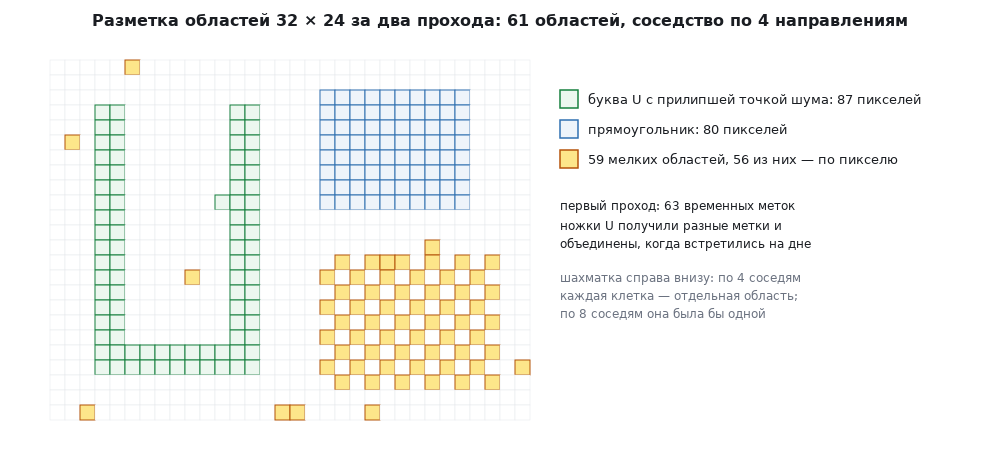
A run on a frame with the letter U, a rectangle, a checkerboard and twelve noise pixels: 231 pixels, 63 provisional labels, 61 regions. The legs of the letter U got different labels — they are not connected at the top — and merged when the first pass reached its bottom. There are two large regions — 87 and 80 pixels — and 56 single-pixel regions. The number and areas of the regions agreed with an independent breadth-first search in Python. All the finds of both passes took 52 steps along links.
76м.6 4 or 8 neighbours
The checkerboard at the bottom right is 54 pixels touching each other only at the corners. With 4 neighbours each of them is a separate region, hence most of the 56 single ones. With 8 neighbours — when the neighbours above-left and above-right are also checked — the checkerboard would become one region. Which connectivity is right is decided by the task: for counting parts on a conveyor it is usually 8, for separating objects that touch at corners — 4. In the code the difference is two additional neighbours in the first pass.
76м.7 Memory and code
| What | M4 | M0 |
|---|---|---|
uf_find, code bytes |
24 | 24 |
uf_union, code bytes |
120 | 132 |
label_regions, code bytes |
298 | 356 |
label_regions, stack frame |
312 | 312 |
RAM: the labels of a 32 × 24 frame take 768 bytes, the parents and sizes 512. The
label_regions frame is 312 bytes: it holds the renumbering table for 256 labels.
There are at most 255 provisional labels — byte numbers; if labels run out,
the function returns −1 instead of writing past the end. For larger frames the labels
are made uint16_t, and the frame is processed in strips.
76м.8 Union-find, flood fill or Dijkstra
| Task | What to take |
|---|---|
| are two nodes connected, how many groups, links appear one by one | union-find |
| a path and its cost between two nodes | Dijkstra (76л) |
| one region from a given point | scanline fill (76и) |
| all regions of a frame, memory known in advance | two-pass labelling with union-find |
| links both disappear and appear | rebuilding union-find or a graph walk |
76м.9 Pitfalls
Search became slow. The trees degenerated into chains: without compression a search in a chain of 200 nodes takes 199 steps every time. Path compression and union by size.
A recursive find with compression crashed the stack. The classic form of compression is recursion as deep as the chain is long. Halving in a loop does the same without a stack.
The checkerboard counted fifty objects. Connectivity by 4, while the object touches itself at corners. Choose the connectivity for the task.
The labels ran out. On a noisy frame there are more than 255 provisional labels. Check
the limit and return an error; uint16_t labels or suppress the noise before labelling.
A link disappeared, but the nodes are still "connected". Union-find cannot split groups. Rebuild from the current links.
76м.10 Summary
- Union-find is an array of parents: 512 bytes for 256 nodes together with the sizes.
- A worst-case chain of 200 nodes: without compression a search takes 199 steps every time, with halving — 100, 50 and 1 by the tenth time.
uf_findon M4 is 24 bytes, without recursion; union by size keeps trees shallow.- A network of 16 nodes and 15 links: 2 groups, one link is redundant — it closes a cycle.
- Two-pass labelling of a 32 × 24 frame: 63 provisional labels, 61 regions, the large ones 87 and 80 pixels; agreed with breadth-first search.
- A checkerboard with 4 neighbours is all separate pixels; connectivity is chosen for the task.
Next: section 77 "Compilation and compilers".