 Embedded HandbookApps
76ж. A prefix tree for command parsing: AT commands and a console on a tree in flash
A modem answers AT commands, a debug console answers operator commands,
and in both cases the firmware solves the same problem: which of the known commands
has arrived. Scanning a table with strcmp works, but compares the same
beginnings ("AT+C…") again and again and first requires collecting the whole string in
a buffer. A prefix tree parses the name one byte at a time straight from
UART reception, looks at each character once, and the tree itself is a constant
table in flash built by a generator at build time.
Basis: the generator gen.py builds the tree table for 17 AT commands,
alg.c with the parser and a scan for comparison built with gcc 12.2.0 on the
computer (stm-sys:1) — all commands, abbreviations, errors and the count of
character comparisons. The same file built with arm-none-eabi-gcc 12.2.1
(stm-arm:1) at -O2 for Cortex-M4F and Cortex-M0 — function sizes; the node size
is fixed by _Static_assert. Work is measured by the number of character
comparisons, not cycles.
Terms used in the documentation
Original Meaning trie, prefix tree prefix tree: common beginnings of strings are stored once left-child right-sibling "left child — right sibling": a tree in an array with two indices per node AT command set a modem's set of AT commands: AT, AT+CSQ, AT+CREG? … command abbreviation shortening a command to an unambiguous beginning streaming parser parsing one character at a time, without a line buffer generated table a table built by a program at build time terminator character the end-of-name character: "?", "=", carriage return In plain words. Imagine a phone book where the surnames starting with "Iv…" are gathered into one branch, and inside it are separate branches "Ivanov", "Ivashin". Reading a surname letter by letter, you choose a branch each time and never go back. A command tree works the same way: "A" arrived — go into branch "A", "T" arrived — into "AT", and by the end of the name it is already clear which command it is, or clear that there is no such command.
76ж.1 Why not a string scan
A scan with strcmp is simple, but almost all AT command names begin with
"AT+C", and every comparison goes through those four characters again. A run
on 17 commands: to find a command, the scan needs 41.5
character comparisons on average, 86 at worst; the tree needs 8.7 and 12. There is also a second
reason: the scan needs the whole string in a buffer before parsing, while the tree
takes byte after byte right in the reception handler and by the end of the name already
knows the answer.
| What | Scan with strcmp |
Prefix tree |
|---|---|---|
| character comparisons per lookup, 17 commands | 41.5 on average, 86 worst | 8.7 on average, 12 worst |
| line buffer | needed | not needed, the state is 2 bytes |
| unknown command | compare with all | rejection at the first wrong character |
| letter case | needs its own folding | folding in one place |
76ж.2 A tree in an array in flash
Pointers in a constant table take 4 bytes each and require relocatable addresses. Instead there are node indices in one array: each node knows its first child and its next sibling ("left child — right sibling"). Five bytes per node are enough as long as there are fewer than 256 nodes:
typedef struct {
    char ch;       /* символ на ребре к узлу */
    uint8_t child; /* первый ребёнок; 0 — нет */
    uint8_t sib;   /* следующий брат; 0 — нет */
    uint8_t id;    /* команда, которая здесь кончается; 0 — нет */
    uint8_t uniq;  /* единственная команда в поддереве; 0 — их несколько */
} trie_node_t;
_Static_assert(sizeof(trie_node_t) == 5, "узел — 5 байт без выравнивания");
All fields are bytes, so there is no alignment and a node takes exactly 5 bytes. For 17 AT commands there were 36 nodes — 180 bytes in flash:
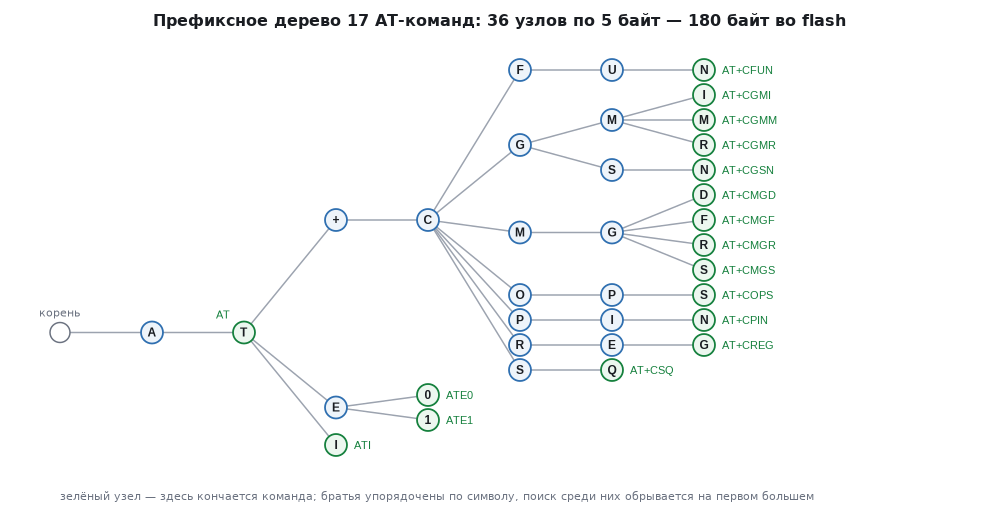
The command names themselves as strings would take 120 bytes plus 68 bytes of pointers to them — comparable. The tree's gain is not in memory but in time and in the absence of a buffer.
76ж.3 The table generator
Such a tree is not written by hand: the index of every child and sibling is easy
to mix up. The table is built by a short Python program at build time —
from the list of commands — and it writes the header trie_tab.h:
/* Сгенерировано gen.py — не править руками. 17 команд, 36 узлов. */
#define TRIE_NODES 36
#define TRIE_CMDS 17
static const trie_node_t TRIE[TRIE_NODES] = {
    {'\0', 1, 0, 0, 0}, /* 0 */
    {'A', 2, 0, 0, 0}, /* 1 */
    {'T', 3, 0, 1, 0}, /* 2 */
The generator orders the siblings by character and for each node computes
uniq — the command number if it is the only one in the subtree. To add a command,
append a line to the list and rebuild; the section's check runs the
generator again and compares the header byte for byte.
76ж.4 Parsing one byte at a time
The parser state is the current node index and a character counter, two bytes. Each received character is looked up among the children of the current node:
void trie_feed(trie_state_t *s, char c)
{
    if (s->node == TRIE_FAIL)
        return;
    if (c >= 'a' && c <= 'z')
        c = (char)(c - 'a' + 'A'); /* AT-команды не различают регистр */
    for (uint8_t n = TRIE[s->node].child; n; n = TRIE[n].sib) {
        CMP_HOOK();
        if (TRIE[n].ch == c) {
            s->node = n;
            s->len++;
            return;
        }
        if (TRIE[n].ch > c)
            break; /* братья упорядочены: дальше искать бесполезно */
    }
    s->node = TRIE_FAIL;
}
The function can be called right from the receive interrupt: it does not wait, does not copy and runs in a time bounded by the number of siblings of a node — here no more than seven (the children of node "C"). When the end-of-name character arrives — "?", "=" or a carriage return — the answer is taken from the current node:
uint8_t trie_result(const trie_state_t *s, int allow_prefix)
{
    if (s->node == TRIE_FAIL || s->node == 0)
        return 0;
    if (TRIE[s->node].id)
        return TRIE[s->node].id;
    return allow_prefix ? TRIE[s->node].uniq : 0;
}
Parameters after "=" are parsed separately, already knowing the command: each has its own format, and a common parser is not needed for them.
76ж.5 The run: commands, abbreviations, errors
Each line is as it would arrive from the UART; "exact" means without abbreviations, "with abbreviation" means an unambiguous beginning is allowed:
| Line | exact | with abbreviation | comparisons in the tree | scan found | comparisons by scan |
|---|---|---|---|---|---|
AT+CSQ |
AT+CSQ | AT+CSQ | 12 | AT+CSQ | 39 |
AT+CMGD=1 |
AT+CMGD | AT+CMGD | 9 | AT+CMGD | 86 |
AT+CREG? |
AT+CREG | AT+CREG | 12 | AT+CREG | 45 |
at+cops? |
AT+COPS | AT+COPS | 10 | — | 17 |
ATI |
ATI | ATI | 5 | ATI | 13 |
AT+CGM |
— | — | 7 | — | 84 |
AT+CPI |
— | AT+CPIN | 10 | — | 79 |
AT+XYZ |
— | — | 4 | — | 64 |
ATZ |
— | — | 5 | — | 51 |
AT+CMGS="123" |
AT+CMGS | AT+CMGS | 12 | AT+CMGS | 72 |
What can be seen. The tree folded lowercase letters in one place, while the scan
did not find the command at+cops? — it needs its own case folding.
AT+CGM is ambiguous (CGMI, CGMM, CGMR) — rejected even with abbreviations;
AT+CPI is an unambiguous beginning of AT+CPIN. The unknown AT+XYZ and ATZ
were rejected by the tree in 4 and 5 comparisons — at the first character that is not
among the siblings — while the scan went through the whole table: 64 and 51.
Abbreviations are convenient in a console for a human and dangerous in a protocol for
a machine: a command AT+CPIX was added — and AT+CPI stopped being
unambiguous. For the AT protocol they are switched off.
76ж.6 A console with hints
The same tree gives a console two useful things almost for free. The first is
tab completion: if the current node has a single child, its
character can be typed for the operator, and if uniq is non-zero — the whole name
can be completed. The second is listing the options: a walk over the subtree of the current node
lists all commands with the beginning already typed. Both actions work with
the same two-byte state as the parser.
For a console of a dozen words without common beginnings the tree's gain is small, and
the hash index from 76д is simpler. The tree wins where commands have long common
beginnings: AT commands, paths like net.wifi.ssid, SCPI commands of instruments.
76ж.7 Code and memory
| What | M4 | M0 |
|---|---|---|
trie_feed, code bytes |
88 | 80 |
trie_result, code bytes |
36 | 40 |
linear_find, code bytes |
60 | 64 |
| tree table in flash, bytes | 180 | 180 |
Parsing with the tree is 124 bytes of code and 180 bytes of table; the scan is 60 bytes of code, 120 bytes of strings and 68 bytes of pointers. In memory they are almost equal; the tree pays with a constant table for time, rejection at the first wrong character and working without a buffer.
76ж.8 When to choose what
| Command set | Choice |
|---|---|
| 5–10 short words | a scan with strcmp — the simplest |
| dozens of words without common beginnings | a hash index (76д) |
| long common beginnings, byte-by-byte parsing from the UART | a prefix tree in flash |
| commands are defined at run time, not at build time | a hash table in RAM, not a constant tree |
76ж.9 Pitfalls
The tree was edited by hand and broken. A sibling index pointed to the wrong place, and some commands became unreachable. The table is built by a generator, the check compares it with the generator's output.
The search among siblings does not stop. The generator did not order the siblings, while the parser stops the search at the first greater character — a command "disappeared". The order of siblings is part of the table format.
A command stopped being recognised after a new one was added. Abbreviations
were on: AT+CPI was unambiguous until a second command starting with
"AT+CPI" appeared. In a protocol for a machine — exact names only.
Lowercase letters are not recognised. Modems accept at+csq; case
folding is in one place, at the parser input.
There are more than 255 nodes. The indices are bytes. The generator must check the
limit and switch to uint16_t rather than silently truncate the indices.
76ж.10 Summary
- A prefix tree parses the name one byte at a time from UART reception; the state is 2 bytes, no line buffer is needed.
- 17 AT commands — 36 nodes of 5 bytes, 180 bytes in flash; the node is fixed by
_Static_assert. - Command lookup: the tree takes 8.7 character comparisons on average and 12 at worst, a scan
with
strcmptakes 41.5 and 86. - The tree rejected the unknown
AT+XYZin 4 comparisons, the scan in 64. AT+CPIwith abbreviations gaveAT+CPIN,AT+CGMis ambiguous; for a protocol abbreviations are switched off.- The table is built by a generator at build time; siblings are ordered by character.
Next: section 76з "Radix sort and counting sort: 8- and 16-bit keys and the memory cost" — how to sort short keys without comparisons and how much RAM has to be given up for it.