 Embedded HandbookApps
5б. HAL2, the new generation of STM32 drivers: what changed from HAL1, architecture, error handling, callbacks, LL under the hood and porting a project
Sections 5 and 5а are about HAL as it has been known since 2014: the handle
UART_HandleTypeDef with its Init field, HAL_UART_Init with MspInit
inside, HAL_BUSY from a busy port, weak callbacks. Below, that HAL is called
HAL1. ST now has a second generation, HAL2: the same idea of "one function, one
action", but a different interface. It is not compatible with HAL1: code has to
be rewritten. This section covers what exactly changed and why, how HAL2 is
built inside (it stands entirely on LL), how it reports errors, what happened to
callbacks, the RTOS support and the time base, how much it weighs next to HAL1
on the same program, and how to port a project.
Sources: the STM32CubeC5 package with the stm32c5xx_drivers 2.1.0 drivers
(README and Release Notes, 12 June 2026), the templates/, os_port/ and
timebases/ folders and the examples/hal/uart examples; the HAL2 preview for
U5, the STM32CubeU5 HAL2 drivers Preview repository, V2.0.0-beta.1.1 of 4 July
2025, with its "Breaking changes in concepts" document (docs/breaking_concepts);
HAL1 from the Keil packs STM32U5xx_DFP 2.2.1 (HAL driver V1.3.0) and STM32F4xx_DFP
2.17.1. The HAL2 drivers in both packages are licensed under BSD-3-Clause. What is
said about HAL2 Migrator comes from ST documentation ("HAL1 to HAL2 — migration
guide" 1.0.0, data brief DB5796 Rev 1) and is not verified: the tool is not on disk.
Terms used in the documentation
Term Meaning HAL2 (STM32Cube HAL drivers v2.x) the second generation of HAL; the previous one is called HAL1 here HAL-over-LL principle HAL touches registers only through LL functions unitary configuration function a function that changes one setting ( HAL_UART_SetBaudRate)global state / process state the state of the block and the state of one process ( tx_state,rx_state)hal_status_tthe HAL2 status code: five values far apart in bits debug assertion ( ASSERT_DBG_PARAM,ASSERT_DBG_STATE)a debug check of a parameter or a state, empty in release builds run-time parameter check ( USE_HAL_CHECK_PARAM)a parameter check that stays in release builds acquire / release bus ( HAL_PPP_AcquireBus)taking and releasing a block between RTOS tasks time base pattern a ready-made HAL time base file on a timer or the RTC HAL1 detection script, stubbing a script that finds HAL1 calls, and a stub mode to keep the build going NRND (not recommended for new design) not recommended for new designs
5б.1 Why HAL2 and where it exists
The README of the STM32CubeC5 drivers lists the goals: less code, a clearer interface, finer-grained settings, better behaviour under an RTOS, HAL on top of LL, and code following MISRA C:2012 and checked with analysers. The price is stated plainly in the README of the U5 preview: incompatibility with the old HAL.
Where HAL2 exists. As the standard library on STM32C5: the STM32CubeC5
package carries drivers version 2.1.0, the second official release (the first,
2.0.0, came out on 13 March 2026). Supported are C531, C532, C542, C551, C552, C562,
C591, C593 and C5A3, the boards NUCLEO-C562RE, NUCLEO-C542RC and NUCLEO-C5A3ZG;
tested with IAR EWARM 9.60.3, Keil MDK 5.42, STM32CubeIDE for VS Code with GCC 13
and STM32CubeMX2 1.0.0. For U5 there is only a preview, V2.0.0-beta.1.1, and the
repository itself is marked as archived: "no longer maintained", NRND. The other
series live on HAL1: the Keil pack for F4 carries STM32F4xx_HAL_Driver with
HAL_OK = 0x00U, the classic of sections 5 and 5а. So HAL2 is, for now, a choice
that comes with the C5 series, not an update for F1 or F4.
What the driver package contains (the stm32c5xx_drivers folder):
| Folder | Contents |
|---|---|
hal/ |
47 .c files and headers; the application entry point is stm32_hal.h |
ll/ |
33 stm32c5xx_ll_*.h headers, only static inline functions, not a single .c |
os_port/ |
no_os/ and freertos/: semaphores and mutexes for HAL |
timebases/ |
the HAL time base on a timer, on the RTC alarm and on the RTC wakeup |
utils/ |
timing calculation for I2C, I3C and FDCAN |
templates/ |
stm32c5xx_hal_conf.h, stm32_assert.h, stm32_ll.h, RTOS and time base templates |
For comparison: HAL1 for the same U5 (pack 2.2.1) has 117 .c files, of which 31
are LL init functions *_ll_*.c and 24 are extensions *_ex.c. HAL2 has neither:
the extensions are merged into the main files, and LL-based initialisation is
generated by CubeMX2 from inline functions. The series name has also left the
entry header: the application includes stm32_hal.h, not stm32u5xx_hal.h, and
the same program from 5б.6 builds for the U575 and for the C562 without changing a
single line.
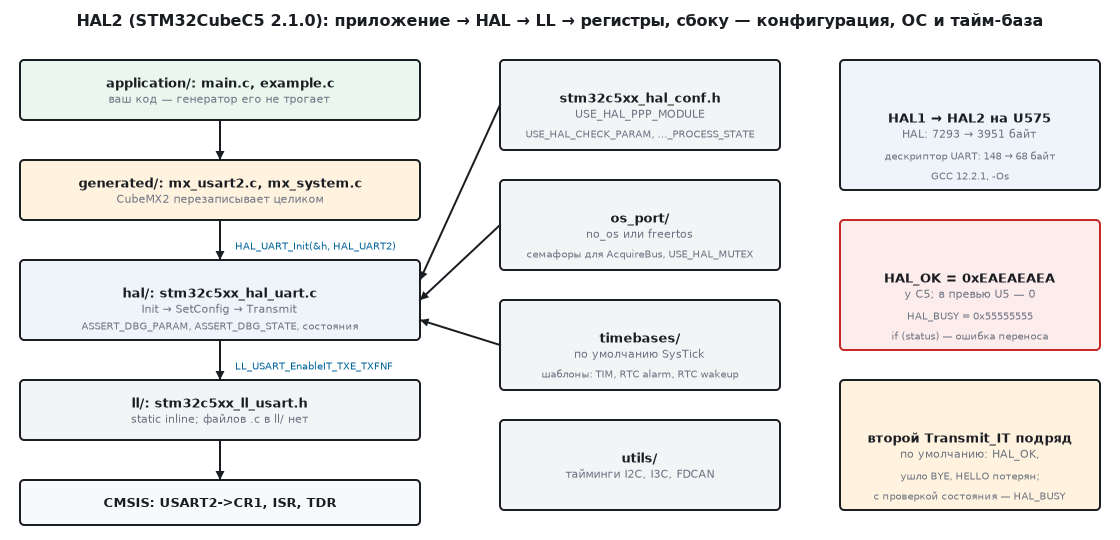
5б.2 The handle: Init, then SetConfig, with LL under the hood
In HAL1 a single function HAL_UART_Init did three jobs: it tied the handle to
the block (the user filled in Instance), parsed the Init structure and wrote
the registers, and in the middle it called HAL_UART_MspInit for clocks and pins.
The Init structure stayed inside the handle. HAL2 cuts this into parts:
    if (HAL_UART_Init(&huart2, HAL_UART2) != HAL_OK) {   /* 1. дескриптор + экземпляр */
        for (;;) {
        }
    }
    HAL_RCC_USART2_EnableClock();                          /* 2. то, что было в MspInit */
    (void)HAL_RCC_USART2_SetKernelClkSource(HAL_RCC_USART2_CLK_SRC_PCLK1);
    g.mode = HAL_GPIO_MODE_ALTERNATE;
    g.alternate = HAL_GPIO_AF_7;
    (void)HAL_GPIO_Init(HAL_GPIOA, HAL_GPIO_PIN_2 | HAL_GPIO_PIN_3, &g);

    u.baud_rate = 115200;                                  /* 3. настройка */
    u.clock_prescaler = HAL_UART_PRESCALER_DIV1;
Three steps. HAL_UART_Init(&h, HAL_UART2) only fills in the handle: it sets the
instance, clears the states and the DMA pointers and moves global_state to
HAL_UART_STATE_INIT. It does not touch the registers: in the experiment of 5б.3
the "register" CR1 is preloaded with 0x12345678 and still holds it after Init.
The second step, clocks, clock source and pins, is written by the user (or by
CubeMX2 in mx_usart2.c): there is no MspInit or MspDeInit in HAL2. The third
is HAL_UART_SetConfig(&h, &cfg): the settings structure is passed by pointer,
applied to the registers and not stored in the handle. After it,
global_state = HAL_UART_STATE_CONFIGURED. Individual parameters are then
changed one by one: HAL_UART_SetBaudRate, HAL_UART_SetParity,
HAL_UART_SetStopBits and four more such functions.
What this gained in bytes is visible with nm (5б.6): the global huart2 in HAL1
on the U575 takes 148 bytes, in HAL2 it takes 68, on the same U575 and on the C562.
The fields of the HAL2 handle are documented as private: the application works
with it only through functions.
HAL on top of LL. The second rule of HAL2: HAL functions do not write registers themselves, they call LL. Here is a pin toggle, the whole HAL2 function and what it calls:
void  HAL_GPIO_TogglePin(hal_gpio_t gpiox, uint32_t pins)
{
  ASSERT_DBG_PARAM(IS_GPIO_PORT((gpiox)));
  ASSERT_DBG_PARAM(IS_GPIO_PIN(pins));

  LL_GPIO_TogglePin(GPIO_GET_INSTANCE(gpiox), pins);
}
__STATIC_INLINE void LL_GPIO_TogglePin(GPIO_TypeDef *gpiox, uint32_t pin_mask)
{
  uint32_t odr = STM32_READ_REG(gpiox->ODR);
  STM32_WRITE_REG(gpiox->BSRR, ((odr & pin_mask) << 16U) | (~odr & pin_mask));
}
The HAL layer is responsible for checks, states and the order of steps, LL for
the register write. The same goes for UART: at the end HAL_UART_Transmit_IT
enables the interrupt by calling LL_USART_EnableIT_TXE_TXFNF, not
__HAL_UART_ENABLE_IT. Three consequences follow. The __HAL_PPP_* macros that
worked on registers are gone in HAL2: instead of __HAL_RCC_GPIOA_CLK_ENABLE()
there is the inline HAL_RCC_GPIOA_EnableClock(), instead of
__HAL_UART_ENABLE_IT there are LL functions. HAL constants became LL aliases:
HAL_GPIO_PIN_5 is defined as LL_GPIO_PIN_5, the clock source
HAL_RCC_USART2_CLK_SRC_PCLK1 as LL_RCC_USART2_CLKSOURCE_PCLK1. And any HAL
function can be read as a ready-made sequence of LL calls, should HAL need to be
thrown out of a hot path.
5б.3 Status codes, states and checks
Status codes. HAL1 has four of them, from 0 to 3 (5а.3). HAL2 has five, and they are not small numbers:
typedef enum
{
  HAL_OK            = 0xEAEAEAEAU, /* HAL operation completed successfully */
  HAL_ERROR         = 0xF5F5F5F5U, /* HAL operation completed with error   */
  HAL_BUSY          = 0x55555555U, /* HAL concurrent process ongoing       */
  HAL_INVALID_PARAM = 0xAAAAAAAAU, /* HAL invalid parameter                */
  HAL_TIMEOUT       = 0x5A5A5A5AU  /* HAL operation exceeds user timeout   */

} hal_status_t;
This is stm32c5xx_hal_def.h from release 2.1.0. The values are spread apart in
bits on purpose: "Breaking changes in concepts" refers to a secure coding rule:
the return values of sensitive functions must differ in at least eight bits, so
that a single flipped bit cannot turn an error into success. In the U5 preview
HAL_OK is still 0x00000000 and HAL_ERROR is 0xFFFFFFFF; on the C5 success has
become non-zero. For porting this is the main point: a check if (status) or
if (!HAL_..()) in the "zero means good" style reads success as an error on the
C5. Compare only against HAL_OK by name.
HAL_INVALID_PARAM is a new code: an invalid parameter that could lead to a memory
fault (a null pointer). HAL_TIMEOUT is returned only when a timeout set by the
user expires; hardware failures and internal waits give HAL_ERROR.
States. For blocks where processes run in parallel, the state is split. For
the UART on the C5: the common global_state is RESET (0), INIT (bit 31),
CONFIGURED (bit 30); transmission and reception have tx_state and rx_state
with RESET (bit 31), IDLE (bit 30), ACTIVE (bit 29), PAUSED and ABORT.
Each value is one bit, so one check can accept several allowed states at once.
Checks: three independent groups of keys.
| Key | Where it is set | What it does | Default |
|---|---|---|---|
USE_ASSERT_DBG_PARAM |
compiler option | ASSERT_DBG_PARAM(...) in every function calls assert_dbg_param_failed(file, line) |
not set |
USE_ASSERT_DBG_STATE |
compiler option | ASSERT_DBG_STATE(state, allowed) calls assert_dbg_state_failed |
not set |
USE_HAL_CHECK_PARAM |
stm32c5xx_hal_conf.h |
a check that stays in release: null pointer → HAL_INVALID_PARAM |
0U |
USE_HAL_SECURE_CHECK_PARAM |
stm32c5xx_hal_conf.h |
the same check for "sensitive" functions (AES and others) | 0U |
USE_HAL_CHECK_PROCESS_STATE |
stm32c5xx_hal_conf.h |
atomic state change; busy → HAL_BUSY |
0U |
In HAL1, assert_param was used only in the Init functions, while the busy port
check was always there, with no keys. HAL2 is the other way round: parameter and
state checks are in every function, but by default all of them are off. Here is
the start of HAL_UART_Transmit_IT:
  ASSERT_DBG_PARAM(huart != NULL);
  ASSERT_DBG_PARAM(p_data != NULL);
  ASSERT_DBG_PARAM(size_byte != 0);

  ASSERT_DBG_STATE(huart->global_state, HAL_UART_STATE_CONFIGURED);
  ASSERT_DBG_STATE(huart->tx_state, HAL_UART_TX_STATE_IDLE);

#if defined(USE_HAL_CHECK_PARAM) && (USE_HAL_CHECK_PARAM == 1)
  if ((p_data == NULL) || (size_byte == 0U))
  {
    return HAL_INVALID_PARAM;
  }
#endif /* USE_HAL_CHECK_PARAM */

  HAL_CHECK_UPDATE_STATE(huart, tx_state, HAL_UART_TX_STATE_IDLE, HAL_UART_TX_STATE_ACTIVE);
and here is what the last line turns into when USE_HAL_CHECK_PROCESS_STATE
is 0:
#define HAL_CHECK_UPDATE_STATE(handle, state_field, ppp_conditional_state, ppp_new_state) \
  (handle)->state_field = (ppp_new_state)
A plain assignment. With the key set to 1 the same macro reads the state with an
LDREX instruction, compares it with the expected one, returns HAL_BUSY on a
mismatch and otherwise writes the new state with STREX: check and update are
atomic even between RTOS tasks and interrupts.
Experiment (QEMU mps2-an505, a Cortex-M33 core; the real
stm32c5xx_hal_uart.c from the package is compiled, files in _verify/hal2_5b/).
This machine has no USART block, so the instance is a USART_TypeDef structure in
RAM: the program passes its address to HAL_UART_Init, sets the TXE and TC flags
and calls HAL_UART_IRQHandler itself, collecting bytes from the TDR "register".
The SetConfig step is replaced: its states are set by hand, because it needs the
RCC clocks that QEMU does not have. The first transmission is "HELLO", right
after it, before it has finished, comes the second, "BYE". Build with the
configuration template as is:
tx1=0xeaeaeaea tx_state=0x20000000 txeie=0x00000001
tx2=0xeaeaeaea buf_is_msg2=0x00000001 count=0x00000003
sent=BYE bytes=0x00000003 callback=0x00000001 tx_state=0x40000000
tx_null=0xeaeaeaea tx_state=0x20000000
The second call returned HAL_OK and overwrote the buffer and the counter: BYE
went out on the line and HELLO vanished without a trace; the callback came once.
The call with a null pointer and zero length also returned HAL_OK and left
tx_state in ACTIVE (0x20000000), a transmission that will never end. The same
program with USE_HAL_CHECK_PARAM and USE_HAL_CHECK_PROCESS_STATE set to 1:
tx2=0x55555555 buf_is_msg2=0x00000000 count=0x00000005
sent=HELLO bytes=0x00000005 callback=0x00000001 tx_state=0x40000000
tx_null=0xaaaaaaaa tx_state=0x40000000
HAL_BUSY, HELLO went out, the null pointer gives HAL_INVALID_PARAM, the state
is IDLE. With the USE_ASSERT_DBG_PARAM and USE_ASSERT_DBG_STATE keys the
debug checks fire: assert_dbg_param_failed already in HAL_UART_Init, at line
810, the instance check, since an address in RAM does not look like a USART;
assert_dbg_state_failed on the second call, at line 4454, the tx_state check;
two parameter checks at lines 4450 and 4451. But the handler from the template
simply returns, and the function carries on: BYE still went out. A debug check
reports, it does not protect; put a halt into your own assert_dbg_state_failed.
The conclusion for anyone coming from 5а: in HAL2 there is no "silent HAL_BUSY"
by default; there is no refusal at all. The order of calls has become the
application's job, and the protection is switched on by the
USE_HAL_CHECK_PROCESS_STATE key, for 138 bytes of code in the program of 5б.6.
Process errors. The error flags (overrun, framing, noise, parity) are still
collected in the handle, but only when USE_HAL_UART_GET_LAST_ERRORS = 1, and are
read with HAL_UART_GetLastErrorCodes; by default it is 0, the field does not
exist and the bytes are saved.
5б.4 Callbacks, RTOS, time base and the configuration file
Callbacks. Both mechanisms from 5а.8 remain. By default there are weak
functions; with USE_HAL_UART_REGISTER_CALLBACKS = 1 there are pointers in the
handle and one registration function per event: HAL_UART_RegisterTxCpltCallback,
HAL_UART_RegisterRxCpltCallback and eleven more. In the experiment of 5б.3 the
build with this key delivered the call to its own on_tx_done, not to the weak
function. Registration is allowed in both INIT and CONFIGURED. The callbacks
themselves have changed: MspInit is gone, and the end of reception is merged with
"reception until idle":
__WEAK void HAL_UART_RxCpltCallback(hal_uart_handle_t *huart, uint32_t size_byte, hal_uart_rx_event_types_t rx_event)
Instead of the HAL1 pair HAL_UART_RxCpltCallback(huart) and
HAL_UARTEx_RxEventCallback(huart, Size) there is one function: how much was
received and on which event (HAL_UART_RX_EVENT_TC, _IDLE, _RTO,
_CHAR_MATCH). Telling "who called" by huart->Instance is no longer possible:
the fields are private, so you compare the handle address (huart == &huart2) or
attach a pointer to your own data with HAL_UART_SetUserData when
USE_HAL_UART_USER_DATA = 1.
RTOS: taking the block. With USE_HAL_MUTEX = 1, HAL_UART_Init creates a
semaphore, and the block gets HAL_UART_AcquireBus and HAL_UART_ReleaseBus:
hal_status_t HAL_UART_AcquireBus(hal_uart_handle_t *huart, uint32_t timeout_ms)
{
  hal_status_t status;

  ASSERT_DBG_PARAM((huart != NULL));

  status = HAL_ERROR;

  if (HAL_OS_SemaphoreTake(&huart->semaphore, timeout_ms) == HAL_OS_OK)
  {
    status = HAL_OK;
  }

  return status;
}
HAL_OS_SemaphoreTake and its family come from os_port/: in freertos/ they are
FreeRTOS semaphores (hal_os_semaphore_t = SemaphoreHandle_t), in no_os/ a
volatile uint32_t variable. Taking the block is the task's job: two tasks writing
to one UART first take the block, then transmit. This does not replace the atomic
state change (5б.3), it complements it.
Time base. HAL_Init sets up SysTick at one of three rates:
HAL_TICK_FREQ_1KHZ (the default), _100HZ, _10HZ; HAL_IncTick adds to
uwTick not one but the period in milliseconds. The tick priority is
HAL_TICK_INT_LOWEST_PRIORITY; on the C5, with four priority bits, that is 15, the
lowest, so the HAL_Delay-in-an-interrupt trap from 5а.6 has not gone away.
HAL_InitTick is weak; as replacements timebases/ has three ready-made files, on
a timer, on the RTC alarm and on the RTC wakeup; they are bound to a specific timer
by aliases in stm32_hal_timebase.h (timebase_gethandle → mx_tim6_gethandle
and so on). New is HAL_Delay_NoISR: a delay that does not need the tick
interrupt. The tick handler is generated by CubeMX2 in mx_system.c:
void SysTick_Handler(void)
{
  HAL_IncTick();
  HAL_CORTEX_SYSTICK_IRQHandler();
}
The timer callback in HAL2 is called HAL_TIM_UpdateCallback, not
HAL_TIM_PeriodElapsedCallback.
Configuration file. stm32c5xx_hal_conf.h (687 lines in the template) holds
only HAL keys: system ones (USE_HAL_TICK_INT_PRIORITY, USE_HAL_FLASH_PREFETCH),
USE_HAL_MUTEX, the three check keys from 5б.3 and a block for each of 42 modules:
USE_HAL_UART_MODULE, USE_HAL_UART_CLK_ENABLE_MODEL,
USE_HAL_UART_REGISTER_CALLBACKS, USE_HAL_UART_USER_DATA,
USE_HAL_UART_GET_LAST_ERRORS, USE_HAL_UART_DMA. The template enables all 42
modules, the generated echo example enables 8. Crystal frequencies (HSE_VALUE and
others) have moved out of it into stm32_external_env.h from the DFP, internal
oscillators into the CMSIS device header; they are pulled in by the
USE_EXTERNAL_ENV key. Module names have changed: what was
HAL_UART_MODULE_ENABLED is now USE_HAL_UART_MODULE.
5б.5 What to replace with what: the table and porting
Every row is checked against the headers of both versions: HAL1 from the STM32U5xx_DFP 2.2.1 pack, HAL2 from STM32CubeC5 2.1.0.
| Task | HAL1 | HAL2 |
|---|---|---|
| set up a UART | HAL_UART_Init(&h) with h.Instance, h.Init |
HAL_UART_Init(&h, HAL_UART2) + HAL_UART_SetConfig(&h, &cfg) |
| block clock | __HAL_RCC_USART2_CLK_ENABLE() in MspInit |
HAL_RCC_USART2_EnableClock() in your own code |
| blocking transmit | HAL_UART_Transmit(h, const uint8_t *, uint16_t, Timeout) |
HAL_UART_Transmit(h, const void *, uint32_t size_byte, uint32_t timeout_ms) |
| blocking receive | HAL_UART_Receive |
HAL_UART_Receive (length uint32_t) |
| interrupt transmit | HAL_UART_Transmit_IT |
HAL_UART_Transmit_IT; without the key, no HAL_BUSY (5б.3) |
| DMA transmit | HAL_UART_Transmit_DMA + __HAL_LINKDMA |
HAL_UART_SetTxDMA(&h, &hdma) + HAL_UART_Transmit_DMA |
| reception until idle with DMA | HAL_UARTEx_ReceiveToIdle_DMA |
HAL_UART_ReceiveToIdle_DMA |
| end of reception | HAL_UART_RxCpltCallback(h), HAL_UARTEx_RxEventCallback(h, Size) |
HAL_UART_RxCpltCallback(h, size_byte, rx_event) |
| block errors | HAL_UART_GetError |
HAL_UART_GetLastErrorCodes (with USE_HAL_UART_GET_LAST_ERRORS) |
| configure a pin | HAL_GPIO_Init(GPIOA, &init), pins in init.Pin, returns nothing |
HAL_GPIO_Init(HAL_GPIOA, HAL_GPIO_PIN_5, &cfg), returns hal_status_t |
| write, toggle | HAL_GPIO_WritePin(GPIOA, GPIO_PIN_5, GPIO_PIN_SET), HAL_GPIO_TogglePin |
HAL_GPIO_WritePin(HAL_GPIOA, HAL_GPIO_PIN_5, HAL_GPIO_PIN_SET), HAL_GPIO_TogglePin |
| I2C, memory read | HAL_I2C_Mem_Read(h, DevAddress, MemAddress, MemAddSize, …) |
HAL_I2C_MASTER_MemRead(h, device_addr, memory_addr, memory_addr_size, …) |
| SPI, exchange | HAL_SPI_TransmitReceive(h, pTxData, pRxData, Size, Timeout) |
HAL_SPI_TransmitReceive(h, p_tx_data, p_rx_data, count_packet, timeout_ms) |
| PWM: start, duty | HAL_TIM_PWM_Start(&h, TIM_CHANNEL_1), __HAL_TIM_SET_COMPARE |
HAL_TIM_OC_StartChannel(&h, HAL_TIM_CHANNEL_1), HAL_TIM_OC_SetCompareUnitPulse |
| timer period | HAL_TIM_PeriodElapsedCallback |
HAL_TIM_UpdateCallback |
| delay, ticks | HAL_Delay(Delay), HAL_GetTick() |
HAL_Delay(delay_ms), HAL_GetTick() |
| NVIC | HAL_NVIC_SetPriority(IRQn, 5, 0) |
HAL_CORTEX_NVIC_SetPriority(IRQn, HAL_CORTEX_NVIC_PREEMP_PRIORITY_5, HAL_CORTEX_NVIC_SUB_PRIORITY_0) |
A small detail with consequences: timer channels in HAL2 are numbered from zero in
a row, HAL_TIM_CHANNEL_1 = 0, HAL_TIM_CHANNEL_2 = 1, while in HAL1
TIM_CHANNEL_2 is 0x00000004U. A number kept "as is" from old code will point to a
different channel.
Porting by ST's steps. The "HAL1 to HAL2 — migration guide" (1.0.0) and the
HAL2 Migrator package (from ST documentation, not verified: neither is on disk)
propose this order: copy the project, replace the HAL1 drivers with HAL2, use the
stm32_hal.h entry point instead of stm32xxxx_hal.h, then run the detection
script hal1_detection.py (Python 3.8 or later; there is also an executable for
Windows 11). It walks the sources, finds HAL1 calls and writes an HTML report with
the places found; it does not edit the code itself. A separate -d stub mode
inserts stubs so that the project builds before the port is finished. Rewriting the
calls is still done by hand.
What such a script looks for is shown by our very simple detect5b.py (not the ST
tool: ten regular expressions for the types *_HandleTypeDef, *_InitTypeDef,
MspInit, __HAL_*, the Instance and Init.* fields, constants without the
HAL_ prefix). On mig_hal1.c, an interrupt-driven string transmission on HAL1,
it found 28 places in 20 lines, on the ported mig_hal2.c none. Both files build.
The most visible difference is in the callback:
void HAL_UART_TxCpltCallback(hal_uart_handle_t *huart)
{
    if (huart == &huart2)                    /* поля дескриптора закрыты: сравниваем адрес */
        tx_busy = 0;
}
MspInit is gone: clocks, pins and NVIC have moved into app_start between
HAL_UART_Init and HAL_UART_SetConfig, and the eight huart2.Init.* lines into a
local hal_uart_config_t that is no longer needed after SetConfig.
5б.6 Code size: one program on HAL1 and HAL2
There is one program: SysTick, pin PA5 as an output, USART2 on PA2/PA3 at 115200
baud; in the loop, Receive of one byte with a 500 ms timeout, if a byte came,
Transmit it back, if not, toggle the LED. Built with arm-none-eabi-gcc 12.2.1
(Docker image stm-arm:1), -mcpu=cortex-m33 -Os, -ffunction-sections
-fdata-sections, --gc-sections, newlib-nano. The bytes are counted from the
linker map: by the input sections of each object file, without the heap and stack
reserves, which differ between linker scripts.
| Variant | HAL, flash | HAL, RAM | UART handle | Whole image, flash |
|---|---|---|---|---|
| U575, HAL1 (pack 2.2.1, HAL V1.3.0) | 7293 | 9 | 148 | 10863 |
U575, HAL1 + USE_FULL_ASSERT |
9145 | 9 | 148 | 12727 |
| U575, HAL2 (preview beta.1.1) | 3951 | 9 | 68 | 8211 |
| C562, HAL2 (2.1.0) | 3865 | 9 | 68 | 6615 |
C562, HAL2 + USE_HAL_CHECK_PARAM + USE_HAL_CHECK_PROCESS_STATE |
4003 | 9 | 68 | 6753 |
C562, HAL2 + USE_ASSERT_DBG_PARAM + USE_ASSERT_DBG_STATE |
5531 | 9 | 68 | 8309 |
The fair comparison is between the first and the third rows: one series, one
compiler, the same options, the same application source. On the U575 the HAL code
shrank from 7293 to 3951 bytes, by 46 %, and the handle from 148 to 68 bytes. The
whole image went from 10863 to 8211, by 24 %: the rest is startup, system_*.c and
the library, and each package brings its own. The image RAM is left out of the
table on purpose: it is larger with HAL2 (353 bytes against 189), but that is not
HAL: the C startup file of the DFP enters the C library through _start from
newlib, which brings atexit and impure with it (244 bytes), while HAL holds 9
bytes in both cases. The C562 next to the U575 is a different chip and a different
HAL2 version: rows 4 and 3 are close (3865 and 3951), but that is not a comparison
of the same thing.
The price of the checks: the release keys (CHECK_PARAM and CHECK_PROCESS_STATE)
cost 138 bytes, the HAL2 debug checks 1666, USE_FULL_ASSERT in HAL1 1852. Where
the checks sit is visible in individual functions: HAL_UART_Transmit in HAL1
weighs 186 bytes with and without checks, since assert_param is only in Init;
in HAL2 it grows from 184 to 252.
ST's own estimate in the README of the preview, on ST's "HAL versus HAL2" examples, in bytes and percent: pin toggle −1980 (32 %), I2C with interrupts −5104 (43 %), PWM −3187 (35 %), clock configuration −1970 (31 %). Our result is of the same order. Nothing was run on hardware: there is no board, and QEMU models neither U5 nor C5; what is checked is a warning-free build and the sizes.
5б.7 Pitfalls
if (status) after porting turns success into an error. On the C5 HAL_OK =
0xEAEAEAEA, on the U5 preview it is 0. Compare only against HAL_OK by name (5б.3).
A second start on a busy port silently corrupts the transfer. In the template
USE_HAL_CHECK_PROCESS_STATE = 0: Transmit_IT on top of a running one returns
HAL_OK and swaps the buffer, see the experiment in 5б.3. For multitasking code,
enable the key (138 bytes) or enforce the order yourself.
A debug check fired, and the code went on. The assert_dbg_state_failed
handler from the template returns. If you need a halt, write it in the handler.
HAL1 and HAL2 do not live together in one project. The same names have
different meanings: HAL_OK exists in both enumerations. A file that includes the
HAL2 stm32_hal.h and the HAL1 stm32u5xx_hal_def.h for the same U575 series does
not build: five errors, four of them redeclaration of enumerator (HAL_OK,
HAL_ERROR, HAL_BUSY, HAL_TIMEOUT). Files with the same name
(stm32u5xx_hal_conf.h, stm32u5xx_hal_uart.h) also exist in both versions. Port
the whole project.
Your own code in generated files. CubeMX2 overwrites generated/ entirely: of
20272 .c/.h files in the generated folders of the STM32CubeC5 examples,
USER CODE BEGIN blocks exist in two. Your code goes into application/ or into
the weak hooks pre_system_init_hook / post_system_init_hook.
Old macro and constant names. GPIO_PIN_5 → HAL_GPIO_PIN_5,
HAL_UART_MODULE_ENABLED → USE_HAL_UART_MODULE, __HAL_RCC_*_CLK_ENABLE →
HAL_RCC_*_EnableClock, timer channels from zero (5б.5).
huart->Instance in a callback. The fields are gone: compare the handle address
or keep your data with HAL_UART_SetUserData (5б.4).
HAL2 for F1 or F4. It does not exist: of what is on disk, HAL2 is standard on C5 and a preview on U5, archived and NRND. F1, F4 and the rest use the HAL1 of sections 5 and 5а.
5б.8 Summary
- HAL2 is the second generation of HAL and is not compatible with HAL1. Standard on C5 (drivers 2.1.0, 12 June 2026), on U5 only the archived preview V2.0.0-beta.1.1; there is no HAL2 for F1/F4.
- The package:
hal/(47.cfiles),ll/(33 headers, onlystatic inline),os_port/,timebases/,utils/,templates/; the entry point isstm32_hal.hwith no series name; there are no*_ex.cor*_ll_*.cfiles. HAL_PPP_Init(&h, instance)only binds the handle (it does not touch registers),HAL_PPP_SetConfigapplies the settings and does not store them, there is noMspInit. UART handle: 148 → 68 bytes.- HAL reaches registers only through LL:
HAL_GPIO_TogglePin→LL_GPIO_TogglePin; HAL constants are LL aliases, there are no__HAL_*macros. hal_status_t: five codes far apart in bits; on the C5HAL_OK= 0xEAEAEAEA,HAL_BUSY= 0x55555555, the newHAL_INVALID_PARAM.- Checks are off by default. Experiment in QEMU: a second
Transmit_ITin a row returnedHAL_OK,BYEwent out,HELLOwas lost; withUSE_HAL_CHECK_PROCESS_STATE,HAL_BUSY; the debugASSERT_DBG_*only report (lines 810, 4450, 4451, 4454). - Callbacks: weak or registered,
RxCpltCallbacknow gets the length and the event; RTOS:AcquireBus/ReleaseBusthroughos_port; tick: 1 kHz, priority 15, ready-made time bases on TIM and RTC. - One program on the U575, GCC 12.2.1
-Os: HAL code 7293 → 3951 bytes (−46 %), image 10863 → 8211 (−24 %); release keys +138 bytes, debug checks +1666. - Porting: the table in 5б.5, ST's
hal1_detection.pyfinds HAL1 calls and writes a report, the edits are manual; HAL1 and HAL2 do not mix in one project.
Next: section 5в "One project twice on STM32F103: CMSIS and registers only versus HAL — 72 MHz clock, SysTick, GPIO and EXTI, UART with a ring, DMA, PWM, ADC, I2C and comparison" — the same F103 project twice: registers only and HAL, output, sizes and instructions side by side.