 Embedded HandbookApps
76а. Factorial on a microcontroller: recursion and loop, overflow, big numbers, gamma and logarithm, table
In section 76 the factorial appeared only once: in 76.6 the binomial coefficient
cannot be computed through n! — the intermediate values do not fit in an int.
Here the factorial is taken apart in full, because it shows several things
at once that matter for firmware: how much stack recursion eats and what the
compiler does with it, where each type ends, when a table in flash memory
beats computation, how to compute 1000! without libraries and what it costs on a
Cortex-M4, what replaces n! when only its order is needed, and why
Taylor series do not divide by the factorial.
Basis: one file fact76a.c built with gcc 12.2.0 on the computer (stm-sys:1)
and arm-none-eabi-gcc 12.2.1 for the Cortex-M4F; the firmware ran in QEMU 7.2
(stm-arm:1, board netduinoplus2 with an STM32F405 — the same core as the F407).
QEMU with -icount counts instructions, not cycles: the time in this section is a lower
bound. The STM32F407 clock comes from the device description in the Keil pack
STM32F4xx_DFP 2.17.1. All numbers come from the saved run fact76a_host.txt.
Terms used in the documentation
Original Meaning factorial n! factorial: 1 · 2 · … · n, 0! = 1 recursion, tail call recursion, tail call: the call is the last action of the function stack frame stack frame: return address, saved registers, local variables -fstack-usage gcc option: frame size of each function in a .su file overflow builtins gcc built-in functions for multiplication with an overflow check lookup table table of ready values arbitrary-precision arithmetic long arithmetic: a number in an array of limbs Stirling's formula Stirling's formula: n! approximated through a power and a root gamma function Γ, lgamma, tgamma gamma function, Γ(n + 1) = n!; its logarithm and value in libm Taylor series Taylor series Horner's scheme Horner's scheme: a polynomial as a chain of "multiply and add"
76а.1 What the factorial is and where it appears in firmware
n! is the product of all integers from 1 to n, by definition 0! = 1. It grows faster than any power: 10! = 3 628 800, 20! already has 19 digits.
In firmware the factorial is rarely needed by itself, but it stands behind many formulas:
| Where | What the factorial does there |
|---|---|
| Taylor series for sin, cos, exp | divisors 1/3!, 1/5!, … of the series terms |
| combinations C(n, k) | n!/(k!(n − k)!) — but it must not be computed through factorials (76.6) |
| probabilities | binomial and Poisson distributions, false-alarm estimates |
| permutations | how many orders n events have, the index of a permutation in a table |
| tests | n! mod p and the number of trailing zeros — short check numbers |
Hence the plan: first how to compute it (76а.2), where the types end (76а.3), table and series (76а.4), long numbers (76а.5), logarithm and gamma (76а.6).
76а.2 Recursion versus loop: the stack and what gcc -O2 does
Three ways to write the same thing:
uint64_t fact_rec(unsigned n)
{
    if (n < 2)
        return 1;
    return n * fact_rec(n - 1);
}
uint64_t fact_loop(unsigned n)
{
    uint64_t r = 1;
    for (unsigned i = 2; i <= n; i++)
        r *= i;
    return r;
}
static uint64_t fact_acc(unsigned n, uint64_t acc)
{
    if (n < 2)
        return acc;
    return fact_acc(n - 1, acc * n); /* хвостовой вызов */
}
On the computer all three and the table from 76а.4 gave the same answers for n from 0
to 20. The difference is in the stack and the instructions. The -fstack-usage option writes the frame size
of each function into a .su file; the real depth was measured in QEMU: the area below
the stack pointer was filled with the pattern 0xA5A5A5A5, the function was called and the
lowest touched word was searched for.
| frame by .su, -O0 | stack at n = 20, -O0 | frame by .su, -O2 | stack at n = 20, -O2 | instructions per call, -O0 / -O2 | |
|---|---|---|---|---|---|
fact_rec |
32 bytes | 636 bytes | 4 bytes | 4 bytes | 588 / 180 |
fact_tail → fact_acc |
40 bytes | 816 bytes | 4 bytes | 4 bytes | 677 / 180 |
fact_loop |
40 bytes | 36 bytes | 0 bytes | 0 bytes | 440 / 122 |
Without optimisation recursion honestly puts a frame on every level: at n = 10
fact_rec ate 316 bytes, at n = 20 — 636, 32 bytes per level. For
the factorial this is a trifle, but the same scheme in parsing nested expressions or
walking a tree ends in a stack overflow (11.4).
With -O2 gcc 12 turned both recursions into a loop: in the machine code not
a single call of fact_rec or fact_acc remained (at -O0 — one each),
the stack is 4 bytes for any n. Replacing a tail call with a jump is a common
technique, but gcc also unrolled n * fact_rec(n - 1), where the multiplication comes after
the call: multiplication can be reordered. Do not rely on it: at -O0
the recursion stays, and the C standard does not promise tail calls. In firmware
write the loop — it is shorter even at -O2: 122 instructions against 180.
Instruction counts are per call at n = 20, without the 4 instructions of the measuring loop itself.
76а.3 Overflow: where each type ends
The largest n whose n! still fits was found by a run — on the computer and in QEMU the answers are the same:
| Type | Type limit | Largest n! |
|---|---|---|
uint32_t |
4.29·10⁹ | 12! = 479 001 600 |
int32_t |
2.15·10⁹ | 12! |
uint64_t |
1.84·10¹⁹ | 20! = 2 432 902 008 176 640 000 |
float |
3.40·10³⁸ | 34! ≈ 2.952328·10³⁸ |
double |
1.80·10³⁰⁸ | 170! ≈ 7.257416·10³⁰⁶ |
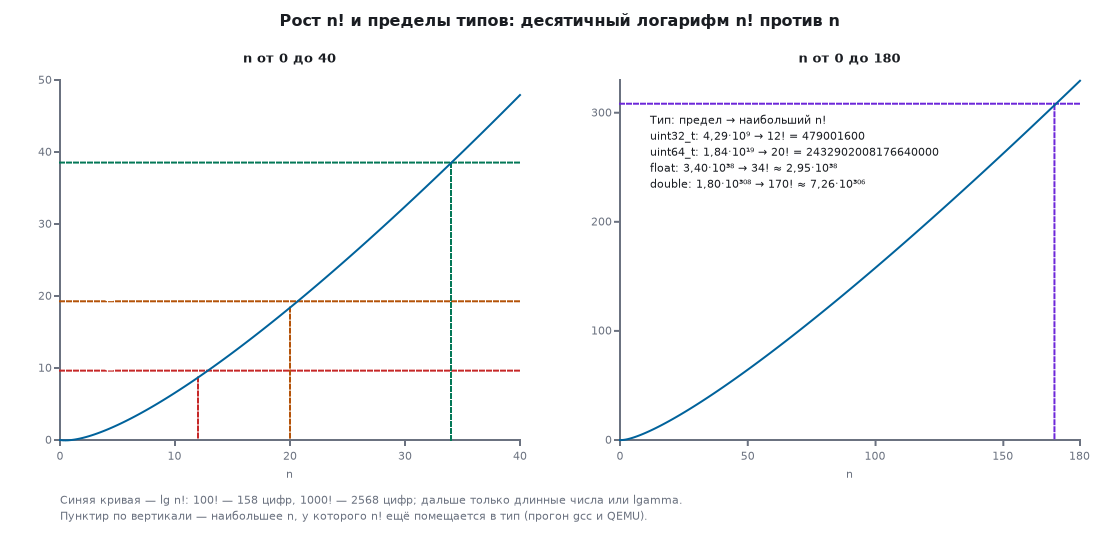
float holds 34!, but exactly — only up to 13!: the 24-bit mantissa
runs out of bits after that, and (float)14! already differs from the integer 14!.
double is exact up to and including 20! — after that uint64_t ends anyway.
So "float up to 34!" is about the order of magnitude, not the exact value.
What happens past the limit. For unsigned types overflow is defined — counting modulo
2³² (122.4): 13! in a uint32_t silently gives 1 932 053 504 instead of
6 227 020 800. For a signed int it is undefined behaviour (123.3):
the compiler may throw away a check written after the multiplication.
The check must come before or together with the operation — gcc and clang have
a built-in function for this:
int fact_u32(unsigned n, uint32_t *out)
{
    uint32_t r = 1;
    for (unsigned i = 2; i <= n; i++)
        if (__builtin_mul_overflow(r, i, &r))
            return 0;
    *out = r;
    return 1;
}
fact_u32(13, …) returned 0. On a Cortex-M4 the check is almost free: the multiplication
umull gives the high word, and that is what is compared with zero. At -O2 a call for
n = 12 is 75 instructions, the function is 52 bytes.
76а.4 A table in flash memory, Taylor series and ready 1/n!
Since only 13 values fit in a uint32_t, it is simpler to store them:
static const uint32_t FACT_TAB[13] = {
    1, 1, 2, 6, 24, 120, 720, 5040, 40320, 362880, 3628800, 39916800, 479001600,
};
uint32_t fact_tab(unsigned n)
{
    return n < 13 ? FACT_TAB[n] : 0; /* 0 — не помещается в uint32_t */
}
| -O2, Cortex-M4 | code bytes | data bytes | instructions per call |
|---|---|---|---|
fact_tab + FACT_TAB |
20 | 52 | 7 |
fact_u32 (loop with check), n = 12 |
52 | 0 | 75 |
fact_loop (uint64_t), n = 20 |
36 | 0 | 122 |
The table is 36 bytes larger than the fact_loop loop and more than 10 times faster than
fact_u32. For uint64_t a table of 21 values takes 168 bytes — also
little. Computing n! in firmware makes sense only if n is large and the answer
is needed as a long number (76а.5) or as a logarithm (76а.6).
Taylor series. sin x = x − x³/3! + x⁵/5! − … The naive version computes the power and the factorial anew for every term:
float t = powf(x, (float)n) / (float)fact_loop(n);
The right way is to store ready coefficients ±1/n! and evaluate the polynomial by Horner's scheme: x · (c₁ + x² · (c₃ + x² · (c₅ + …))). Not a single division, not a single power:
float sin_horner(float x)
{
    float x2 = x * x;
    float p = SIN_C[6];
    for (int k = 5; k >= 0; k--)
        p = p * x2 + SIN_C[k];
    return p * x;
}
Both versions have 7 terms, up to x¹³/13!. Their accuracy is the same: the largest
error on [−π, π] is 2.12·10⁻⁵ and 2.11·10⁻⁵, this is the tail of the series, not
rounding. The cost differs: on a Cortex-M4F at -O2 the naive call is 2238
instructions, Horner is 26, 86 times fewer. sinf from newlib is 92 instructions.
In the machine code of the naive version every term has a call to powf, a conversion of
uint64_t to float through __aeabi_ul2f and a vdiv.f32 division; Horner
has none of the three; the coefficients are computed once —
on the computer, when the table is written.
76а.5 Big numbers: 100! and 1000! in an array of limbs
When the exact n! beyond 20! is needed, the number is kept in an array. A convenient base is
10⁹: a limb fits in a uint32_t, the product of a limb by n plus the carry fits in a
uint64_t, and decimal output is simply 9 digits per limb.
for (unsigned k = 0; k < len; k++) {
    uint64_t t = (uint64_t)d[k] * i + carry;
    d[k] = (uint32_t)(t % BIG_BASE);
    carry = (uint32_t)(t / BIG_BASE);
}
| limbs | digits | instructions, -O2 | time at 168 MHz, at least | |
|---|---|---|---|---|
| 100! | 18 | 158 | 49 428 | 0.29 ms |
| 1000! | 286 | 2568 | 7.88 million | 47 ms |
1000! needs an array of 286 limbs — 1144 bytes of RAM. Without optimisation
1000! takes 20.99 million instructions. The main cost is the 64-bit division by 10⁹: the
Cortex-M4 has no such instruction, and % and / go to the library
__aeabi_uldivmod. The top limb of 1000! is 402, the whole number starts with 402…
Two short characteristics of n! are computed without long numbers at all:
- trailing zeros — n/5 + n/25 + n/125 + …: 100! has 24 of them, 1000! — 249; the long number gave the same 249;
- n! mod p — multiply with a remainder at every step: 1000! mod (10⁹ + 7) = 641 419 708, 59 976 instructions. Such numbers are handy as check values in tests and as a simple hash.
unsigned fact_zeros(unsigned n)
{
    unsigned z = 0;
    while (n) {
        n /= 5;
        z += n;
    }
    return z;
}
76а.6 The logarithm of the factorial: Stirling, lgamma and tgamma
Often what is needed is not n! itself but its order — in probabilities, in estimating the number of
variants, in ratios of factorials. Then ln n! is computed: it grows
slowly and does not overflow. The gamma function extends the factorial to
fractional numbers: Γ(n + 1) = n!. libm has lgamma (the logarithm) and tgamma
(the value itself). ln 1000! = 5912.128178, hence the number of digits of 1000! is
⌊5912.128178 / ln 10⌋ + 1 = 2568, the same as for the long number.
Stirling's formula: ln n! ≈ n ln n − n + ½ ln(2πn). With the correction +1/(12n) it is orders of magnitude more accurate:
| n | Stirling error | with the 1/(12n) correction |
|---|---|---|
| 1 | 7.8 % | 0.23 % |
| 10 | 0.83 % | 2.8·10⁻⁶ |
| 100 | 0.083 % | 2.8·10⁻⁹ |
Without the correction Stirling underestimates n! by about 1/(12n) — exactly what the correction gives back.
Cost on a Cortex-M4F (QEMU, instructions per call):
| Function | Argument | Instructions |
|---|---|---|
lgammaf (float) |
100 | 139 |
tgammaf (float) |
5.5 | 234 |
lgamma (double) |
100 | 3970 |
On the M4F float is computed by the FPU, double in software, hence the 29-fold
difference. The accuracy of lgammaf for n from 2 to 1000 — relative error at most
1.33·10⁻⁷, that is at the level of float itself. tgammaf(36) = 35! is already
infinity — the same limits as in 76а.3. For firmware the conclusion is simple:
the order of n! — through lgammaf, not through double.
76а.7 Pitfalls
A recursive factorial works in the release build and crashes in the debug build. At -O2 gcc made a loop out of the recursion, at -O0 every level costs 32 bytes of stack. For n = 20 this is 636 bytes, and for a recursive walk of something bigger — a stack overflow that does not exist in the release version. Write a loop.
int for the factorial silently lies from 13! on. 13! does not fit in 32 bits.
An unsigned type gives the remainder modulo 2³², a signed one gives undefined
behaviour (123.3). The check is __builtin_mul_overflow or a table with a
bound.
"float holds 34!" is not the same as "float computes 34! exactly". Exactly — only up to 13!. For combinations and probabilities this usually does not matter, for checksums it does.
Dividing by the factorial in every term of a series. The same sin is 86 times more expensive than by Horner with ready coefficients, at the same accuracy.
double functions of libm on an M4F. lgamma is 29 times more expensive than lgammaf:
the Cortex-M4 FPU has single precision only.
The stack measurement is spoiled by an interrupt. The first depth measurement in QEMU showed 104 bytes for a function with a 4-byte frame: SysTick fired after being re-enabled, and the interrupt frame with the FPU registers — those very 104 bytes — landed in the pattern-filled area. The pattern is checked with interrupts off.
76а.8 Summary
- n! fits: in
uint32_t— up to 12!, inuint64_t— up to 20!, infloat— up to 34! (exactly — up to 13!), indouble— up to 170!. - Recursion at -O0 — 32 bytes of stack per level (636 bytes at n = 20); gcc -O2 turned both simple and tail recursion into a loop, but in firmware write a loop: 122 instructions against 180.
- A table of 13
uint32_tvalues — 52 bytes and 7 instructions per call. - 1000! in limbs of 10⁹ — 286 limbs, 2568 digits, 7.88 million instructions on an M4.
- Trailing zeros of 1000! — 249; 1000! mod (10⁹ + 7) = 641 419 708.
- Stirling with the 1/(12n) correction is off by 2.8·10⁻⁶ at n = 10;
lgammafon an M4F is 139 instructions,lgamma— 3970. - In Taylor series store ±1/n! and evaluate by Horner: 26 instructions instead of 2238.
Next: section 76б "Sorting on a microcontroller: insertion, Shell, quicksort without recursion, merge and an ADC median filter" — which sort to take with 2 KB of RAM and a predictable-time requirement, and how an ADC median filter works.