 Embedded HandbookApps
138. A daemon and its log: setsid, syslog, lock file, backtrace, core
A program that must run all the time — a server, a data collector for
instruments, a bridge between a serial port and the network — cannot depend on the terminal
it was started from. Such a process is called a daemon: it lives in the
background, without a terminal, writes to a log instead of the screen, and can
reread its settings and stop cleanly on a signal. The second half of the section
covers what a daemon is blind without: your own logging library with a
call stack on errors, and post-mortem debugging from a core file.
The daemon and the logger in this section were written and run in stm-sys:1
(_verify/sys138/): ps shows that the daemon has no terminal, /proc shows
that its descriptors point to /dev/null, and a second instance refuses
to start.
Terms used in the documentation
Term Meaning daemon a background process without a terminal controlling terminal the terminal a session is attached to session, session leader a session and the process that leads it process group a group of processes signalled together double fork calling forktwicepid file, lock file a file with the process number; a file that is locked advisory lock a lock that only cooperating processes honour ( fcntl)syslog, facility, priority the system log, the message source, the severity reload on SIGHUP reread the settings on SIGHUPunit file a systemd service description file backtrace the call stack core dump, post-mortem debugging a memory image of the process; debugging after the crash
138.1 Session, group, terminal
Every process has three kinship numbers: pid, the process group pgid and
the session sid. The shell keeps all processes of one pipeline in one
group, and all its groups in one session, which has a controlling
terminal. Ctrl-C sends SIGINT to the whole foreground group; closing the
terminal sends SIGHUP to the session leader and on to everyone. A program
started from a terminal and simply left there dies together with it.
A daemon must leave this hierarchy: become the leader of its own session, which has no terminal and never will.
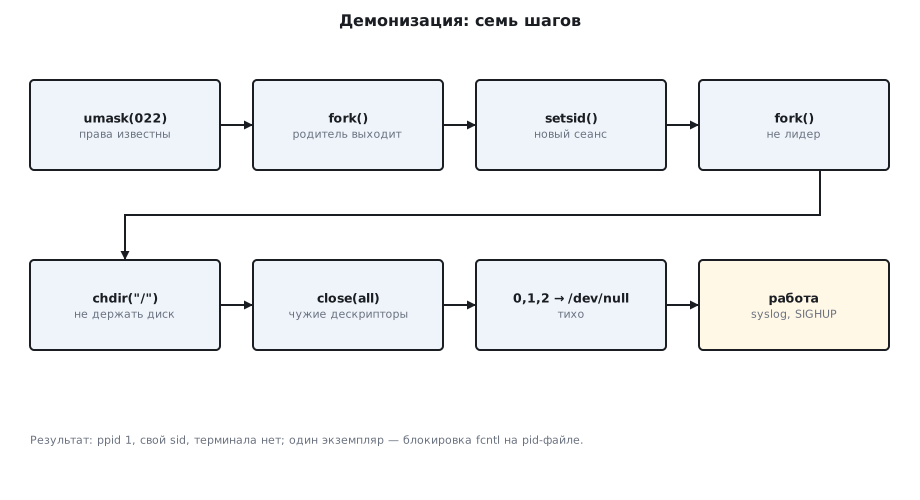
138.2 Seven steps of daemonization
static void daemonize(void)
{
    umask(022);                                          /* 1. маска прав — известная и безопасная */
    pid_t pid = fork();                                  /* 2. первый fork: оболочка получает управление */
    if (pid < 0) exit(1);
    if (pid > 0) exit(0);                                /*    родитель уходит — потомок становится сиротой */
    setsid();                                            /* 3. новый сеанс: без управляющего терминала */
    signal(SIGHUP, SIG_IGN);
    pid = fork();                                        /* 4. второй fork: не лидер сеанса — терминал не получить */
    if (pid > 0) exit(0);
    chdir("/");                                          /* 5. корень: не держать смонтированный каталог */
    struct rlimit rl; getrlimit(RLIMIT_NOFILE, &rl);
    if (rl.rlim_max == RLIM_INFINITY) rl.rlim_max = 1024;
    for (int i = 0; i < (int)rl.rlim_max; i++) close(i); /* 6. закрыть всё унаследованное */
    open("/dev/null", O_RDWR); dup(0); dup(0);           /* 7. 0, 1, 2 → /dev/null */
}
Why each step is there:
umask(022)— a known and safe permission mask: otherwise the files the daemon creates get permissions inherited from who knows where.umask(0)is also "known", but thenfopencreates files with mode 0666, and any user can write to them — and a daemon often runs as root. If others must not even read them, useumask(027).- First
fork— the parent exits, and the shell thinks the command has finished; the child is not a group leader, which is the condition forsetsid. setsid— the process becomes the leader of a new session and a new group and loses its controlling terminal:pid = sid = pgid.- Second
fork— a session leader can acquire a terminal again by opening a terminal device; a non-leader cannot. The library functiondaemon(3)in glibc skips this step, and its daemon stays a session leader. chdir("/")— a process sitting in a directory on a removable disk prevents it from being unmounted.- Close descriptors — inherited files and sockets hold resources.
- 0, 1, 2 to
/dev/null— so that a forgottenprintfdoes not fail with an error and does not write into someone else's file opened as number 1.
The result is visible in ps: the daemon with pid 52 is a child of init (ppid 1), session
51, no terminal (?), state S:
52 1 51 51 ? S daemon
Its descriptors:
0 -> /dev/null
1 -> /dev/null
2 -> /dev/null
3 -> /tmp/demo-daemon.pid
cwd: /
nohup and setsid from the shell do part of the same work for someone else's
program; systemd (138.5) does all of it, and a modern daemon
does not need to daemonize itself — it needs a switch to skip doing so
(here -f).
138.3 One instance: the lock file
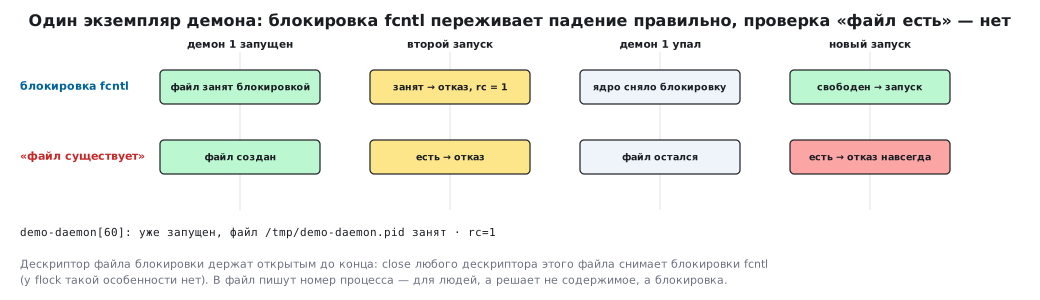
Two daemon instances on one port or one instrument are trouble. The classic approach:
a file /var/run/name.pid holding the process number, with an advisory
lock on it:
static int already_running(void)
{
    int fd = open(LOCKFILE, O_RDWR | O_CREAT, 0644);
    if (fd < 0) return -1;
    struct flock fl = { .l_type = F_WRLCK, .l_whence = SEEK_SET };
    if (fcntl(fd, F_SETLK, &fl) < 0) {                   /* блокировка снимается ядром при смерти процесса */
        if (errno == EACCES || errno == EAGAIN) { close(fd); return 1; }
        return -1;
    }
    ftruncate(fd, 0);
    dprintf(fd, "%ld\n", (long)getpid());
    return 0;                                            /* дескриптор не закрываем — блокировка живёт с ним */
}
Why a lock and not just "the file exists": after the daemon crashes the
file remains, and an existence check will never let a new instance
start. The kernel releases an fcntl lock by itself when the process dies. The second
instance from the run:
demo-daemon[60]: уже запущен, файл /tmp/demo-daemon.pid занят
rc=1
The lock file descriptor is never closed: a close of any descriptor
of this file in the process releases its locks — a quirk of fcntl
that flock does not have.
138.4 Logging through syslog and reloading on SIGHUP
A daemon has no stderr, and its log is syslog:
openlog("demo-daemon", LOG_PID | (foreground ? LOG_PERROR : 0), LOG_DAEMON);
openlog sets the name, the options (LOG_PID — add the process number,
LOG_PERROR — duplicate to stderr) and the facility (LOG_DAEMON,
LOG_USER, LOG_LOCAL0…LOG_LOCAL7), which the logging service uses
to sort records into files. Every record has a priority, from
LOG_EMERG to LOG_DEBUG; %m in the format string inserts strerror(errno):
if (!f) { syslog(LOG_WARNING, "нет файла настроек %s: %m", path); return; }
Records go to the /dev/log socket, where rsyslog, syslog-ng
or journald picks them up and stores them in /var/log or in journalctl. In a container
there is no logging service — the /dev/log socket does not exist, and the records
are lost; that is why the daemon in the run is started with LOG_PERROR.
The daemon rereads its settings on SIGHUP and stops on SIGTERM.
The handler only sets a flag (section 136), and the main loop checks it:
    while (!stop) {
        if (reload) { reload = 0; read_config(cfg); }
        syslog(LOG_DEBUG, "тик %d", ++tick);
        sleep(period);
    }
    syslog(LOG_INFO, "остановлен по сигналу после %d тиков", tick);
    unlink(LOCKFILE);
Good daemons take their settings in one order of precedence: command-line
arguments override environment variables, those override the user's
file, that overrides the system file, and at the bottom are sensible
defaults. File formats and libraries for them: INI (iniparser), JSON
(jansson, cJSON), YAML (libyaml), and for complex cases, Lua.
138.5 Starting at boot: systemd
Daemons used to be started by /etc/init.d/name scripts with start-stop-daemon;
today it is systemd almost everywhere, and a service is described by a unit file:
[Unit]
Description=Demo daemon
After=network.target

[Service]
Type=simple
ExecStart=/usr/local/bin/demo-daemon -f /etc/demo-daemon.conf
ExecReload=/bin/kill -HUP $MAINPID
Restart=on-failure

[Install]
WantedBy=multi-user.target
Type=simple — the program does not daemonize; systemd itself keeps it in the
background, tracks its pid, collects stdout and stderr into the journal and
restarts it after a crash. Type=forking is for old daemons with a double
fork and PIDFile=. So a modern daemon must be able to run in the
foreground: the -f switch in the example is exactly the mode for systemd. Commands:
systemctl start|stop|reload|status name, the journal — journalctl -u name.
138.6 Your own logging library
syslog is fine for a daemon, but an application often needs its own log: to a file,
with levels, with the location in the code, thread-safe and working even
when memory has run out. The interface is macros that insert the file,
line and function:
#define LOG(lvl, ...) log_write(lvl, __FILE__, __LINE__, __func__, __VA_ARGS__)
#define LOG_D(...) LOG(LOG_DEBUG, __VA_ARGS__)
#define LOG_I(...) LOG(LOG_INFO, __VA_ARGS__)
#define LOG_W(...) LOG(LOG_WARN, __VA_ARGS__)
#define LOG_E(...) LOG(LOG_ERROR, __VA_ARGS__)
Three design decisions inside log_write:
- Nothing from the heap. The line is assembled in a stack buffer
char buf[1024]withsnprintf/vsnprintfand goes out in a singlewrite. The log must work whenmallochas returnedNULL— that is exactly when it is needed most. - A mutex around the write. One line written with one
writeto a regular file is not split even without it. But an error is a line plus a stack of severalwritecalls, and without a mutex lines from other threads get in between. Four threads of a hundred lines each write to one file, and everything stays in order. - A call stack on errors.
backtracecollects frame addresses,backtrace_symbols_fdwrites them straight to the descriptor — also withoutmalloc. With one caveat: on the first callbacktraceloads the stack unwinding librarylibgcc_s, and loading it callsmallocitself — in the experiment five times, while the second call made none. Solog_initmakes one dummybacktracecall: at the moment of a crash the library is already in place.
    pthread_mutex_lock(&log_mx);                          /* строки разных потоков не перемешиваются */
    write(log_fd, buf, n);
    if (lvl == LOG_ERROR) {                               /* при ошибке — стек вызовов */
        void *frames[32];
        int depth = backtrace(frames, 32);
        backtrace_symbols_fd(frames, depth, log_fd);      /* пишет прямо в дескриптор, без malloc */
    }
    pthread_mutex_unlock(&log_mx);
The run: 412 lines, of which 401 are INFO (one from main and 400 from four
threads), and one error with a stack of eight frames (the first five below; after them
come two libc frames and _start):
2026-09-13 15:41:57 DEBUG log_test.c:21 main(): отладочная строка
2026-09-13 15:41:57 INFO  log_test.c:22 main(): старт, аргументов 1
2026-09-13 15:41:57 WARN  log_test.c:23 main(): предупреждение
2026-09-13 15:41:57 ERROR log_test.c:14 deep3(): что-то пошло не так: malloc вернул NULL
./log_test(log_write+0x238)[0x5e9e690876da]
./log_test(+0x12b6)[0x5e9e690872b6]
./log_test(+0x12c2)[0x5e9e690872c2]
./log_test(+0x12ce)[0x5e9e690872ce]
./log_test(main+0x12d)[0x5e9e690873fe]
Only functions visible to the linker have names in the stack: log_write and
main. The static deep1–deep3 appear as offsets — their names are
recovered by addr2line -e log_test 0x12b6 from the debug information
(-g). The -rdynamic build option puts the names of external functions into the
dynamic symbol table; without it even main would be an offset. With the threshold
at LOG_INFO the file contains 0 DEBUG lines.
138.7 Post-mortem debugging: core and gdb
When a daemon crashes at night, the stack from the log is not enough — you need a memory image.
ulimit -c unlimited allows the kernel to write core on SIGSEGV,
SIGABRT and other signals whose action is "core"; where and under what name is
set by /proc/sys/kernel/core_pattern. Then:
gdb -q -batch -ex bt ./log_test core
prints the stack at the moment of the crash, and interactive gdb gives you frame N,
print variable, info locals — everything as in live debugging, except the
process is already dead. For this the executable is built with -g and the
debug information is not stripped: for a release it is split off into a .debug file
(objcopy --only-keep-debug) and stored next to the version.
In the container from the run, core_pattern points to the host's crash
handler program (|/wsl-capture-crash …), and no core file appears
in the current directory — the crash is visible only from exit code 139 (128 + 11). systemd-coredump
behaves the same way on ordinary distributions: the dumps are kept in
/var/lib/systemd/coredump, and you read them with coredumpctl gdb.
138.8 Pitfalls
| Symptom | Cause |
|---|---|
| the daemon dies when the terminal is closed | no setsid: it stayed in the shell's session and received SIGHUP |
| the daemon suddenly got a terminal | a session leader opened a terminal device — the second fork is needed |
| the disk cannot be unmounted | the daemon sits in a directory on it — chdir("/") |
| after a crash the daemon will not start: "already running" | the check is for the pid file's existence; an fcntl lock is needed |
| the lock vanished by itself | some descriptor of the same file was closed — fcntl releases all locks |
syslog writes nothing |
no /dev/log (container, minimal system) — LOG_PERROR or your own file |
under systemd the service "crashes" right after start |
Type=simple, but the program daemonizes itself — either -f or Type=forking |
| lines from other threads got into the error stack | no mutex around writing the line and the stack |
| the logger fails together with the program when memory runs out | malloc inside the logger — use only the stack and write |
| the stack shows only addresses | static functions and a build without -rdynamic; addr2line with -g |
core does not appear |
ulimit -c 0 or core_pattern leads to a crash handler |
138.9 Summary
- Daemonization:
umask,fork,setsid,fork,chdir("/"), close descriptors, 0/1/2 to/dev/null; the result isppid1, terminal?. - One instance: an
fcntllock on the pid file; the kernel releases it when the process dies. - A daemon's log is
syslogwith a facility and a priority;SIGHUP— reread,SIGTERM— stop. systemd:Type=simple, the program runs in the foreground.- Your own library: macros with
__FILE__/__LINE__, a stack buffer, a mutex,backtrace_symbols_fdon errors;-rdynamicfor names. ulimit -c,core_pattern,gdb -ex bt— post-mortem debugging.
Full sources
daemon.c — step-by-step daemonization, lock file, syslog and rereading the settings on SIGHUP.
/* Раздел 138: демонизация по шагам, файл блокировки, syslog, перечитывание настроек по SIGHUP.
   Запуск: ./daemon <файл настроек>; ./daemon -f — в переднем плане, без демонизации. */
#define _DEFAULT_SOURCE
#include <stdio.h>
#include <stdlib.h>
#include <string.h>
#include <errno.h>
#include <fcntl.h>
#include <signal.h>
#include <syslog.h>
#include <unistd.h>
#include <sys/stat.h>
#include <sys/resource.h>

#define LOCKFILE "/tmp/demo-daemon.pid"
static volatile sig_atomic_t reload, stop;
static int period = 1;

static void on_sig(int s) { if (s == SIGHUP) reload = 1; else stop = 1; }

static void daemonize(void)
{
    umask(022);                                          /* 1. маска прав — известная и безопасная */
    pid_t pid = fork();                                  /* 2. первый fork: оболочка получает управление */
    if (pid < 0) exit(1);
    if (pid > 0) exit(0);                                /*    родитель уходит — потомок становится сиротой */
    setsid();                                            /* 3. новый сеанс: без управляющего терминала */
    signal(SIGHUP, SIG_IGN);
    pid = fork();                                        /* 4. второй fork: не лидер сеанса — терминал не получить */
    if (pid > 0) exit(0);
    chdir("/");                                          /* 5. корень: не держать смонтированный каталог */
    struct rlimit rl; getrlimit(RLIMIT_NOFILE, &rl);
    if (rl.rlim_max == RLIM_INFINITY) rl.rlim_max = 1024;
    for (int i = 0; i < (int)rl.rlim_max; i++) close(i); /* 6. закрыть всё унаследованное */
    open("/dev/null", O_RDWR); dup(0); dup(0);           /* 7. 0, 1, 2 → /dev/null */
}

static int already_running(void)
{
    int fd = open(LOCKFILE, O_RDWR | O_CREAT, 0644);
    if (fd < 0) return -1;
    struct flock fl = { .l_type = F_WRLCK, .l_whence = SEEK_SET };
    if (fcntl(fd, F_SETLK, &fl) < 0) {                   /* блокировка снимается ядром при смерти процесса */
        if (errno == EACCES || errno == EAGAIN) { close(fd); return 1; }
        return -1;
    }
    ftruncate(fd, 0);
    dprintf(fd, "%ld\n", (long)getpid());
    return 0;                                            /* дескриптор не закрываем — блокировка живёт с ним */
}

static void read_config(const char *path)
{
    FILE *f = fopen(path, "r");
    if (!f) { syslog(LOG_WARNING, "нет файла настроек %s: %m", path); return; }
    if (fscanf(f, "period=%d", &period) != 1) period = 1;
    fclose(f);
    syslog(LOG_INFO, "настройки прочитаны: period=%d", period);
}

int main(int argc, char **argv)
{
    int foreground = argc > 1 && strcmp(argv[1], "-f") == 0;
    const char *cfg = argc > 2 ? argv[2] : "/tmp/demo-daemon.conf";
    if (!foreground) daemonize();
    openlog("demo-daemon", LOG_PID | (foreground ? LOG_PERROR : 0), LOG_DAEMON);
    if (already_running()) { syslog(LOG_ERR, "уже запущен, файл %s занят", LOCKFILE); return 1; }
    struct sigaction sa = { .sa_handler = on_sig };
    sigemptyset(&sa.sa_mask);
    sigaction(SIGHUP, &sa, NULL); sigaction(SIGTERM, &sa, NULL); sigaction(SIGINT, &sa, NULL);
    read_config(cfg);
    syslog(LOG_INFO, "старт: pid %ld sid %ld pgid %ld", (long)getpid(), (long)getsid(0), (long)getpgid(0));
    int tick = 0;
    while (!stop) {
        if (reload) { reload = 0; read_config(cfg); }
        syslog(LOG_DEBUG, "тик %d", ++tick);
        sleep(period);
    }
    syslog(LOG_INFO, "остановлен по сигналу после %d тиков", tick);
    unlink(LOCKFILE);
    return 0;
}
logger.h — the interface of the logging library.
/* Раздел 138: интерфейс журнала. Макросы подставляют файл, строку и функцию. */
#ifndef LOGGER_H
#define LOGGER_H
#include <fcntl.h>

enum log_level { LOG_DEBUG, LOG_INFO, LOG_WARN, LOG_ERROR };

int  log_init(const char *path, enum log_level min);      /* path == NULL — в stderr */
void log_write(enum log_level lvl, const char *file, int line, const char *func, const char *fmt, ...)
     __attribute__((format(printf, 5, 6)));
void log_close(void);

#define LOG(lvl, ...) log_write(lvl, __FILE__, __LINE__, __func__, __VA_ARGS__)
#define LOG_D(...) LOG(LOG_DEBUG, __VA_ARGS__)
#define LOG_I(...) LOG(LOG_INFO, __VA_ARGS__)
#define LOG_W(...) LOG(LOG_WARN, __VA_ARGS__)
#define LOG_E(...) LOG(LOG_ERROR, __VA_ARGS__)
#endif
logger.c — the logging library: levels, location in the code, call stack, mutex.
/* Раздел 138: библиотека журналирования — уровни, место в коде, стек вызовов при ошибке,
   потокобезопасность через мьютекс, пригодность при нехватке памяти (без malloc). */
#define _GNU_SOURCE
#include <stdio.h>
#include <stdarg.h>
#include <string.h>
#include <time.h>
#include <unistd.h>
#include <pthread.h>
#include <execinfo.h>
#include "logger.h"

static int log_fd = -1;
static enum log_level log_min = LOG_DEBUG;
static pthread_mutex_t log_mx = PTHREAD_MUTEX_INITIALIZER;
static const char *names[] = { "DEBUG", "INFO", "WARN", "ERROR" };

int log_init(const char *path, enum log_level min)
{
    log_fd = path ? open(path, O_WRONLY | O_CREAT | O_APPEND, 0644) : STDERR_FILENO;
    log_min = min;
    void *warm[1];
    backtrace(warm, 1);                                   /* подгрузить libgcc_s сейчас: первый вызов просит malloc */
    return log_fd < 0 ? -1 : 0;
}

void log_write(enum log_level lvl, const char *file, int line, const char *func, const char *fmt, ...)
{
    if (lvl < log_min || log_fd < 0) return;
    char buf[1024];                                       /* всё на стеке: malloc может быть недоступен */
    time_t now = time(NULL);
    struct tm tm; localtime_r(&now, &tm);
    int n = strftime(buf, sizeof buf, "%Y-%m-%d %H:%M:%S ", &tm);
    n += snprintf(buf + n, sizeof buf - n, "%-5s %s:%d %s(): ", names[lvl], file, line, func);
    va_list ap; va_start(ap, fmt);
    n += vsnprintf(buf + n, sizeof buf - n, fmt, ap);
    va_end(ap);
    if (n > (int)sizeof buf - 2) n = sizeof buf - 2;
    buf[n++] = '\n';
    pthread_mutex_lock(&log_mx);                          /* строки разных потоков не перемешиваются */
    write(log_fd, buf, n);
    if (lvl == LOG_ERROR) {                               /* при ошибке — стек вызовов */
        void *frames[32];
        int depth = backtrace(frames, 32);
        backtrace_symbols_fd(frames, depth, log_fd);      /* пишет прямо в дескриптор, без malloc */
    }
    pthread_mutex_unlock(&log_mx);
}

void log_close(void) { if (log_fd > 2) close(log_fd); log_fd = -1; }
Next: section 139 — POSIX threads and synchronization.