 Embedded HandbookApps
123. Undefined behavior: where it hides and how to catch it
Undefined behavior is not a "random result" but a contract:
the programmer promises that certain things will not happen in the program,
and the compiler builds optimizations on that promise. Break the promise and
the compiler is obliged neither to warn you nor to behave consistently.
This is the source of the most mysterious firmware bugs: it works in the debug build
and breaks in the release build, breaks because of an extra printf, behaves differently
on two compilers.
This section shows it by experiment: one and the same text is built in five ways and gives different answers; then it looks at what the compiler's traps catch and what they miss, and what a trap costs on Cortex-M.
Terms used in the documentation
Term Meaning undefined behavior (UB) the language requires nothing at all unspecified behavior one of the allowed options, which one is not said implementation-defined the implementation chooses and documents it strict aliasing an object may be accessed only through a compatible type type punning reading an object as a different type undefined behavior sanitizer (UBSan) checking for UB at run time trap stopping right at the place of the error address sanitizer (ASan) checking memory accesses static analyzer a tool that finds errors without running the code sequence point / unsequenced a point where side effects are complete / no defined order
123.1 Three kinds of "not defined"
The standard distinguishes three things, and confusing them is dangerous.
- Implementation-defined: the compiler chooses and must document it: the sign of
char, right shift of a negative number, the size oflong. The result is constant for a given compiler (section 122). - Unspecified: one of the allowed options is chosen, but which one is not said: the order in which function arguments are evaluated.
- Undefined: there are no requirements at all: signed overflow, going past the bounds of an array, dereferencing a null pointer, shifting by the width of the type, reading an object through a pointer of an incompatible type, modifying a variable twice without a sequence point.
It is the third kind that gives the optimizer its freedom. It does not "break" the program: it trusts the promise that the program has no such places.
123.2 Experiment: one text, different answers
Two probes from the experiment, built in five ways:
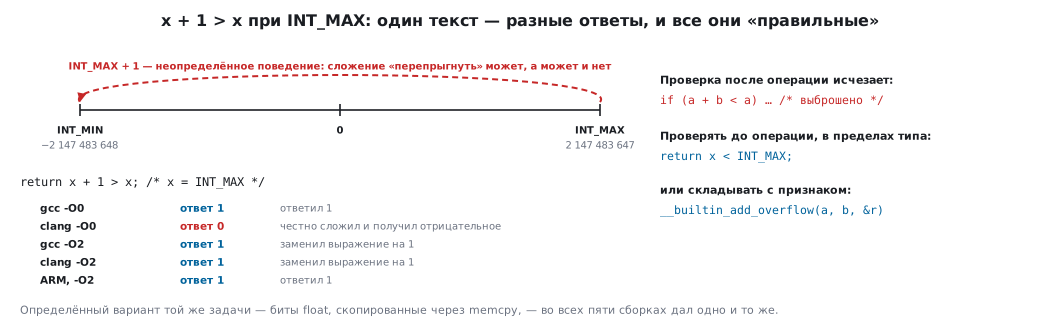
| Build | x + 1 > x with INT_MAX |
writing an int and a float at one address |
|---|---|---|
gcc -O0 |
1 | 0 |
clang -O0 |
0 | 0 |
gcc -O2 |
1 | 1 |
clang -O2 |
1 | 1 |
ARM, -O2 |
1 | 1 |
None of the builds "made a mistake": with undefined behavior any
answer is allowed. The defined version of the same task, the bits of a float
copied with memcpy, gave the same result in all five builds:
0x3F800000.
123.3 Signed overflow
__attribute__((noinline)) int plus_one_bigger(int x)
{
    return x + 1 > x;
}
For INT_MAX the addition overflows. The compiler may assume this
never happens and replace the expression with 1, and that is what gcc and clang did with
optimization. clang without optimization honestly added, got a negative number
and answered 0. Hence the classic bug: an overflow check
after the operation (if (a + b < a)) disappears from the release build.
Check before the operation, within the range of the type:
int can_increment(int x)
{
    return x < INT_MAX;
}
or add with a built-in check, where no overflow happens at all and you get a flag instead:
return __builtin_add_overflow(a, b, out);
123.4 Strict aliasing
The standard allows an object to be accessed only through a compatible type
(plus char). The compiler considers writing a float at the address of an int
impossible:
__attribute__((noinline)) int alias(int *i, float *f)
{
    *i = 1;
    *f = 0.0f;
    return *i;             /* -O2 вправе вернуть 1: float «не может» менять int */
}
With -O0 the function returned 0: it read memory again. With -O2 all three compilers
returned 1: a write through a float "could not" change an int. In firmware this
happens when parsing packets, *(uint32_t *)&buf[4], and when reading
the bits of a float. The correct way is memcpy; the compiler turns it into a single
move:
uint32_t u;
memcpy(&u, &f, sizeof u);
return u;
The second honest way is a union (C allows it). The third is the option
-fno-strict-aliasing: the Linux kernel and many firmware projects do this, paying
with some of the optimizations.
123.5 Out-of-bounds access and shifts
Reading a[4] from an array of four elements may return a neighbouring
variable, garbage, or cause a fault: nothing is promised. On a
Cortex-M without memory protection this usually "works" until a sensitive
variable happens to sit next to the array.
A shift by the width of the type or more is also UB: 1u << 32 on Cortex-M
gives 0 in hardware, on x86 it gives 1, but the compiler is obliged to do neither.
A safe shift checks the amount:
return n < 32u ? v << n : 0u;
And the index is checked before the access:
return i < n ? a[i] : fallback;
123.6 What the compiler's traps catch
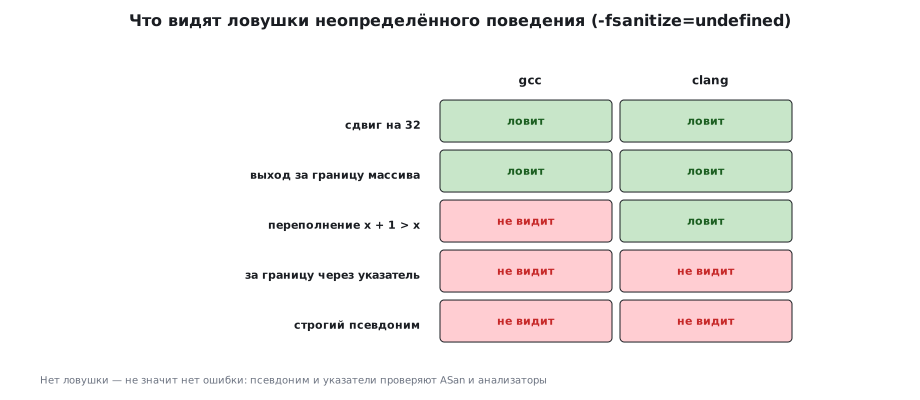
The option -fsanitize=undefined inserts checks, and -fsanitize-trap turns
whatever is found into an immediate stop. The experiment, with optimization:
| Error | gcc | clang |
|---|---|---|
| shift by 32 | yes | yes |
| overrun of a local array | yes | yes |
overflow in x + 1 > x |
no | yes |
| overrun through a pointer | no | no |
| strict aliasing violation | no | no |
The main conclusion: "the trap is silent" does not mean "there is no error". gcc replaced
x + 1 > x with 1 before it inserted the check, so there was nothing left to check.
The size of the array behind a pointer is unknown, so there is nothing to put a check on.
Such errors need other tools: ASan on the computer, static
analyzers and coding rules (section 129).
123.7 Traps on the board itself
armclang can do the same for Cortex-M. The addition a + b with a trap becomes
four instructions instead of two (ADDS, BX lr):
ADDS  r0, r0, r1
IT    VC
BXVC  lr        ; нет переполнения — возврат
UDF   #0xfe     ; есть — неопределённая команда
The function took 8 bytes instead of 4. On M3/M4 UDF raises a UsageFault with the
UNDEFINSTR flag if it is enabled in SHCSR, otherwise a HardFault; on M0 it is a HardFault
straight away. The fault happens at the place of the error: the address in the exception frame
points to the line with the overflow (section 35 shows how to read it).
No run-time library is needed. A sensible practice is to build
the debug and test-bench firmware with traps, and the release firmware as you decide:
the checks cost space and cycles, but a fault "on the spot" is better than silent data corruption.
123.8 Other places
- An uninitialized variable: garbage is read, and the optimizer
may assume any value. Caught by the warnings
-Wall -Wuninitialized. i = i++ + 1,f(i++, i++): modification without a sequence point; gcc and clang give different results. Warning-Wsequence-point.- Dereferencing a null pointer: on Cortex-M the vector table sits at address 0,
so a read "works", and a write to flash is a fault.
The compiler may remove an
if (!p)check that comes after*p. - A function without
returnwhose value is used is UB. - An empty loop with a non-constant condition: if it has no
volatile, no atomic operations and no input/output, C11 allows it to be assumed to terminate: the compiler may throw awaywhile (!flag) { }with an ordinaryflag. An endlessfor (;;) { }with a constant condition is not covered by this rule and stays. Loops that wait for a flag are written withvolatile(section 124).
123.9 How to live with it in firmware
- Keep
-Wall -Wextraon and read the warnings: half of UB is visible to the compiler in advance. - Build the debug build with UB traps; unit tests on the computer with ASan as well.
- Types and bits go through
memcpy, never through pointer casts. - Checks come before the operation:
x < INT_MAX,i < n,n < 32. - Signed arithmetic that can go out of range goes through
__builtin_add_overflowor is done in an unsigned type. - If the firmware is inherited and full of pointer casts,
-fno-strict-aliasingis more honest than hope.
123.10 Pitfalls
Works with -O0, breaks with -O2. Almost always UB: overflow,
aliasing, an uninitialized variable. Build with traps and -Wall.
The overflow check disappeared from the release build. The check comes after the operation: the compiler assumes overflow never happens. Check before.
Packet parsing gives garbage after the optimization level changes.
*(uint32_t *)&buf[i] is an aliasing violation; on Cortex-M0 it is also
an unaligned access, and on M3/M4 the compiler may merge two such
reads into LDRD or LDM, which do not tolerate an unaligned address. Use memcpy.
The traps found nothing, but the error is there. The traps do not see everything: aliasing and overruns through a pointer are beyond them.
HardFault on UDF in the debug firmware. This is not a malfunction but a UB trap
that fired: the address in the exception frame points to the guilty line.
123.11 Summary
- Undefined behavior is a promise to the compiler; break it and any answer is possible:
x + 1 > xgave 0 withclang -O0and 1 with the others, the write through afloatgave 0 without optimization and 1 with it. - The defined path is the same everywhere: the bits of a
floatviamemcpyare 0x3F800000 in all five builds. - UB traps catch shifts and array overruns, clang also catches overflow; nobody sees aliasing and pointers.
- On Cortex-M a trap is
UDFand a HardFault at the place of the error: 8 bytes instead of 4 for an addition. - Check before the operation, bits through
memcpy, warnings on.
Full source code
ub123.c contains the undefined-behavior probes for gcc and clang.
/* Раздел 123: неопределённое поведение — нарочно, чтобы увидеть, как оно выглядит.
 * Каждая проба выбирается аргументом командной строки; входные значения идут
 * через volatile, чтобы компилятор не посчитал всё заранее. Сборки: gcc и clang
 * с -O0 и -O2, ARM с -O2 и те же пробы с ловушками UB (_verify/c123_check.py).
 * Разные ответы одного и того же текста — и есть признак UB. */
#include <limits.h>
#include <stdio.h>
#include <string.h>

volatile int g_in = INT_MAX;

/* 1. Переполнение знакового: компилятор вправе считать, что x + 1 > x всегда. */
__attribute__((noinline)) int plus_one_bigger(int x)
{
    return x + 1 > x;
}

/* 2. Нарушение правила строгого псевдонима: int и float по одному адресу. */
__attribute__((noinline)) int alias(int *i, float *f)
{
    *i = 1;
    *f = 0.0f;
    return *i;             /* -O2 вправе вернуть 1: float «не может» менять int */
}

/* То же без UB: байты копируются, компилятор знает, что они общие. */
__attribute__((noinline)) unsigned float_bits(float f)
{
    unsigned u;
    memcpy(&u, &f, sizeof u);
    return u;
}

/* 3. Выход за границу массива — чтение соседней памяти или ловушка. */
__attribute__((noinline)) int read_at(const int *a, int i)
{
    return a[i];
}

/* 4. Сдвиг на ширину типа. */
__attribute__((noinline)) unsigned shift_by(unsigned v, int n)
{
    return v << n;
}

int main(int argc, char **argv)
{
    const char *probe = argc > 1 ? argv[1] : "all";
    if (!strcmp(probe, "overflow") || !strcmp(probe, "all"))
        printf("overflow=%d\n", plus_one_bigger(g_in));
    if (!strcmp(probe, "alias") || !strcmp(probe, "all")) {
        int storage = 0;
        printf("alias=%d\n", alias(&storage, (float *)&storage));
    }
    if (!strcmp(probe, "bits") || !strcmp(probe, "all"))
        printf("bits=0x%08X\n", float_bits(1.0f));
    if (!strcmp(probe, "bounds")) {
        int a[4] = { 1, 2, 3, 4 };
        volatile int i = 4;
        printf("bounds=%d\n", read_at(a, i));
    }
    if (!strcmp(probe, "bounds_direct")) {
        int a[4] = { 1, 2, 3, 4 };
        volatile int i = 4;
        printf("bounds_direct=%d\n", a[i]);       /* размер массива известен здесь же */
    }
    if (!strcmp(probe, "shift")) {
        volatile int n = 32;
        printf("shift=%u\n", shift_by(1u, n));
    }
    return 0;
}
ub123_arm.c is the same without undefined behavior, for the board, with and without UB traps.
/* Раздел 123: как писать без неопределённого поведения — то же на плате.
 * Собирается armclang для F103 и F407 дважды: обычно и с ловушками UB
 * (-fsanitize=undefined -fsanitize-trap=undefined): тогда нарушение превращается
 * в неопределённую команду, и ядро уходит в HardFault прямо на месте ошибки. */
#include <limits.h>
#include <stdint.h>
#include <string.h>

/* Биты float — через memcpy, а не через приведение указателя. */
uint32_t float_bits(float f)
{
    uint32_t u;
    memcpy(&u, &f, sizeof u);
    return u;
}

/* Сложение со знаком с проверкой: переполнения не случается, есть признак. */
int add_checked(int a, int b, int *out)
{
    return __builtin_add_overflow(a, b, out);
}

/* Проверка до операции, в пределах типа. */
int can_increment(int x)
{
    return x < INT_MAX;
}

/* Сдвиг с проверкой величины: сдвиг на 32 и больше — неопределённое поведение. */
uint32_t shl(uint32_t v, unsigned n)
{
    return n < 32u ? v << n : 0u;
}

/* Индекс проверяется до обращения. */
int read_checked(const int *a, unsigned n, unsigned i, int fallback)
{
    return i < n ? a[i] : fallback;
}

/* Эта функция с ловушками UB превращает переполнение в останов. */
int sum_unchecked(int a, int b)
{
    return a + b;
}
Next: section 124 "volatile, const and atomicity" — what
volatile promises, what it does not, and how to share data with an interrupt.