 Embedded HandbookApps
76г. Binary heap and priority queue: software timers by deadline on a static array
Firmware almost always has a dozen jobs "in N milliseconds": turn off the backlight, repeat a request, release a relay, check the link. There are not enough hardware timers for all of them, so software ones are set up: a list of deadlines and one system tick that checks whether the nearest one has come. The question is how to store the deadlines so that the nearest one is found at once, while adding and cancelling do not cost a pass over the whole list. The answer is a binary heap in an ordinary static array.
Basis: alg.c with a timer queue, a sorted array for comparison and
heapsort, built with gcc 12.2.0 on the computer (stm-sys:1) —
there the queue removes the nearest deadline and puts a new one 10000 times, with a tick
counter that wraps around during the run, and after each step
the heap property is checked. The same file built with arm-none-eabi-gcc 12.2.1
(stm-arm:1) at -O2 for Cortex-M4F and Cortex-M0 — sizes and stack frames.
Work is measured by the number of comparisons and moves, not cycles.
Terms used in the documentation
Original Meaning binary heap binary heap: a tree in an array, a parent is not greater than its children priority queue priority queue: always gives out the smallest element sift up, sift down sifting up and down: restoring order after an insertion or a removal min-heap a heap with the smallest element at the root software timer, deadline software timer, the moment it fires tick counter wraparound tick counter wraparound: after 0xFFFFFFFF comes 0 heapsort heapsort decrease-key, cancel changing an element's priority, removing an element from the middle In plain words. Imagine a pile of jobs where the most urgent one is always on top. For that you do not need to keep the whole pile in order: it is enough that every job is more urgent than the two lying "under it". A new job is put at the bottom and raised while it is more urgent than the one above it; the one taken from the top is replaced by the last one, which is lowered. Each time it is a few steps, not a search through the whole pile.
76г.1 What a timer queue needs
Three operations and one restriction:
| Operation | When | How often |
|---|---|---|
| take the nearest deadline | in every tick of the system timer | 1000 times a second with a 1 ms tick |
| start a timer | from tasks and handlers | on every event |
| cancel a timer | the reply came before the timeout expired | almost as often as starting |
| restriction: no heap allocator | no malloc in an interrupt, fragmentation (11, 25) |
always |
The most frequent action is looking at the nearest deadline; it must be known at once, without a search. Hence two candidates: a sorted array (the nearest is at the edge) and a heap (the nearest is at the root). An unsorted array is out: finding the minimum is a pass over all timers in every tick.
76г.2 A heap in an array
A heap is a binary tree in which every parent is not later than its children. There is no order between siblings, and that is the main point: maintaining a partial order is much cheaper than a full one. No pointers are needed — the tree is laid out in the array level by level, and the links are computed from the index:
| Who | Index in the array |
|---|---|
| the root — the nearest deadline | 0 |
| children of element i | 2i + 1 and 2i + 2 |
| parent of element i | (i − 1) / 2, integer division |
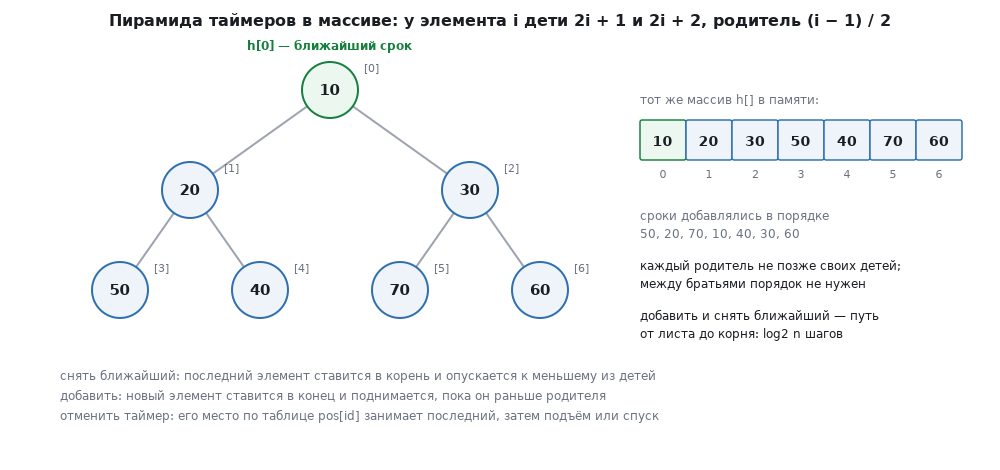
The height of a heap of n elements is about log₂ n, so any operation passes no more than log₂ n levels: for 32 timers — 5.
typedef struct {
    uint32_t due;  /* срок в тиках */
    uint8_t id;    /* номер таймера */
} tq_item_t;
typedef struct {
    tq_item_t h[TQ_CAP]; /* h[0] — ближайший срок */
    uint8_t pos[TQ_CAP]; /* где в пирамиде лежит таймер id; 0xFF — не запущен */
    uint8_t n;
} tq_t;
The pos array is a reverse table: where the timer with a given number lies now.
Without it, cancelling a timer requires a search through the whole heap (76г.5).
76г.3 Adding and removing the nearest
Adding: the new element goes to the end and rises while it is earlier than its parent. The parent moves down to its place — there are no swaps, only moves, as in insertion from 76б:
static void sift_up(tq_t *q, unsigned i)
{
    tq_item_t it = q->h[i];
    while (i > 0) {
        unsigned parent = (i - 1) / 2;
        if (!due_before(it.due, q->h[parent].due))
            break;
        tq_put(q, i, q->h[parent]);
        i = parent;
    }
    tq_put(q, i, it);
}
Removing the nearest: the root leaves, the last element is put in its place and lowered — each time towards the earlier of the two children:
unsigned c = 2 * i + 1;
if (c >= q->n)
    break;
if (c + 1 < q->n && due_before(q->h[c + 1].due, q->h[c].due))
    c++;
if (!due_before(q->h[c].due, it.due))
    break;
tq_put(q, i, q->h[c]);
i = c;
tq_put stores the element and at the same time updates pos — so the reverse table
is always correct.
76г.4 Deadlines and tick counter wraparound
A 32-bit millisecond counter wraps around after 49.7 days — a device
that runs longer will one day see that "now" is less than "the deadline
set a second ago". So deadlines are compared not with an ordinary < but
by the sign of the difference:
static inline bool due_before(uint32_t a, uint32_t b)
{
    CMP_HOOK();
    return (int32_t)(a - b) < 0;
}
The deadline 0xFFFFFFF0 — 32 ticks before the wrap — must be earlier than the deadline
0x10. The run: due_before(0xFFFFFFF0, 0x10) gave true, while the ordinary
comparison 0xFFFFFFF0 < 0x10 gave false. The rule works as long as all deadlines
lie closer than half the circle — 2³¹ ticks, 24.9 days with a 1 ms tick. The whole
run of 10000 steps starts 4096 ticks before the wrap and
passes through it; the deadlines were removed strictly in order.
CMP_HOOK is empty in firmware, on the computer it counts comparisons.
76г.5 Cancelling a timer
A timeout timer is almost always cancelled: the reply came in time. pos[id] helps
to find it by number, and then comes the same trick as when removing the
root: the last element is put in its place and sifted — up or
down, depending on the deadline:
tq_item_t last = q->h[q->n];
tq_put(q, i, last);
sift_up(q, i);
sift_down(q, q->pos[last.id]);
The run: in a queue of 20 timers, timer 7 was cancelled (successfully), then the same one
again (refused — no longer running) and timer 0; 18 remained, the heap
property and the pos table are correct. Then tq_expire with the current time 1050
removed 10 expired timers — all in deadline order.
76г.6 Processing in the tick
In the tick all expired deadlines are removed, but no more than fit in the output array — the handler time is bounded:
while (q->n && k < max && !due_before(now, q->h[0].due)) {
    fired[k++] = q->h[0].id;
    q->pos[q->h[0].id] = 0xFF;
    q->n--;
    if (q->n) {
        q->h[0] = q->h[q->n];
        sift_down(q, 0);
    }
}
The timer handlers themselves are not called in the tick — their numbers are given to a task
or flags, and the heavy work is done outside the interrupt. If the queue is touched by both
tasks and the interrupt, tq_start and tq_cancel are executed with the tick
interrupt disabled or from a single owner task (7).
76г.7 Against a sorted array
A sorted array keeps the deadlines in descending order, the nearest at the end: removal costs one operation, and insertion shifts everything later than the new deadline. The run: n timers are always in the queue, 10000 times the nearest is removed and a new one with a random deadline is put. Work per step is comparisons plus moves:
| Timers | heap: average | heap: worst step | array: average | array: worst step |
|---|---|---|---|---|
| 4 | 8 | 10 | 5 | 6 |
| 8 | 11 | 15 | 10 | 14 |
| 16 | 14 | 20 | 21 | 30 |
| 32 | 17 | 25 | 42 | 62 |
Up to 8 timers the sorted array is no worse, and at 4 it is even cheaper: its insertion is a simple loop, and at small n there is almost nothing to shift. From 16 timers on the heap wins, and the gap grows: the heap's work grows as log n, the array's as n. At 32 timers the array's worst step is 62 operations, the heap's 25.
Code: the heap (sift_up, sift_down, tq_start, tq_cancel,
tq_expire) is 504 bytes on M4, the sorted array (tl_start, tl_pop)
is 128 bytes. In FreeRTOS the lists of delayed tasks and timers are sorted
lists with O(n) insertion, and for a typical dozen elements this is
the right choice. A heap is needed when there are dozens of timers and the worst case
in the tick matters.
76г.8 Heapsort
A heap gives an in-place sort: build a heap from the array, then n times move the root to the end and sift the rest. The worst case is n log n, no memory beyond the array, no recursion. That is why it is taken as the fallback in quicksort from 76б when the depth limit runs out.
void sort_heap(int16_t *a, unsigned n)
{
    for (unsigned i = n / 2; i-- > 0;)
        hs_down(a, i, n);
    for (unsigned end = n; end-- > 1;) {
        int16_t t = a[0];
        a[0] = a[end];
        a[end] = t;
        hs_down(a, 0, end);
    }
}
On 256 elements — random, sorted and reversed — from 3106 to 3452
comparisons: more than quicksort on random data (2385 in 76б), but the spread is
only 11 %. The code is 58 bytes of sort_heap and 108 bytes of hs_down on M4.
It is never stable.
76г.9 Pitfalls
Timers stopped firing after 49 days. The deadlines were compared
with an ordinary <, and after the counter wrapped, a new deadline turned out "less" than
the current time. Compare by the sign of the difference, (int32_t)(a - b) < 0.
A timer fired although it had been cancelled. The cancellation searched for the timer by iteration and
did not find it, because it had already moved during sifting. A reverse table
pos[], updated on every move.
After a cancellation the heap "broke". The last element was put in the place of the cancelled one and only lowered. It may turn out earlier than its new parent — it must also be sifted up.
The tick lasts unpredictably long. All expired timers are removed and processed right in the interrupt. Limit the number removed per tick and give the processing to a task.
A deadline further than half the circle. A 30-day timer with a 1 ms tick goes beyond 2³¹ ticks, and the comparison by the sign of the difference flips. Count long intervals in seconds with a separate counter.
76г.10 Summary
- A heap in an array: the children of element i are 2i + 1 and 2i + 2, the parent is (i − 1) / 2; the nearest deadline is always h[0].
- Adding, removing and cancelling take no more than log₂ n levels: for 32 timers — 5.
- Deadlines are compared by the sign of the difference:
due_before(0xFFFFFFF0, 0x10)is true, an ordinary<is false; the limit is 2³¹ ticks, 24.9 days with a 1 ms tick. - At 32 timers the worst step: heap — 25 operations, sorted array — 62; up to 8 timers the array is no worse.
- Heapsort of 256 elements takes from 3106 to 3452 comparisons on any input, without memory or recursion.
Next: section 76д "A hash table without malloc: open addressing, tombstones, FNV-1a and a console command table" — how to find a key in one or two probes in a static array and why deleting from such a table is harder than inserting.